
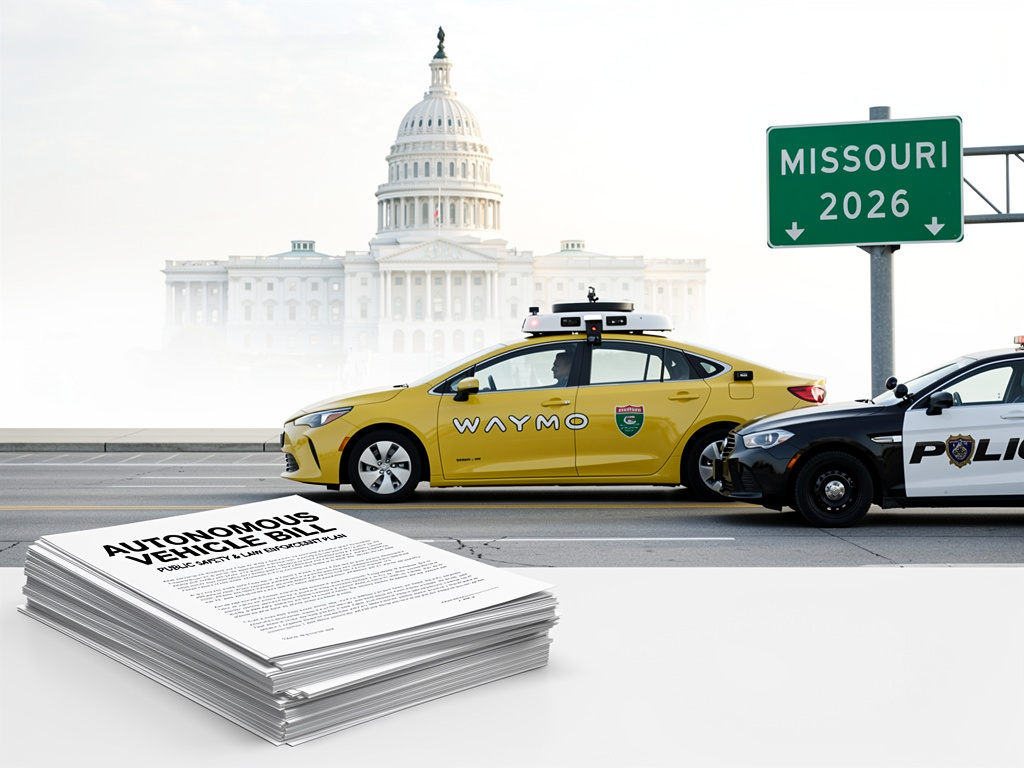
Missouri lawmakers are racing to pave the way for driverless vehicles, with bills clearing key committees amid intense lobbying from Alphabet’s Waymo unit and sharp debates over jobs and safety. House Bills 2069 and 2208, identical measures sponsored by Republican Reps. Don Mayhew of Crocker and Brandon Phelps of Warrensburg, passed the House Emerging Issues Committee on a 7-4 party-line vote on Jan. 20, 2026. The legislation would legalize fully autonomous vehicles on public roads, treating the automated driving system as the legal “driver” for traffic law compliance.
Senate Bill 1050, introduced by Sen. Travis Fitzwater, R-Holts Summit, mirrors the House proposals and was heard by the Senate Transportation, Infrastructure and Public Safety Committee on Jan. 27, 2026. The bill aims to create a statewide regulatory structure, preempting local governments from banning or taxing autonomous operations. Operators must submit proof of financial responsibility to the Department of Revenue and a detailed law enforcement interaction plan to the Department of Public Safety, outlining communication with fleet specialists, vehicle removal procedures, and identification of driverless mode. Vehicles must stay at crash scenes and report incidents, just like human-driven ones.
Waymo, which has begun mapping St. Louis streets with human-driven electric SUVs as a designated test site, hired four Missouri lobbyists in November 2025 to advance the bills. The company, operating driverless taxis in Atlanta, Austin, Los Angeles, Phoenix and San Francisco, sees Missouri as prime expansion territory. St. Louis representatives from Mayor Cara Spencer’s office testified in support during the House hearing, noting current testing limits to manual mode pending state approval. Missouri House Speaker Jon Patterson hailed Waymo’s St. Louis entry as “an exciting step forward for our state… It will offer a safe and reliable transportation option for its residents,” according to FOX 2.
Provisions Unlock Robotaxi Fleets and Trucks
On-demand autonomous networks would fall under existing taxi and for-hire rules, exempting vehicles not designed for human drivers from human-centric equipment laws like mirrors or steering wheels. Commercial autonomous trucks could operate under federal trucking regulations, though sponsors acknowledged technical hurdles remain. Rep. Mayhew told the committee, “There’s obvious technical issues that have to be overcome before commercial vehicles — certainly cross-country 18-wheelers — could participate in this,” as reported by GovTech. A National Disability Institute study cited by supporters projects 171,000 jobs from better workforce access for disabled residents.
The Missouri Chamber of Commerce and Industry backed HB 2069 and HB 2208, with VP Jared Hankinson testifying, “This is a signal to the entire nation, to businesses that are pioneering innovative technologies, that Missouri wants to be a place where those businesses have an opportunity to thrive,” per the Chamber site. Rep. Phelps added, “This bill provides a real opportunity to improve the quality of life for our constituents, drive economic development in the state and increase public safety on our roads.” TechNet’s Andrew Wood emphasized safety: “From a safety perspective, autonomous vehicle technologies are designed to address one of the most persistent challenges on our roadways: human error,” noting most crashes stem from distraction or impairment, according to FOX 2.
Lori Becker, CEO of St. Louis-based Starkloff Disability Institute, told the committee: “I don’t have to rely on someone’s judgment or availability or get their permission to get a ride somewhere — I can just go. And that’s a right that we all deserve. So it’s about our rights, it’s about our dignity, and it’s also about putting more money back into the economy,” as quoted in Missouri Independent. Mothers Against Drunk Driving also supported the measures during the three-hour hearing.
Unions and First Responders Sound Alarms
Opposition erupted from labor unions and emergency workers fearing job losses and response hazards. Jacob Hummel, president of the Missouri AFL-CIO, warned: “This bill directly threatens jobs in transportation, delivery, and commercial driving,” and “By designating the automated driving system as the ‘driver,’ the bill eliminates the need for licensed human operators and undermines worker protections tied to driver status, including training standards, accountability, and employment classification,” per FOX 2. Teamsters labeled it a “job killer” for enabling driverless semis on highways.
St. Louis firefighter Tom Mullins of Teamsters Local 610 testified: “Delays in even seconds can make a life or death difference in property preservation and human survival. Emergency crews have had to physically intervene, smashing windows to force the vehicle to stop or physically stand in front of an autonomous vehicle to keep it from entering the scene,” cited in both Missouri Independent and News-Leader. School bus drivers cited Waymo vehicles ignoring stop signs in Atlanta. Kansas City Democrats, including Rep. Emily Weber, voted no, with Weber questioning: “We’re having issues hiring police officers, first responders. So now you’re adding additional new training, and it seems like neither one of you have had conversations with the areas that are going to be affected by this,” from Missouri Independent.
Rep. Weber pressed sponsors on talks with police chiefs about training, while St. Louis Rep. Elizabeth Fuch also opposed, citing local control loss. The bills bar municipalities from extra rules, centralizing authority at the state level with Department of Public Safety rulemaking power.
Path Forward Amid National Patchwork
The House bills head to the full chamber, while SB 1050 awaits Senate action; passage could enable operations by late summer 2026. Missouri would join over 20 states permitting Level 4 or 5 autonomy, per FOX 2. Waymo touts 10 million driverless miles nationwide with fewer serious crashes. Yet federal inaction leaves a state-by-state patchwork, as noted in prior reports like Missouri Independent’s 2025 overview.
Rep. Mayhew described it as “the first step in a long journey toward autonomous vehicles coming to Missouri… In order to encourage that technology that’s coming our direction, we need to get some legislation to allow for it,” according to the Missouri Chamber. House Emerging Issues Chairman Rep. Brad Christ, R-South St. Louis County, resisted blocking innovation. Nationally, Sen. Josh Hawley, R-Mo., pushes a federal ban, calling driverless tech “not safe” and “terrible for working people,” but state efforts press on.
For industry insiders, Missouri’s moves signal a pro-innovation pivot, potentially drawing firms like Aurora Innovation, which logged 100,000 driverless miles in Texas and Arizona. Financial responsibility mandates and crash reporting aim to mitigate liability risks, though insurers eye product and cyber coverage expansions. As Waymo eyes St. Louis deployment, the Show-Me State tests balances between tech acceleration and public safeguards.


 WebProNews is an iEntry Publication