
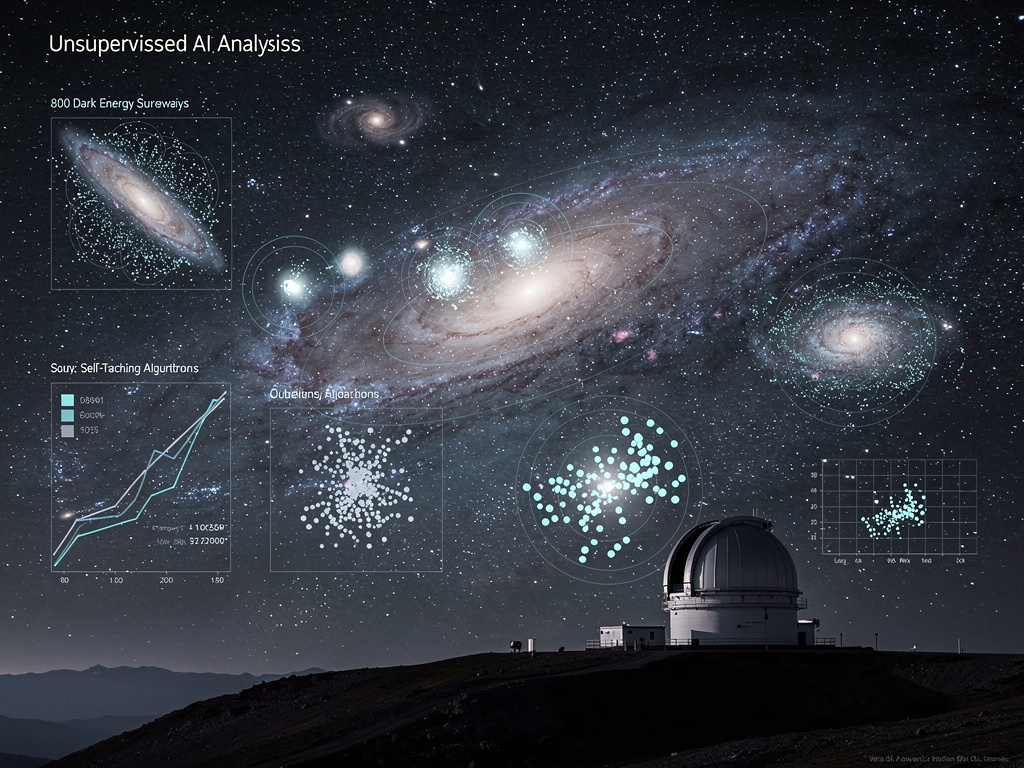
The history of astronomy is largely a history of human patience. For centuries, the rate of discovery was throttled by the speed at which a human eye could peer through a lens or scan a photographic plate. Even in the digital age, as telescopes began pouring terabytes of data into server farms, the bottleneck remained the human capacity to label, sort, and classify. However, a significant shift in this operational paradigm has occurred, signaled by a research team led by Princeton University and the University of Toronto. By deploying a novel artificial intelligence architecture, they have successfully identified over 800 cosmic anomalies within the existing data of the Dark Energy Survey (DES), objects that previous methods had completely overlooked.
This discovery is not merely a catalog of new stars or galaxies; it represents a fundamental change in how scientific data is processed. As reported by Engadget, the team utilized a form of unsupervised deep learning to sift through images of 700 million astronomical objects. Unlike traditional AI, which requires humans to feed it examples of what to look for—a method known as supervised learning—this new tool was not told what to find. Instead, it was designed to learn what a "normal" galaxy looks like and then flag anything that deviated from that norm. The result is a treasure trove of potential gravitational lenses and merger events that could redefine our understanding of dark matter distribution.
The transition from human-led classification to unsupervised machine learning creates a new paradigm for analyzing celestial data, moving the industry away from confirmation bias and toward genuine discovery.
The core technology driving this breakthrough is a convolutional autoencoder, a type of neural network that compresses information and then attempts to reconstruct it. In the context of the Dark Energy Survey, the AI was fed millions of images of standard galaxies. Over time, the system became an expert at reconstructing these standard forms. However, when presented with something geometrically complex or visually distinct—such as a galaxy warped by the intense gravity of a foreground object—the AI failed to reconstruct the image accurately. These high reconstruction errors acted as a digital flare, signaling to the researchers that they had found something unique.
This methodology addresses one of the most pervasive issues in modern astrophysics: the limitations of supervised learning. In a standard supervised model, an algorithm is trained on labeled datasets. If you want an AI to find spiral galaxies, you show it thousands of spiral galaxies. The flaw in this approach is inherent; the AI will only find what it has been trained to see. It excels at categorization but fails at discovery. According to a release by the Dark Energy Survey collaboration, the shift to unsupervised learning allows the data to speak for itself, revealing outliers that human biases might have excluded from training sets entirely.
By prioritizing distinct outliers over pre-defined categories, researchers can discover phenomena they never programmed the system to recognize, effectively automating serendipity in scientific research.
Among the 800 anomalies detected, the most scientifically valuable are candidates for strong gravitational lenses. Predicted by Einstein’s theory of general relativity, this phenomenon occurs when a massive object, such as a galaxy cluster, sits between an observer and a distant light source. The gravity of the foreground object bends the light, creating arcs, rings, or multiple images of the background source. These cosmic mirages are critical for mapping the distribution of dark matter, a substance that makes up about 27% of the universe but cannot be seen directly. By analyzing how light is distorted, astronomers can weigh the invisible mass causing the distortion.
The identification of these lenses has historically been a labor-intensive process. Previous efforts, such as the citizen science project Galaxy Zoo, relied on hundreds of thousands of volunteers manually classifying images. While successful, that approach is not scalable for the next generation of telescopes. The The Astrophysical Journal has published numerous studies highlighting that while human classification is accurate, it simply cannot keep pace with the petabytes of data generated by modern sky surveys. The autoencoder model proves that AI can not only match human speed but can identify subtle geometric distortions that might escape even a trained eye.
Validating these algorithmic discoveries requires a synthesis of computational power and traditional spectroscopic confirmation to ensure that digital artifacts are not mistaken for physical realities.
The implications of this study extend far beyond the current findings of the Dark Energy Survey. The technique serves as a proof-of-concept for the impending data deluge from the Vera C. Rubin Observatory in Chile. Set to begin operations soon, the Rubin Observatory will conduct the Legacy Survey of Space and Time (LSST), imaging the entire visible southern sky every few nights. It is expected to discover 30 to 40 times more astronomical objects than currently known. The volume of data—approximately 20 terabytes per night—renders human analysis impossible. Without robust, unsupervised AI pipelines, much of this data would remain dark, archived but unexamined.
The industry is taking note of this shift. We are witnessing a move toward “self-driving telescopy,” where the detection, classification, and even the follow-up observation requests are handled autonomously by algorithms. As noted by researchers at Princeton University, the ability to automate the discovery of anomalies is crucial for catching transient events—phenomena that appear and disappear quickly, such as supernovae or kilonovae. An unsupervised system that flags a change in the sky in real-time could trigger other telescopes to observe the event before it fades, a capability that supervised systems struggle to provide without specific prior training.
The impending data deluge from next-generation observatories necessitates a complete automated overhaul of detection pipelines, forcing the astronomical community to trust algorithms as primary investigators.
However, the integration of these advanced AI tools is not without challenges. The “black box” nature of deep learning means that while the AI can identify an anomaly, it cannot always explain why it flagged a particular object. This lack of interpretability poses a hurdle for scientific rigor. The 800 detected anomalies required subsequent human verification to confirm their nature. The AI acts as a massive filter, reducing 700 million objects down to a manageable list of interesting targets, but the final scientific judgment still rests with the researchers. This symbiotic relationship—AI as the scout, human as the analyst—defines the current operational model.
Furthermore, the definition of an “anomaly” is mathematically fluid. In the context of the autoencoder, an anomaly is simply a high reconstruction error. This can be a gravitational lens, but it can also be a satellite trail, a digital artifact in the camera sensor, or a merger of two galaxies that creates an irregular shape. Distinguishing between a scientific breakthrough and a camera glitch is the next frontier in refining these algorithms. Researchers are now looking into hybrid models that combine the open-ended discovery of unsupervised learning with the precision of supervised classification to filter out instrumental errors.
As artificial intelligence architectures evolve, the distinction between data processing and scientific discovery blurs, raising questions about the role of human intuition in the future of astrophysics.
The success of this project also highlights the growing intersection between astrophysics and data science industries. The techniques used to find gravitational lenses are remarkably similar to those used in financial fraud detection or industrial quality control, where the goal is also to find rare deviations in massive datasets. This cross-pollination of expertise means that astronomers are increasingly recruiting talent from the tech sector, and conversely, tech companies are looking at astronomical challenges as testing grounds for their most advanced algorithms. The Vera C. Rubin Observatory project, for instance, involves massive data management challenges that rival those of global tech giants.
Ultimately, the discovery of these 800 anomalies is a testament to the power of asking the right questions—or rather, building a machine that knows how to ask questions we hadn’t thought of. By removing the constraint of looking for specific, known objects, the researchers have opened a door to the unknown. As we stand on the precipice of a new era in space observation, tools like this autoencoder will be the primary instruments of exploration. They will sift through the darkness, mining the void for the sparks of weirdness that often lead to the most profound shifts in our understanding of the cosmos.


 WebProNews is an iEntry Publication