
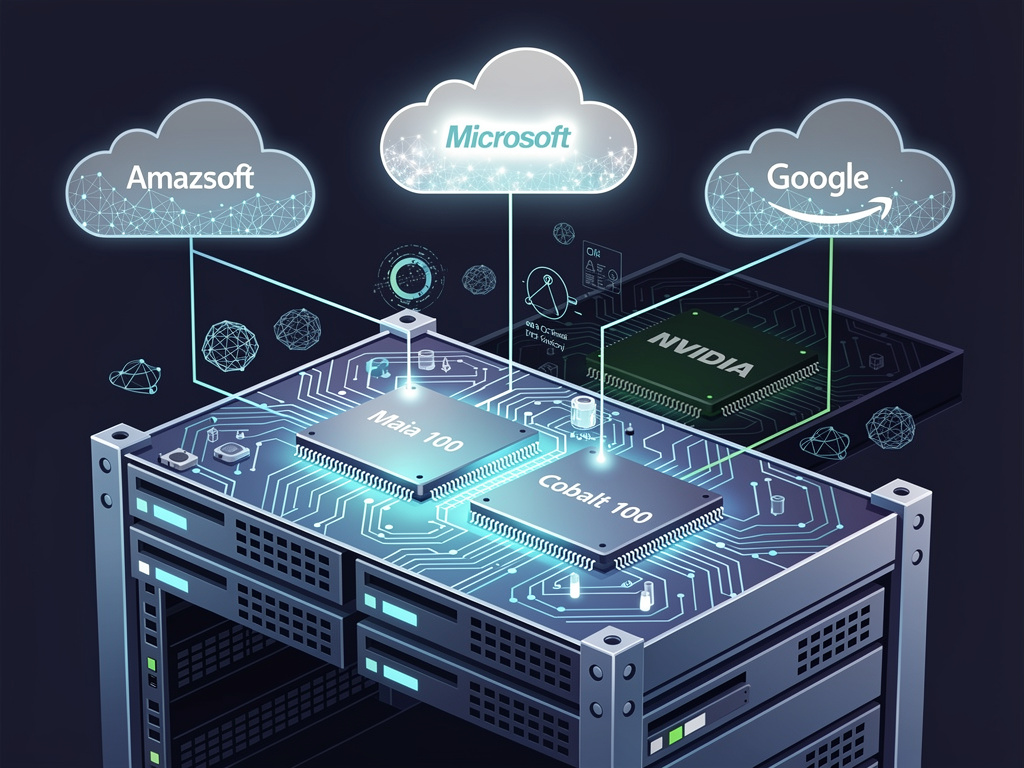
SEATTLE — In a move that reverberated from Silicon Valley to Wall Street, Microsoft Corp. has formally entered the high-stakes game of semiconductor design, unveiling a pair of custom-built chips aimed at powering its sprawling cloud and artificial intelligence ambitions. The initiative, culminating in the Maia 100 AI accelerator and the Cobalt 100 central processing unit, represents a multi-billion dollar investment and a fundamental strategic pivot for a company now determined to control its own technological destiny in the AI era.
Announced at its annual Ignite conference, the chips are not intended for sale but are instead the foundational elements of a sweeping internal overhaul. They are designed to optimize performance and, crucially, control the soaring costs associated with the AI boom that Microsoft itself helped ignite through its partnership with OpenAI. This foray into custom silicon places Microsoft in direct strategic alignment with its chief cloud rivals, Amazon.com Inc. and Alphabet Inc.’s Google, which have long been developing their own chips to gain an edge in the fiercely competitive cloud computing market.
A Calculated Response to Unprecedented Demand
The genesis of Microsoft’s silicon ambition can be traced to the explosive success of generative AI, particularly the ChatGPT service from its partner OpenAI. This created a voracious, near-insatiable demand for specialized processors, primarily the powerful but costly graphics processing units (GPUs) manufactured by Nvidia Corp. The resulting supply-chain bottlenecks and astronomical capital expenditures forced a moment of reckoning for the world’s largest software company: to secure its future, it needed to become a master of hardware, too.
“Microsoft is building the infrastructure to support AI innovation,” CEO Satya Nadella stated, framing the move as a necessary step to provide customers with a more resilient and cost-effective foundation. This vertical integration strategy is a well-trodden path in the cloud sector. Amazon Web Services has found significant success with its Graviton CPUs and its Trainium and Inferentia AI chips, while Google’s Tensor Processing Units (TPUs) have powered its AI services for years. Microsoft’s entry, while later than its rivals, is seen by industry insiders as a meticulously planned offensive to bring its infrastructure capabilities to parity.
Beyond the Chip: A Full-System Reinvention
Company executives are quick to emphasize that the project goes far beyond simply designing a piece of silicon. Microsoft has engineered an entire server stack from the ground up, a holistic approach it believes is its key differentiator. “We are co-designing and optimizing hardware and software together,” Rani Borkar, Corporate Vice President for Azure Hardware Systems and Infrastructure, explained in a company blog post. This includes everything from the custom server boards that house the Maia 100 chips to entirely new, liquid-cooled server racks designed to handle the immense heat and power density required for training and running massive AI models.
The Maia 100, built on a 5-nanometer manufacturing process by Taiwan Semiconductor Manufacturing Co., according to a report from Reuters, has been developed in close collaboration with OpenAI. This partnership has given Microsoft a crucial advantage: the ability to tailor its hardware specifically for the world’s most demanding AI workload. OpenAI CEO Sam Altman confirmed his company provided critical feedback, stating, “We were excited to partner with Microsoft to help design Maia and we think it will enable us to train more capable models.” This endorsement lends significant credibility to Microsoft’s efforts, positioning Maia not as a generic processor but as a purpose-built engine for the future of AI.
A Delicate Dance with a Key Partner
Despite the massive investment in its own silicon, Microsoft has been careful to manage its relationship with Nvidia, which is both a key supplier and a strategic partner. Officials stress that Maia is about offering more choice and better price-performance for specific internal workloads, not about replacing Nvidia GPUs across the board. Microsoft will continue to be one of Nvidia’s largest customers, offering the latest Nvidia H100 and forthcoming H200 GPUs on its Azure cloud platform. The strategy is one of diversification, not displacement.
This “and, not or” approach allows Microsoft to mitigate supply chain risks while targeting different tiers of the market. High-end Nvidia GPUs will likely remain the top choice for customers who need maximum raw performance for a wide variety of tasks. Meanwhile, as detailed by GeekWire, the Maia architecture can be finely tuned for the specific software stack used by Microsoft and OpenAI, potentially offering superior efficiency and lower total cost of ownership for those core services. It’s a pragmatic solution to an economic and logistical challenge that has come to define the AI industry.
The Unsung Hero: Cobalt and the Broader Cloud War
While Maia has captured most of the headlines, the parallel development of the Cobalt 100 CPU is arguably just as significant for Microsoft’s long-term cloud strategy. The 128-core processor is built on Arm architecture, a design renowned for its power efficiency. Cobalt is Microsoft’s direct answer to AWS’s highly successful Graviton chips, which have helped Amazon lower costs and offer more competitive pricing on general-purpose computing instances, stealing market share from traditional x86-based processors from Intel Corp. and Advanced Micro Devices Inc.
By developing its own Arm-based CPU, Microsoft aims to achieve similar efficiencies across the vast array of services that form the backbone of its Azure cloud, from databases to web servers. As reported by The Verge, the company is already testing Cobalt to power services like Microsoft Teams and SQL Server, with plans to make it available to external customers in the near future. This move signals that the battle for cloud supremacy is increasingly being fought at the level of the transistor, where custom hardware can provide compounding advantages in performance-per-watt and performance-per-dollar.
The Road Ahead: High Risks and Higher Rewards
Designing and manufacturing custom silicon is a notoriously difficult and expensive endeavor, fraught with risk. The history of technology is littered with failed chip projects that consumed billions in research and development without ever delivering a competitive product. Microsoft is betting that its deep software expertise and the guaranteed demand from its own massive services, along with its anchor partnership with OpenAI, will be enough to ensure a return on its immense investment.
The successful deployment of Maia and Cobalt will serve as a powerful new weapon in Microsoft’s arsenal, enabling it to better control its cost structure, accelerate innovation, and offer a more compelling value proposition to its Azure customers. It marks the beginning of a new chapter for the Redmond-based giant, one where it is no longer just a consumer of cutting-edge hardware but a creator of it, shaping the very foundation of the next generation of computing from the silicon up.


 WebProNews is an iEntry Publication