
Microsoft has spent years positioning itself at the center of the artificial intelligence surge. At its Build 2026 conference this week the company took a concrete step beyond software. It introduced Project Solara. This new platform aims to move AI agents out of laptop screens and phone apps and into dedicated hardware that sits on desks, clips to clothing, or slips into pockets.
The surprise lies in its foundation. Solara runs on Android. Not Windows. Microsoft built it atop its Microsoft Device Ecosystem Platform, a hardened fork of the Android Open Source Project already used for Teams Rooms devices. Executives chose this path because it supports smaller, lower-power hardware while delivering the security, management, and update capabilities IT teams demand.
Ars Technica first highlighted the decision. The choice signals pragmatism. Windows simply carries too much overhead for the always-on, battery-conscious gadgets Microsoft envisions. And the timing feels deliberate. With competitors racing toward agentic hardware, Microsoft wants speed.
Steven Bathiche leads Microsoft’s Applied Sciences Group. He has spent years exploring what comes next in computing. “Boundaries are collapsing,” Bathiche told reporters during a briefing ahead of the announcement. “You don’t necessarily need the traditional app model. You don’t need the traditional way of developing experiences.”
That conviction shapes Solara completely. The platform treats agents as the primary interface. Users invoke intelligence rather than open software. Agents reason over data, tools, and workflows without forcing navigation through menus or screens. They generate interfaces on the fly, tailored to the moment, the device, and the task.
Microsoft calls it a chip-to-cloud system. The “operating system” becomes liminal, existing partly on the device and partly in Azure. State lives in the cloud. A lightweight agent window appears at the edge. This design lets one agent span multiple specialized devices without duplication or fragmentation.
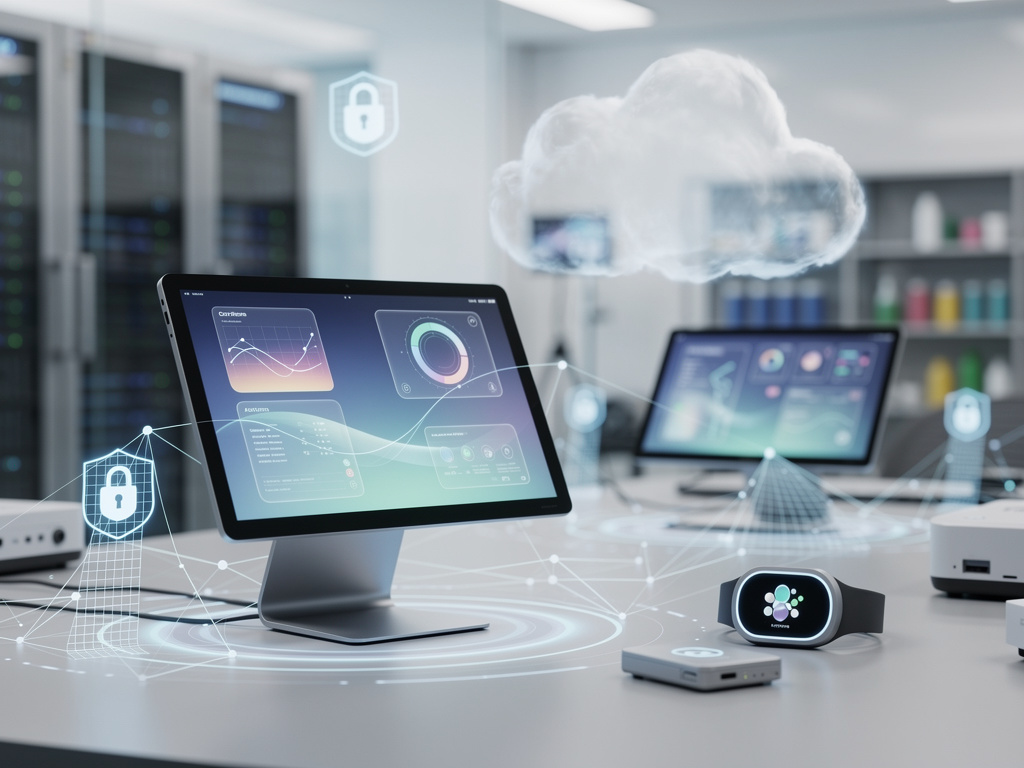
Two reference designs illustrate the idea. The first, a desk companion, resembles a smart display. It unlocks with facial recognition, surfaces priority items from Microsoft 365, and pairs with a nearby PC over Bluetooth. Attach a monitor and it can run a full Windows 365 session. The second is a wearable badge. Press a fingerprint sensor to wake it. Tap once to record and transcribe a conversation. Its camera lets the agent see what the wearer sees and act accordingly.
In one demonstration shared with GeekWire, a health-care worker uses the badge to scan a patient’s QR code. The agent logs vitals, transcribes the visit, and starts a prescription order. In another, the badge photographs a whiteboard covered in brainstorm notes and suggests adding plants to improve the office layout. These are not finished products. They are proofs of concept built in days using off-the-shelf chips from Qualcomm and MediaTek.
Bathiche made the point explicit. Purpose-built devices solve problems that phones cannot. Nurses pulling out personal phones to view patient data creates trust issues and security headaches. A dedicated badge reduces the attack surface, lasts longer on a charge, and orients its sensors for natural interaction. “Computers are continuing to specialize,” he said. “Computers are continuing to come closer to you.”
Enterprise buyers will run the first tests. AccuWeather, Best Buy, CVS Health, Levi’s, and Target plan pilots in the coming months, according to multiple reports including The Verge. Microsoft itself will not sell the hardware. It supplies the platform, reference designs, and cloud services. Partners and manufacturers will create the actual products tuned for specific industries and roles.
Security sits at the core. Devices support Windows Hello for Business biometrics, physical microphone mute switches, and clear recording indicators. Management comes through Intune and Entra ID. Microsoft Defender watches over the fleet. The smaller attack surface of dedicated hardware helps. So does the requirement that only approved chipsets run the platform.
Agents tie into the Microsoft 365 Copilot family. Users can extend Copilot with declarative agents or custom ones built in Copilot Studio. The system coordinates multiple agents at once, routing tasks to the right specialist while respecting data boundaries and organizational controls. One agent might research, another facilitate meetings, a third surface priorities from Work signals.
Microsoft’s official announcement frames the shift clearly. “What changes when agents become both a new unit of programming and an emerging new unit of human-to-machine interaction?” it asks. The mission centers on experiences “shaped around you: your agents, your tasks, your environment, under your control.”
Analysts see echoes of past platform battles. Microsoft dominated the PC era. It stumbled with mobile. Now it hopes agents create another opening. The company faces stiff competition. Google, Amazon, OpenAI, and hardware makers all chase similar visions. Qualcomm’s partnership on the badge underscores the shared interest in efficient, on-device AI. Its Snapdragon platforms target exactly the wearable and low-power scenarios Solara targets.
Yet Solara feels different from earlier Microsoft hardware efforts. The company learned from Surface, from Windows Phone, from Kinect. This time it avoids selling the devices directly. It focuses on the platform layer, the cloud connection, and the agent coordination that others might struggle to replicate at enterprise scale.
Early days still. The prototypes work. The pilots have not started. Fundamental questions remain about pricing, business models beyond Azure consumption, and how quickly manufacturers will adopt the reference designs. Some scenarios shown so far are illustrative rather than production-ready.
Even so, the direction is unmistakable. Microsoft sees a future where computing slips into the nooks where laptops and phones feel clumsy. A badge that listens during rounds. A desk display that knows the day’s priorities before you ask. Glasses, rings, or scanners that carry the same agent identity. All managed, secure, and grounded in corporate data.
Bathiche posed the question that seems to drive the entire project. “What is the next thing that comes closer to you?” Project Solara offers one possible answer. It discards the app-centric model that defined the last two decades of personal computing. In its place comes intelligence that acts, adapts, and travels with the user across form factors purpose-built for the task at hand.
The industry will watch the pilots closely. Success with retail, health care, and weather teams could accelerate adoption. Failure would reinforce the difficulty of creating new device categories. For now Microsoft has placed a sizable bet. It has done so not on Windows, its longtime flagship, but on a tuned version of Android that lets it move faster and lighter than before. The agent era may demand exactly that kind of flexibility.


 WebProNews is an iEntry Publication