
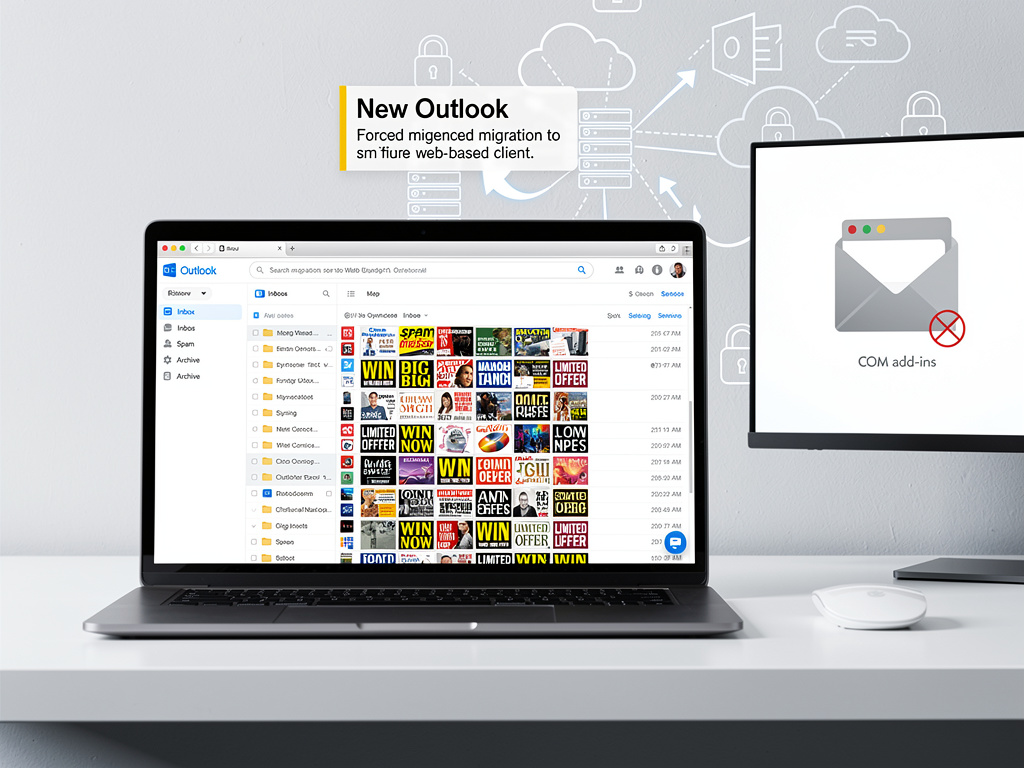
The promise of cloud-based communication is predicated on a simple, singular expectation: reliability. For Microsoft Corp., that expectation has been tested severely in recent months, culminating in a wave of user dissatisfaction that threatens to undermine the software giant’s dominance in the enterprise and consumer email markets. As reported by The Register, users are increasingly vocal regarding persistent service degradations, ranging from catastrophic spam filter failures to the forced migration toward a web-centric architecture that many argue is not ready for prime time.
This unrest is not merely the result of a temporary glitch. It represents a friction point in Microsoft’s broader strategy to unify its email platforms under the "One Outlook" umbrella, a move that has exposed significant technical and privacy fault lines. For industry observers, the situation offers a case study in the risks of prioritizing platform consolidation over user agency and infrastructure stability.
The Spam Filter Collapse
The most immediate catalyst for the current uproar involves the deterioration of Microsoft’s Exchange Online Protection (EOP) filtering capabilities. Users have reported inboxes inundated with obvious phishing attempts and solicitations, bypassing what was historically considered a capable defense perimeter. This is not an isolated incident but part of a recurring pattern of instability affecting the Redmond-based company’s cloud services.
Technical analysis suggests that recent updates to the filtering algorithms, intended to reduce false positives, may have inadvertently lowered the threshold for malicious entry. For enterprise clients relying on Microsoft 365, this translates to increased security overhead as IT departments must scramble to deploy third-party hygiene solutions to compensate for native deficiencies. As noted in recent coverage by BleepingComputer, these outages leave consumer and business accounts vulnerable to credential harvesting campaigns that slip through the cracked armor of the primary inbox.
The Controversy of ‘New Outlook’
While spam issues represent an operational failure, the strategic shift toward the "New Outlook"—a Progressive Web App (PWA) designed to replace the classic Win32 application—has generated a more philosophical and functional revolt. Microsoft’s objective is clear: reduce engineering overhead by maintaining a single code base across Windows, Mac, and the Web. However, power users and IT administrators view this transition as a regression in capability.
The classic Outlook client, a staple of corporate environments for decades, supports a vast library of COM (Component Object Model) add-ins. These integrations are essential for legal, financial, and compliance workflows. The New Outlook, built on web technologies, breaks compatibility with these legacy tools, forcing organizations to rewrite critical extensions or lose functionality entirely. The friction is palpable in online forums and support tickets, where the sentiment mirrors the frustration highlighted by The Register regarding the disconnect between Microsoft’s product roadmap and the immediate needs of its user base.
Data Sovereignty and Privacy Alarms
Perhaps the most alarming aspect of the new architecture for security-conscious insiders is the mechanism by which the New Outlook handles non-Microsoft accounts. When a user adds an IMAP account (such as a personal iCloud or ISP-provided email) to the new client, the application does not merely connect locally. Instead, it synchronizes those credentials and emails to the Microsoft Cloud to facilitate features like search and categorization.
This architectural choice has drawn sharp criticism from privacy advocates and European data regulators. A recent analysis by Proton highlights the inherent risk: users are effectively handing over the keys to their entire digital correspondence to Microsoft, often without fully grasping the implications of the "sync" dialogue box. For industries regulated by GDPR or strict confidentiality mandates, this data egress renders the New Outlook a compliance nightmare.
Performance Metrics vs. User Experience
Microsoft frequently cites telemetry indicating high adoption rates for the New Outlook, but these numbers may be misleading. The company has aggressively pushed the switch through toggle prompts in the classic Mail app and Windows updates, often defaulting users into the new experience. Retention metrics, however, tell a different story. Many users revert to the classic client—if they can find the option—citing sluggish performance, lack of offline capabilities, and a user interface that prioritizes whitespace over information density.
The reliance on WebView2 (essentially running an Edge browser window inside a frame) means the application consumes significantly more memory than its native predecessor while offering less responsiveness. In high-volume email environments, such as customer support centers or executive offices, milliseconds of latency accumulate into hours of lost productivity. The disparity between Microsoft’s internal efficiency goals and the external user reality is widening.
The Erosion of Trust
The cumulative effect of these technical and strategic missteps is a gradual erosion of trust. For years, Microsoft Exchange has been the default standard for business communication. However, the recurring outages and the perceived heavy-handedness of the migration strategy are causing Chief Information Officers to re-evaluate their dependency on a single vendor.
Competitors are sensing an opening. While Google Workspace remains the primary alternative, niche providers focusing on privacy and sovereignty are gaining traction among SMEs and privacy-conscious sectors. As detailed in a report by TechCrunch, the forced obsolescence of the Windows Mail app is driving a segment of the user base to seek third-party clients that promise to respect user data and local processing preferences.
Navigating the Path Forward
Microsoft finds itself at a critical juncture. The company must balance its desire for a unified, cloud-first architecture with the operational realities of its massive installed base. Ignoring the "fuming" users described by The Register carries a tangible risk. If the spam filters remain porous and the flagship client remains a source of friction, the cost of switching platforms begins to look less daunting compared to the cost of staying put.
For industry insiders, the coming months will be telling. Will Microsoft pause its aggressive migration timeline to address feature parity and stability? Or will it continue to push forward, betting that the inertia of the enterprise market is strong enough to withstand the current headwinds? The answer will determine whether Outlook remains the undisputed king of business communication or becomes a legacy burden that agile competitors can dismantle.


 WebProNews is an iEntry Publication