
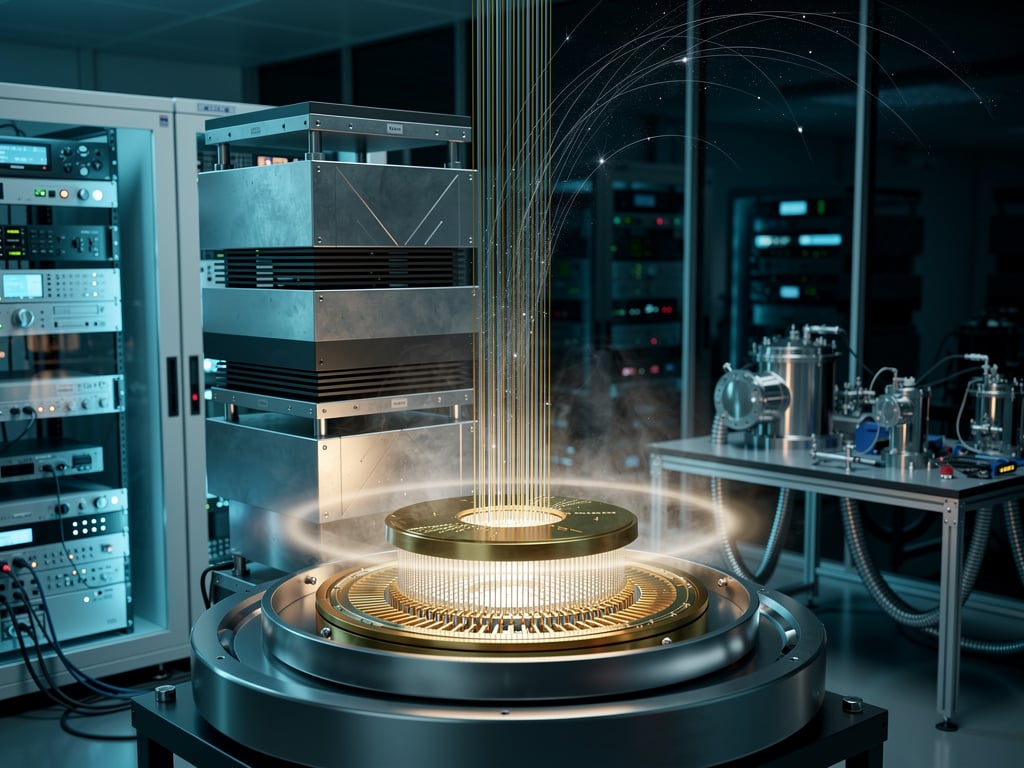
Microsoft on Tuesday introduced Majorana 2. The new topological quantum processor marks a sharp step forward from its predecessor. Qubits now last a mean 20 seconds. Some stretch beyond a minute. That represents a 1,000-times gain in reliability over the first-generation device unveiled in 2025.
The advance arrives at a moment when quantum efforts face mounting scrutiny. Past claims around Majorana particles drew sharp questions from physicists. Yet the company insists this iteration rests on firmer experimental ground. A new material stack sits at its core. Lead replaces aluminum in the superconductor layer. The switch enlarges the topological gap by more than double. It also shields fragile states from cosmic rays that once disrupted earlier designs.
Operations run on the microsecond scale. Individual qubits measure just one one-hundredth of a millimeter across. Those traits, combined with the extended lifetimes, open a clearer path to fault-tolerant systems. Microsoft now targets a scalable, commercially useful quantum computer by 2029. That halves the timeline the team once projected.
Agentic AI made much of the difference. Microsoft’s Discovery platform deployed autonomous agents to handle data analysis, measurement automation, fabrication optimization and hypothesis generation. The quantum team fed it nearly two decades of experimental records stored in mismatched formats. Agents spotted correlations no single researcher could track. They flagged an uncalibrated temperature sensor that had quietly skewed results. They ran voltage sweeps in parallel. What once took weeks of manual tuning now cycles far faster.
“Agentic AI has permeated almost everything we do—it’s just become kind of a very natural part of our workflow,” said Chetan Nayak, Microsoft technical fellow, in Microsoft’s announcement. “The agents can really accelerate things as much or as little as you want. It can be as little as pulling information together and summarizing it, or it can go further down the road of synthesizing it more or generating an interesting hypothesis. I think that’s extremely powerful right now.”
Zulfi Alam, corporate vice president for quantum at Microsoft, described the practical impact. “Finding the exact recipe, the right amount to put to get the desired energy structure, requires a lot of experimentation in the old world order. In the new world order, through simulations, you can see where the highly probable target is. And then with that knowledge, you ideally only have to experiment once.”
The platform also bridged disciplines. Physicists, materials scientists and process engineers work across time zones. Discovery agents synthesized knowledge from each domain and surfaced recommendations while keeping humans in the loop. “It’s always ‘scientist in the loop,’” Alam noted.
These tools now sit inside a broader product. Microsoft made Discovery generally available to customers on the same day. Organizations in life sciences, chemicals, energy and manufacturing can deploy the same agent teams for their own research. A lightweight Discovery app entered early preview. Users with a GitHub Copilot account can download it and run core functions locally. Aseem Datar, corporate vice president for product innovation on Discovery, pointed to early adopters. “In the year since we launched, we’ve seen customers light up use cases across critical industries like life sciences, chemicals and materials, energy, manufacturing and consumer goods,” he said in the Microsoft release. “With companies like Syensqo developing next-generation fluids for semiconductor manufacturing, the opportunities for impact are vast.”
The Majorana 2 architecture builds on tetron devices. Each holds two qubits formed from Majorana zero modes at the ends of superconducting wires. Parity measurements replace traditional gate operations. Digital pulses control readout and error correction. The design aims for eventual scaling to millions of qubits on a single chip, a goal that has long distinguished Microsoft’s approach from trapped-ion or superconducting competitors.
Yet history tempers enthusiasm. Microsoft’s 2025 Majorana 1 announcement faced immediate pushback. Some physicists questioned whether true topological behavior had been achieved. Peer-reviewed papers and conference presentations followed, but skepticism lingers. Scientific American reported that outside experts remain unconvinced the latest chip fully delivers on its promises. A technical paper detailing the 20-second parity lifetime has been posted, and further independent verification will shape how the field receives these claims.
Even so, the integration of agentic AI adds a fresh dimension. Quantum development has always been data-intensive and interdisciplinary. Discovery’s ability to automate measurement loops and correlate vast datasets compresses cycles that once stretched for months. The same platform now ships to external teams. That transfer of capability could accelerate progress well beyond Microsoft’s own roadmap.
Holger Mueller, an analyst who follows the sector, called the reliability jump “a massive step forward.” He noted the 20-second parity lifetime makes the qubits “1,000-times more potent” than before, according to coverage in SiliconANGLE.
The announcement landed at Microsoft’s Build conference. It arrives as the company pours resources into both AI and quantum. The two fields now feed each other. AI speeds quantum hardware design. Quantum hardware, once mature, could turbocharge AI training on certain optimization tasks. That symbiosis appears more tangible today than it did a year ago.
Practical applications remain years away. Problems in materials discovery, drug development and climate modeling sit on the horizon. Microsoft argues the 2029 target for a scalable system would let those workloads move from theory to experiment. Success hinges on continued yearly gains in reliability, error rates and system size. Nayak framed the stakes plainly. “We need to make improvements each year that will get us closer to delivering a computer that we believe will have massive commercial and societal value. We’ve got to keep marching to that roadmap to accomplish that, but where are we relative to last year? We’re 1,000 times better.”
Competitors watch closely. Google, IBM, Quantinuum and others pursue their own qubit technologies. Each reports steady progress on coherence times and gate fidelities. Microsoft’s bet on topological protection has always carried higher risk and higher reward. The Majorana 2 results, if they hold under independent review, tilt the odds in its favor. The parallel release of Discovery broadens the impact. Enterprises that once viewed quantum as distant can now experiment with the AI tools that helped create it.
Twenty seconds of qubit lifetime still sounds brief in classical terms. In quantum, where microseconds once defined the state of the art, it feels like a different era. The gap between promise and delivery has narrowed. How far that narrowing extends will determine whether 2029 brings useful quantum machines or simply another milestone on a longer road. For now, the combination of lead-based materials, extended parity lifetimes and agentic AI assistance gives Microsoft a compelling story to tell.


 WebProNews is an iEntry Publication