
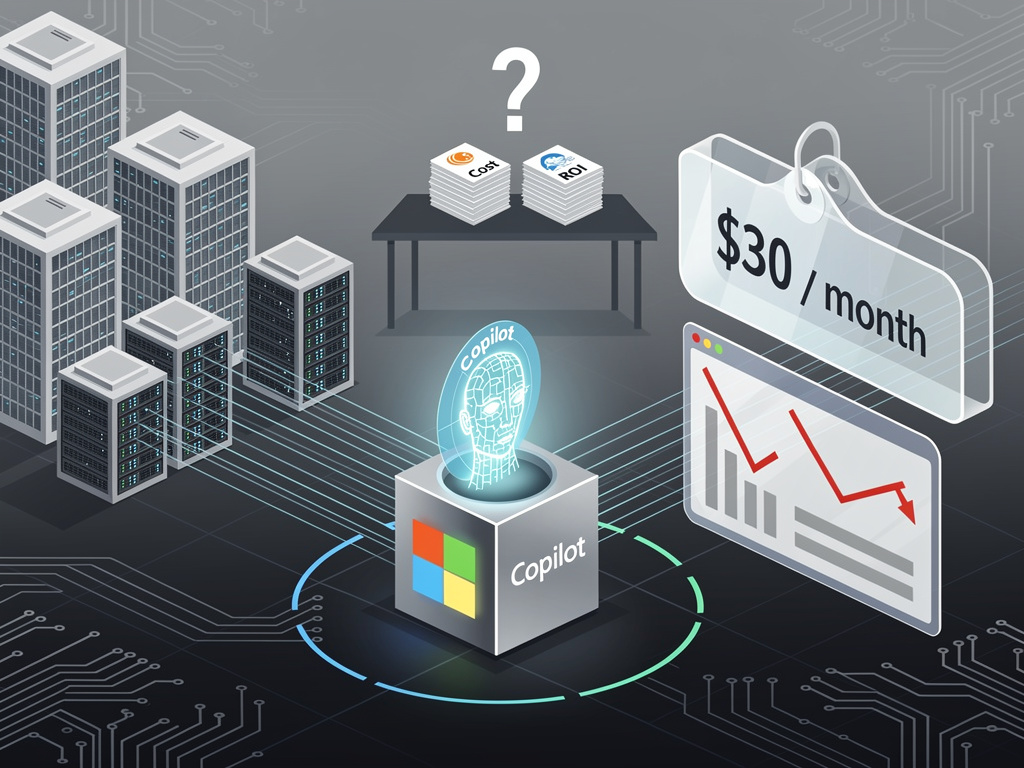
Microsoft’s ambitious bet on artificial intelligence is encountering significant resistance in the enterprise market, as the company’s flagship Copilot product struggles to deliver the transformative productivity gains that justified its premium pricing. According to The Wall Street Journal, the software giant’s $30-per-month AI assistant is facing widespread skepticism from corporate customers who question whether the technology provides sufficient value to warrant the substantial investment required for organization-wide deployment.
The challenges facing Microsoft Copilot represent more than just teething problems for a new product category. They signal potential vulnerabilities in the broader narrative that generative AI will rapidly revolutionize white-collar work. Companies that rushed to pilot Copilot are now conducting rigorous return-on-investment analyses, and many are discovering that the productivity improvements fall short of expectations. Some organizations report that employees find the AI suggestions unhelpful or irrelevant to their specific workflows, while others cite concerns about data security and the accuracy of AI-generated content.
Industry analysts estimate that Microsoft needs widespread Copilot adoption to justify the massive capital expenditures required to build and maintain the AI infrastructure powering these services. The company has invested billions in partnership with OpenAI and constructed extensive data center capacity to support AI workloads. Yet corporate customers remain cautious, with adoption rates significantly lower than Microsoft’s internal projections suggested. This hesitation threatens to delay the return on these substantial investments and raises questions about the timeline for AI monetization across the technology sector.
The Productivity Paradox Emerges
The core promise of Microsoft Copilot centers on dramatic productivity enhancements across the Microsoft 365 suite, including Word, Excel, PowerPoint, and Outlook. Microsoft has marketed the tool as capable of drafting emails, summarizing meetings, creating presentations, and analyzing spreadsheets with minimal human intervention. However, real-world implementation reveals a more complex picture. According to The Wall Street Journal’s reporting, many users find that Copilot requires extensive prompting and refinement to produce usable results, effectively negating much of the promised time savings.
Several Fortune 500 companies that participated in early Copilot pilots have shared concerns privately with Microsoft about the tool’s performance. These organizations report that while Copilot occasionally produces impressive results, the inconsistency of output quality makes it difficult to integrate into mission-critical workflows. Employees express frustration when the AI misunderstands context or generates content that requires more time to correct than it would have taken to create manually. This variability creates a trust deficit that proves difficult to overcome, even as Microsoft continues to refine the underlying models.
The technical limitations become particularly apparent in specialized business contexts where domain expertise and institutional knowledge prove essential. Copilot’s training on broad internet data means it often lacks the specific understanding of industry terminology, company processes, or regulatory requirements that characterize professional work. Legal departments worry about liability when AI drafts contracts, finance teams question the accuracy of AI-generated analyses, and communications professionals find that AI-written content lacks the nuance required for sensitive stakeholder engagement.
Economic Calculations Complicate Deployment Decisions
The economics of Copilot deployment present challenging calculations for chief information officers and chief financial officers. At $30 per user per month, implementing Copilot across a 10,000-person organization represents an additional $3.6 million in annual software costs. This substantial investment requires clear justification through measurable productivity gains, yet quantifying such improvements proves elusive. Traditional productivity metrics struggle to capture the nuanced ways AI might enhance work quality or employee satisfaction, even when time savings remain modest.
Companies face additional hidden costs beyond the subscription fees. IT departments must invest in training programs to help employees use Copilot effectively, as the technology requires new skills and workflows that differ from traditional software tools. Organizations also incur expenses related to data governance, as they must ensure that sensitive information isn’t inadvertently exposed through AI interactions. Security teams need to implement new monitoring and compliance frameworks, while legal departments develop policies governing AI use in various business contexts.
The competitive dynamics within the enterprise software market further complicate Microsoft’s position. Google, Salesforce, and numerous startups have launched competing AI products, creating fragmentation in the enterprise AI ecosystem. Some companies prefer to wait and evaluate multiple options before committing to a specific platform, while others experiment with open-source alternatives that offer greater customization at lower costs. This competitive pressure limits Microsoft’s pricing power and may force more aggressive discounting to drive adoption, potentially undermining the revenue projections that justified the initial AI investments.
Technical Debt and Infrastructure Challenges
Behind the scenes, Microsoft grapples with significant technical challenges in scaling Copilot to meet enterprise demands. The computational requirements for running large language models at scale create infrastructure bottlenecks that occasionally result in performance degradation or service interruptions. Some customers report latency issues that disrupt workflow, particularly during peak usage periods when many users simultaneously query the AI systems. These technical limitations undermine confidence in Copilot’s reliability for time-sensitive business operations.
The integration of AI capabilities into Microsoft’s existing product suite also introduces complexity that affects user experience. Copilot must work seamlessly across multiple applications, each with distinct data structures and user interfaces. Achieving this level of integration while maintaining performance and security standards requires extensive engineering effort. Microsoft continues to release updates addressing compatibility issues and feature gaps, but the pace of improvement hasn’t kept up with customer expectations formed by the company’s ambitious marketing.
Data privacy concerns represent another significant technical and policy challenge. Enterprise customers demand assurances that their proprietary information used to train or fine-tune Copilot models remains confidential and isn’t inadvertently shared with competitors or exposed through AI outputs. Microsoft has implemented technical safeguards and contractual protections, but many organizations remain skeptical, particularly in highly regulated industries like healthcare, finance, and government. This skepticism slows adoption as legal and compliance teams conduct lengthy reviews before approving Copilot deployment.
Strategic Implications for Microsoft’s AI Vision
The challenges facing Copilot carry profound implications for Microsoft’s broader AI strategy and market position. The company has positioned itself as the leader in practical AI applications for business, leveraging its dominant position in enterprise productivity software to distribute AI capabilities widely. If Copilot fails to achieve strong adoption, it could undermine confidence in Microsoft’s AI capabilities and create opportunities for competitors to capture market share with alternative approaches.
Microsoft’s financial performance increasingly depends on successfully monetizing its AI investments. The company has guided investors to expect significant revenue growth from AI products, with Copilot positioned as a key driver. Disappointing adoption rates could force Microsoft to revise these projections, potentially affecting its stock valuation and ability to fund continued AI research and development. The pressure to demonstrate returns on AI investments may lead to strategic adjustments, including pricing changes, feature modifications, or shifts in go-to-market strategy.
The situation also highlights broader questions about the timeline for AI transformation in the enterprise. While the technology continues to advance rapidly, the gap between technical capability and practical business value remains substantial. Organizations need time to develop the processes, skills, and cultural adaptations required to effectively leverage AI tools. Microsoft’s experience with Copilot suggests that the transition to AI-augmented work may unfold more gradually than the technology industry’s most optimistic projections anticipated, requiring patience from investors and sustained commitment from vendors.
Industry-Wide Ramifications and Future Outlook
Microsoft’s struggles with Copilot adoption offer important lessons for the entire technology sector as it navigates the AI transition. The experience demonstrates that impressive technical capabilities don’t automatically translate into successful products without careful attention to user needs, workflow integration, and clear value propositions. Other companies developing AI products must grapple with similar challenges around pricing, performance, and proving return on investment to skeptical customers.
The enterprise AI market remains in its early stages, with business models and best practices still evolving. Microsoft’s willingness to iterate on Copilot based on customer feedback and market response will likely determine whether the product ultimately succeeds or becomes a cautionary tale about premature commercialization of emerging technologies. The company continues to invest heavily in improving Copilot’s capabilities, expanding its features, and developing more sophisticated methods for demonstrating business value to prospective customers.
As the AI revolution unfolds, the gap between technological potential and practical implementation will continue to shape outcomes for vendors and customers alike. Microsoft’s experience with Copilot illustrates that even well-resourced technology leaders with dominant market positions face significant obstacles in translating AI capabilities into widely adopted, revenue-generating products. The resolution of these challenges will influence not only Microsoft’s competitive position but also the broader trajectory of AI adoption in the enterprise, setting precedents that will affect the entire industry for years to come.


 WebProNews is an iEntry Publication