
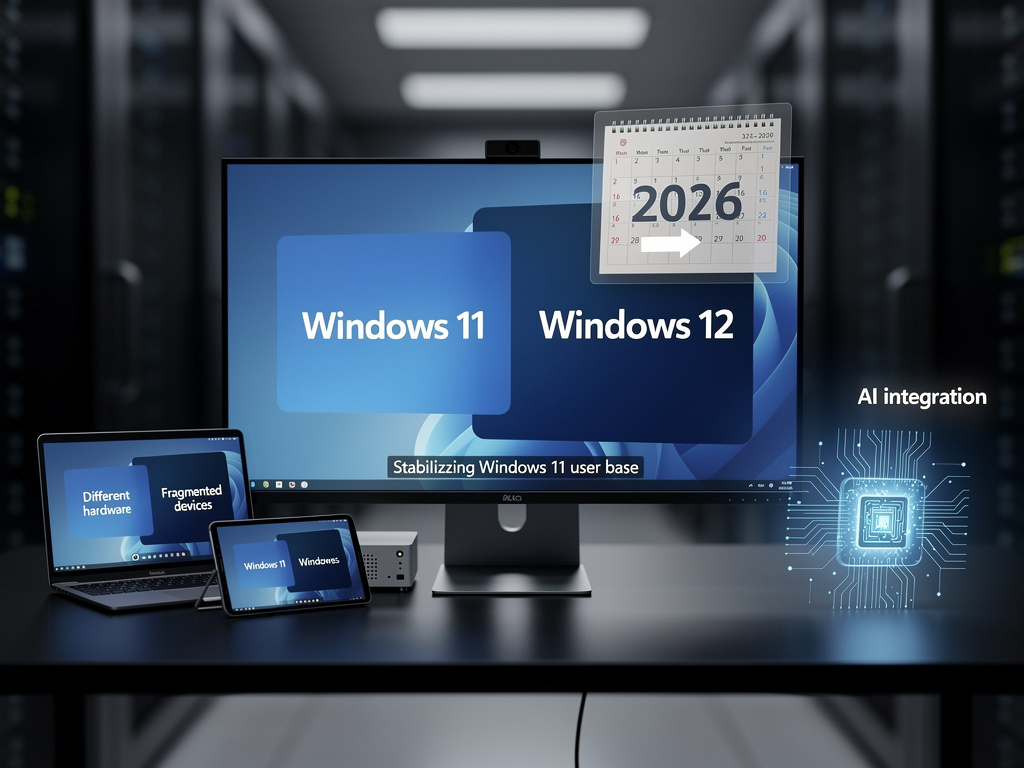
The technology sector operates on a rhythm of anticipation, particularly when Microsoft prepares to turn the page on its operating system version numbers. For nearly two years, industry analysts and hardware partners operated under the assumption that 2024 would mark the arrival of Windows 12. This expectation was grounded in Microsoft’s historical return to a three-year development cycle. However, emerging intelligence suggests a significant strategic pivot in Redmond. Instead of rushing a new integer release to market, Microsoft appears to be recalibrating its timeline, pushing the next true generational leap—colloquially dubbed Windows 12—to potentially as late as 2026.
This adjustment is not merely a delay; it represents a fundamental change in how the company views the operating system in the age of generative artificial intelligence. According to a recent report by TechRepublic, leaks indicate that while a visual refresh and platform update are imminent, the full-scale release of Windows 12 is likely reserved for a later window. This aligns with a broader corporate strategy to prioritize market stability and AI penetration over arbitrary release schedules.
The Collision of Hardware Cycles and Software Ambitions
The hesitation to commit to a 2024 launch for Windows 12 stems largely from the fragmented state of the personal computing hardware market. Microsoft is currently aggressively pushing the concept of the “AI PC,” a standard requiring Neural Processing Units (NPUs) capable of handling roughly 40 trillion operations per second (TOPS). While partners like Qualcomm, Intel, and AMD are rushing silicon to market that meets these demands, the install base for such devices remains microscopic relative to the billions of Windows PCs in circulation.
Launching a new operating system that heavily relies on hardware consumers do not yet own would risk a tepid reception similar to the Windows Vista era. By targeting a 2025 or 2026 window, as suggested by the TechRepublic analysis, Microsoft allows the hardware cycle to mature. This ensures that when the next OS arrives, a critical mass of enterprise and consumer machines will actually be capable of running the local AI workloads that will define the software’s identity.
Prioritizing the Windows 11 Base to Avoid Fragmentation
Corporate IT departments are notoriously risk-averse, and Microsoft is currently battling to migrate its enterprise customers from Windows 10 to Windows 11. Introducing Windows 12 prematurely would fracture the user base further, creating three concurrent operating systems requiring support. This fragmentation is a logistical nightmare for Chief Information Officers and developers alike. By opting to release the upcoming “Hudson Valley” update as Windows 11 version 24H2 rather than a new OS, Microsoft maintains continuity.
This strategy allows Redmond to inject next-generation features—specifically deep Copilot integration—into the existing environment without forcing a disruptive migration process. The focus remains on increasing the adoption rate of Windows 11, which still trails its predecessor significantly in global market share. A 2026 target for Windows 12 provides a longer runway for Windows 10 to reach its end-of-support date (October 2025), theoretically clearing the deck for a more unified migration path.
The Germanium Platform and the Technical Underpinnings
Beneath the branding discussions lies the technical reality of the “Germanium” platform release. This underlying engineering milestone serves as the foundation for the next wave of Windows features. While Germanium is ready, decoupling the platform release from the branding allows Microsoft to service its Azure and server clients immediately while holding back the consumer-facing OS overhaul. The leaks cited by TechRepublic suggest that while the plumbing for the next generation is being laid now, the “Next Valley”—the internal moniker for the Windows 12 experience—requires further refinement to justify a full version number jump.
This engineering disconnect highlights a shift in how Windows is built. The OS is becoming modular, with parts of the core kernel, the user interface, and the AI subsystems moving on different development velocities. This modularity enables Microsoft to update the “experience” layer independently of the core, blurring the lines between what constitutes a simple update and a new operating system.
Visual Overhauls and the Floating Taskbar Concept
When Windows 12 does eventually arrive, visual differentiation will be critical to its marketing. Early prototypes inadvertently displayed during Microsoft’s Ignite conferences revealed a user interface that borrows heavily from mobile and macOS aesthetics. The most contentious change observed is a “floating” taskbar that is detached from the bottom of the screen, along with a top bar displaying system status and weather widgets. This design language signals a move toward a touch-friendly, fluid interface designed to scale across form factors, from tablets to desktops.
However, radical UI changes historically alienate legacy users. By pushing the release to 2026, Microsoft buys time to iterate on these designs through the Windows Insider program, testing elements within Windows 11 before codifying them in a new release. The goal is to modernize the look without repeating the navigational disasters of Windows 8.
The Role of Subscription Models and Cloud Computing
Industry observers are closely monitoring how the delay impacts Microsoft’s monetization strategy. There is growing speculation that Windows 12 could be the first version to heavily incentivize, or perhaps require, a subscription model for advanced features. With the rise of Windows 365, which streams a full PC experience from the cloud, the line between local and cloud computing is vanishing. A 2026 release aligns with the maturity of 5G and 6G networks, making a “thin client” version of Windows 12 a viable option for enterprise sectors.
This potential shift explains the cautious approach. Moving the world’s most popular desktop OS toward a recurring revenue model requires delicate handling. A rushed 2024 launch would likely rely on traditional licensing; a 2026 launch allows for a market environment where consumers are more acclimated to subscribing to their operating system in the same way they subscribe to Office 365.
Competitive Pressures from Apple and ChromeOS
Microsoft’s timeline is not developing in a vacuum. The resurgence of the Mac, driven by Apple’s M-series silicon, and the persistence of ChromeOS in the education sector create external pressure. Apple has successfully integrated AI and hardware in a way that Windows currently struggles to match due to the diversity of the PC ecosystem. Microsoft’s decision to delay might be a tactical retreat to ensure that when Windows 12 launches, it offers a level of polish and silicon synergy that can genuinely compete with macOS, rather than just offering a theoretical alternative.
The delay allows the “Wintel” alliance (and the newer Windows on Arm partnership) to solidify. The upcoming Snapdragon X Elite chips are a first step, but Microsoft needs several generations of such hardware to be widespread before it can claim parity with Apple’s integration. A 2026 release grants partners the necessary time to refine drivers, power efficiency, and NPU utilization, ensuring the software doesn’t fail due to hardware inadequacies.
The Future of the Windows Insider Program
For the immediate future, the Windows Insider Program will remain the primary testing ground for features that were originally earmarked for Windows 12. Enthusiasts should expect the Canary and Dev channels to receive code that fundamentally alters Windows 11, serving as a public beta for the 2026 release. This blurring of lines means that the “Windows 12” experience will likely trickle down to users over the next two years, rather than arriving as a singular, monolithic drop.
Ultimately, the leaks reported by TechRepublic paint a picture of a company that has learned from past mistakes. Microsoft is choosing long-term platform health over short-term marketing splashes. By targeting 2026, they are betting that a mature, AI-native, and hardware-optimized operating system will be worth the wait, even if it means extending the lifecycle of Windows 11 beyond original projections.


 WebProNews is an iEntry Publication