
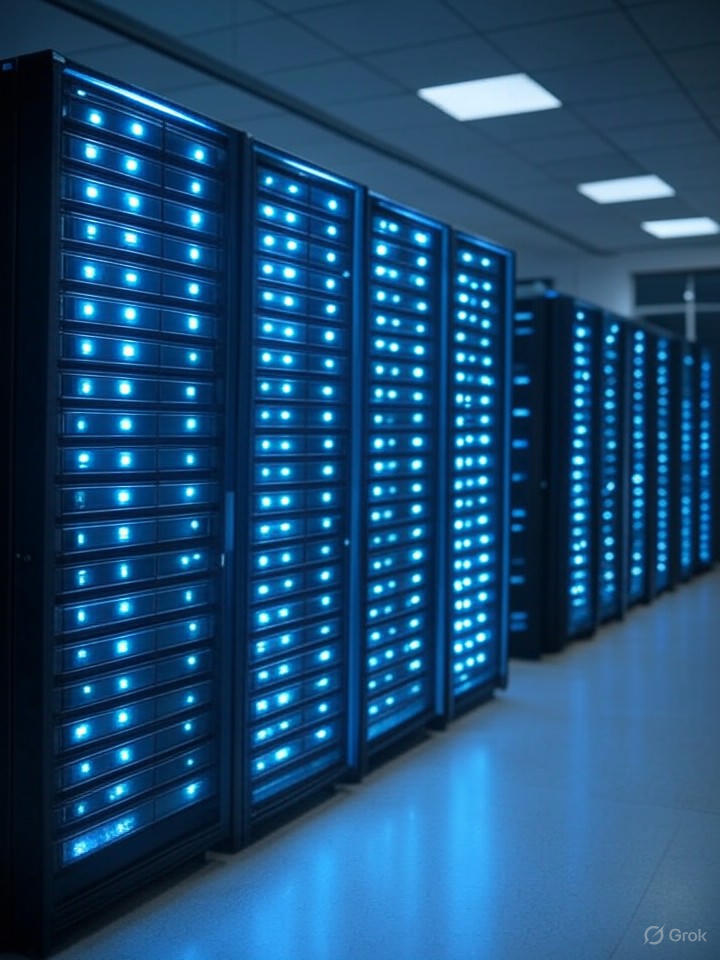
Microsoft has unveiled a groundbreaking approach to AI infrastructure with its first ‘superfactory,’ a networked system connecting datacenters in Wisconsin and Atlanta. This innovation aims to handle the immense computational demands of advanced AI models, marking a shift from isolated facilities to interconnected, planet-scale computing fabrics.
Dubbed Fairwater, the Wisconsin site represents Microsoft’s largest and most sophisticated AI datacenter yet, packed with hundreds of thousands of Nvidia GPUs. According to The Official Microsoft Blog, this facility is designed for cutting-edge AI workloads, supporting global adoption of cloud services and AI technologies.
The Dawn of Interconnected AI Infrastructure
The Atlanta hub, the second in the Fairwater family, connects directly to Wisconsin via a high-speed fiber network, creating what Microsoft calls the world’s first planet-scale AI superfactory. As reported by GeekWire, this setup enables training and running of advanced AI models for partners like OpenAI and Microsoft’s internal projects.
This distributed architecture allows for denser computing power than traditional datacenters, addressing the exponential growth in AI demands. Microsoft Source highlights how the system works across states in near real-time, reducing training timelines from months to weeks.
Technical Backbone: GPUs and High-Speed Networks
At the core of the superfactory are hundreds of thousands of Nvidia GPUs, including next-gen Blackwell models, providing multi-gigawatt power capacity. The Times of India notes CEO Satya Nadella’s emphasis on this unified complex as a ‘planet-scale AI superfactory.’
The high-speed fiber network ensures seamless integration, allowing the datacenters to function as a single entity. This approach, as detailed in The Official Microsoft Blog, connects to prior generations of AI supercomputers and the broader Azure footprint for infinite scale.
Powering AI Innovation for Partners and Beyond
Microsoft’s investment supports key partners like OpenAI, enabling frontier model training. Posts on X, including from industry analysts, underscore the massive scale, with one noting Microsoft’s $80 billion spend on AI datacenters in 2025, signaling a new cloud super cycle.
The superfactory’s design incorporates advanced cooling and sustainable power solutions. Seeking Alpha reports it delivers power from hundreds of thousands of Nvidia GPUs to meet surging AI workloads.
Economic and Industry Impacts
Beyond technology, this initiative drives economic growth in host regions. The Wisconsin facility, introduced in September 2025, involves over $7 billion in investments, creating jobs and boosting local economies, as per X posts from tech observers.
Industry insiders view this as a response to AI’s insatiable hunger for compute. Rough Draft Atlanta describes how linking datacenters accelerates large-scale AI work, positioning Microsoft ahead in the race for AI dominance.
Sustainability and Scalability Challenges
Sustainability is a key focus, with high-availability power and efficient cooling. However, the multi-gigawatt demands raise concerns about energy consumption, echoed in X discussions on the need for ‘chip to grid systems thinking.’
Microsoft plans to expand this model globally, potentially doubling its datacenter footprint. As Windows Report details, the Atlanta site features NVIDIA Blackwell GPUs and advanced networking for resilient operations.
Strategic Implications for Cloud Computing
This superfactory redefines cloud infrastructure, moving toward distributed, high-density computing. Analysts on X highlight Microsoft’s 80% increase in AI capacity this year, underscoring its commitment to leading the AI era.
Competitors may follow suit, but Microsoft’s first-mover advantage, backed by partnerships like Nvidia, sets a new standard. StockTwits notes the Atlanta hub as a pivotal addition to the Fairwater network.
Future Horizons in AI Development
Looking ahead, this infrastructure will power advancements in healthcare, science, and more, as mentioned in X posts from Eonmsk News. Microsoft’s vision integrates AI into everyday applications, from Copilot to enterprise solutions.
The superfactory’s architecture promises to shorten innovation cycles, enabling faster deployment of next-gen AI. Industry sentiment on X reflects excitement over this ‘industrial scale’ approach, potentially transforming global computing landscapes.


 WebProNews is an iEntry Publication