
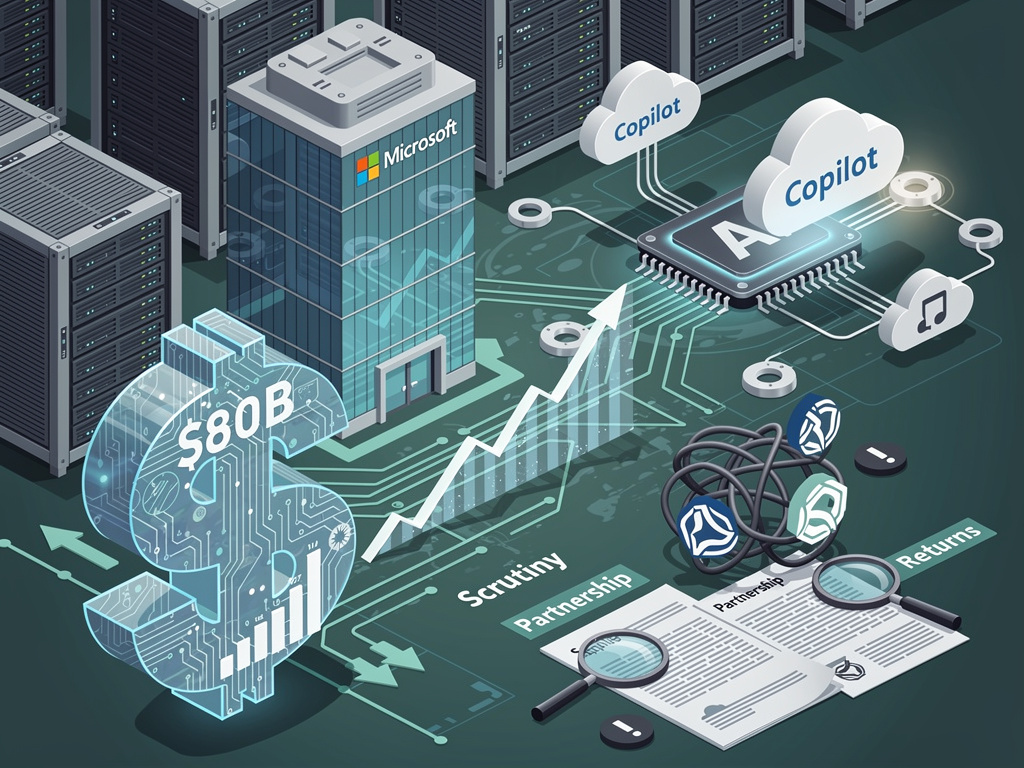
Microsoft has spent the better part of three years positioning itself as the undisputed leader of the artificial intelligence revolution. Armed with a multibillion-dollar partnership with OpenAI and a relentless campaign to embed AI into every corner of its product ecosystem, the Redmond, Washington-based tech giant has staked its future — and tens of billions of dollars in capital expenditure — on the premise that generative AI will reshape enterprise computing. But a growing body of evidence suggests that Microsoft’s AI efforts are not delivering the returns the company promised, and cracks are beginning to show across multiple fronts.
From its flagship AI assistant Copilot to its cloud infrastructure business Azure, Microsoft is confronting an uncomfortable reality: the AI gold rush may not be panning out as quickly or as lucratively as its executives projected. As Futurism recently reported, Microsoft’s AI efforts appear to be “faceplanting” across several key metrics, raising pointed questions about whether the company’s enormous investments will generate meaningful returns anytime soon — or whether they represent one of the most expensive strategic miscalculations in modern tech history.
Copilot’s Rocky Reception and the Enterprise Adoption Problem
At the center of Microsoft’s AI strategy sits Copilot, the AI-powered assistant integrated into Microsoft 365, Windows, and a growing list of enterprise applications. When Microsoft launched Copilot with great fanfare, it promised a transformative productivity tool that would justify its $30-per-user monthly premium for enterprise customers. The pitch was simple and seductive: AI would draft your emails, summarize your meetings, build your spreadsheets, and fundamentally change the way knowledge workers operate. But the reality on the ground has been far less impressive.
Enterprise adoption of Copilot has been sluggish, with numerous reports indicating that many organizations that piloted the tool have declined to expand their subscriptions. The core issue, according to multiple industry analysts and IT decision-makers, is that Copilot’s outputs frequently fall short of the quality and reliability that enterprise customers demand. The tool often produces generic, inaccurate, or unhelpful responses — a problem that becomes particularly acute in specialized business contexts where precision matters. As Futurism noted, the product has struggled to demonstrate the kind of clear, measurable productivity gains that would justify its steep price tag for budget-conscious IT departments already grappling with rising software costs.
The $80 Billion Infrastructure Spending Spree Faces Scrutiny
Microsoft’s AI ambitions have required staggering levels of capital investment. The company has committed approximately $80 billion in capital expenditure for fiscal year 2025 alone, with the vast majority earmarked for AI-related data center construction and GPU procurement. This spending binge has made Microsoft one of the largest infrastructure investors in the world, rivaling the capital outlays of entire nations. CEO Satya Nadella and CFO Amy Hood have repeatedly assured investors that this spending is necessary to capture what they describe as a generational opportunity in AI computing.
But Wall Street’s patience is not infinite. Microsoft’s stock, which soared throughout 2023 and into early 2024 on AI enthusiasm, has faced increasing pressure as investors scrutinize the gap between the company’s massive capital outlays and the actual revenue being generated by its AI products. The fundamental question haunting Microsoft’s balance sheet is straightforward: when will these tens of billions of dollars in spending translate into proportional revenue growth? So far, the answer has been unsatisfying. While Microsoft has pointed to Azure’s AI-related revenue growth as a bright spot, the absolute numbers remain a fraction of what would be needed to justify the scale of investment being made.
Azure’s AI Revenue: Growth Without Enough Substance
Microsoft has repeatedly highlighted Azure’s AI services as a key growth driver, and the numbers are indeed growing. The company has reported that Azure’s AI-related revenue is expanding at a rapid clip, with AI services contributing several percentage points to Azure’s overall growth rate. But context matters enormously here. Azure’s total revenue, while substantial, is growing from a base that makes the AI contribution look more like a promising supplement than a transformative engine. Competitors like Amazon Web Services and Google Cloud are making their own aggressive AI plays, and the cloud infrastructure market is becoming increasingly competitive.
Moreover, there are growing concerns about the sustainability of Azure’s AI growth trajectory. Much of the current demand for AI computing infrastructure is being driven by a relatively small number of large customers — including OpenAI itself, which is one of Azure’s biggest clients. This concentration risk means that Microsoft’s AI cloud revenue is more fragile than headline growth numbers might suggest. If the broader market for AI computing does not expand as rapidly as projected, or if key customers like OpenAI diversify their infrastructure providers, Azure’s AI revenue growth could decelerate sharply.
The OpenAI Partnership: Asset or Liability?
Microsoft’s relationship with OpenAI, once hailed as a masterstroke of strategic positioning, is becoming increasingly complicated. Microsoft has invested approximately $13 billion in OpenAI, securing privileged access to the startup’s models and technology. This partnership was the foundation upon which Microsoft built its entire AI product strategy, from Copilot to Azure AI services. But the relationship has grown more fraught as OpenAI has evolved from a research lab into a commercially aggressive company with its own platform ambitions.
OpenAI’s transition from a nonprofit structure to a for-profit entity, its pursuit of massive new funding rounds at eye-watering valuations, and its development of consumer-facing products that increasingly compete with Microsoft’s own offerings have all introduced tension into the partnership. There are legitimate questions about whether OpenAI’s long-term interests are truly aligned with Microsoft’s, or whether the startup will eventually seek to reduce its dependence on its largest investor and infrastructure provider. For Microsoft, the risk is that it has built a critical part of its AI strategy on a foundation it does not fully control.
Employee Morale and Internal Turbulence
The challenges facing Microsoft’s AI push are not limited to products and finances. Inside the company, there are signs of strain. Microsoft has undergone significant layoffs in recent months, including cuts that have affected teams working on AI-related projects. The juxtaposition of massive capital spending on AI infrastructure with workforce reductions has created internal tension and raised questions about the coherence of Microsoft’s strategy. Employees in some divisions have expressed frustration that the company’s AI-first rhetoric does not always match the reality of resource allocation and organizational priorities.
Additionally, Microsoft has faced scrutiny over the environmental impact of its AI infrastructure buildout. The enormous energy demands of AI data centers have put pressure on the company’s sustainability commitments, and reports have emerged that Microsoft’s carbon emissions have increased significantly as a result of its AI expansion. This creates a reputational risk that could become more significant as regulators, investors, and customers pay increasing attention to the environmental costs of the AI boom.
Competitive Pressures Mount From All Directions
Microsoft is not operating in a vacuum. Google, Amazon, Meta, and a host of well-funded startups are all pursuing AI strategies with enormous resources and significant technical talent. Google’s Gemini models have shown rapid improvement, and the company’s deep integration of AI into its search and cloud products represents a formidable competitive threat. Amazon Web Services continues to dominate the cloud infrastructure market and is aggressively expanding its own AI offerings. Meta has taken an open-source approach to AI development that has resonated with developers and enterprises wary of vendor lock-in.
Perhaps most concerning for Microsoft is the emergence of capable, lower-cost AI models from companies like Anthropic, Mistral, and various Chinese AI labs. These developments challenge the assumption that the most expensive, largest-scale models will always be the most commercially valuable. If the AI market evolves toward smaller, more efficient, and more specialized models, Microsoft’s strategy of massive infrastructure investment and reliance on OpenAI’s frontier models could prove to be poorly calibrated for the market that actually materializes.
What Comes Next for Redmond’s Biggest Bet
None of this means that Microsoft’s AI strategy is doomed to fail. The company possesses extraordinary advantages — a massive installed base of enterprise customers, deep pockets, world-class engineering talent, and a distribution network that few competitors can match. If AI technology continues to improve and enterprise adoption accelerates, Microsoft is well-positioned to capture a significant share of the value created. Satya Nadella has proven himself to be one of the most capable CEOs in technology, and his track record of navigating strategic transitions — most notably the shift to cloud computing — commands respect.
But the warning signs are real and growing harder to ignore. Microsoft’s AI products need to deliver meaningfully better results to justify their pricing. The company’s capital spending needs to translate into revenue growth that satisfies increasingly skeptical investors. And the OpenAI partnership needs to remain stable and mutually beneficial in a period of rapid change. The next twelve to eighteen months will be critical in determining whether Microsoft’s AI bet was a visionary move that cemented its dominance for a generation — or a cautionary tale about the dangers of investing too much, too fast, in a technology whose commercial potential remains unproven at scale. For now, the jury is very much still out.


 WebProNews is an iEntry Publication