
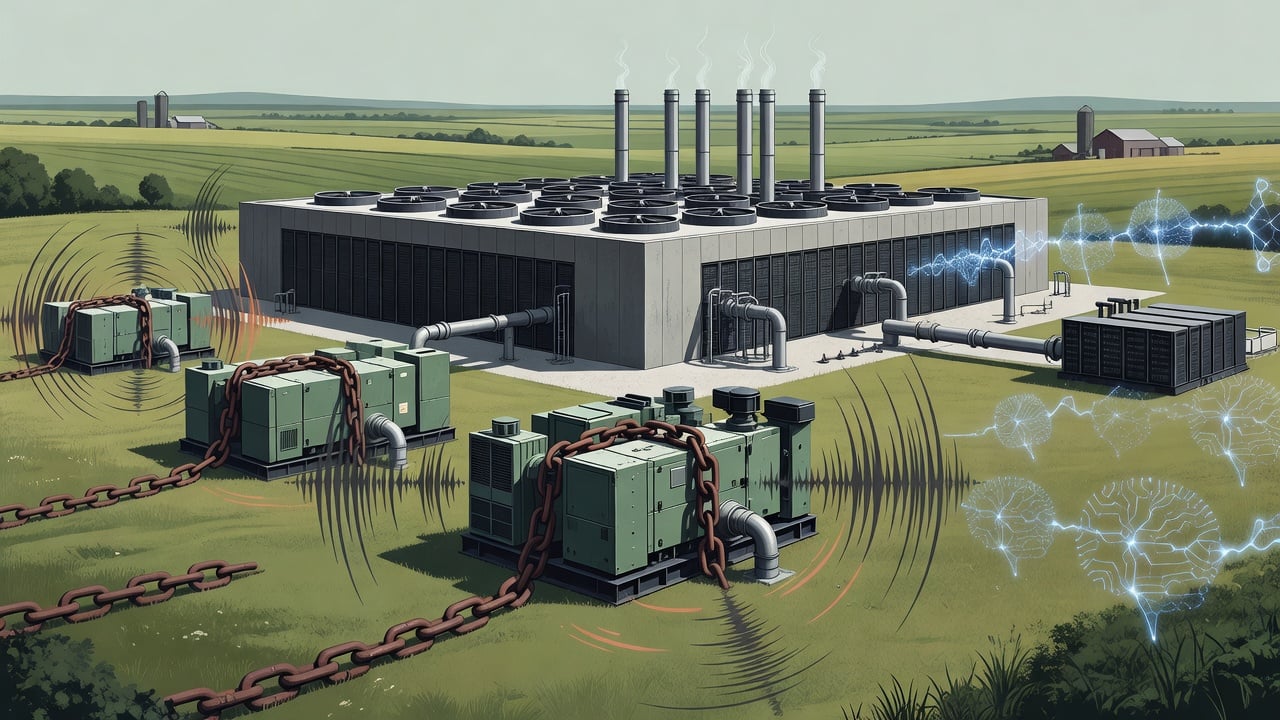
Residents near one of Microsoft’s flagship artificial intelligence facilities have taken the company to federal court. The complaint accuses the tech giant of allowing constant industrial racket to invade their homes. Filed on July 1 in the U.S. District Court for the Eastern District of Wisconsin, the class-action suit targets the $7.3 billion Fairwater data center in Mount Pleasant.
Three Sturtevant homeowners—Garret Ostergaard, David Wade and Joy Wade—lead the action. They live within 1.5 miles of the sprawling 1.2-million-square-foot complex. Their filing claims the site produces “unreasonable and excessive noise” from diesel generators and HVAC equipment. Chillers, cooling towers, air-handling units and condenser fans operate around the clock. The sound, they say, invades properties, disrupts sleep and erodes home values.
The Milwaukee Journal Sentinel first detailed the allegations. One plaintiff, Amy Cimbalnik, described the din to the paper as “similar to the whirring engine of a freight train parked nearby.” She added, “We heard it 24 hours a day, and eventually realized it was coming from the Microsoft campus.”
But this fight stretches beyond a single Wisconsin village. Across the country, communities grapple with the physical footprint of AI infrastructure. Massive power demands, water consumption for cooling and persistent low-frequency hums have sparked opposition from Virginia to Indiana to Oregon. Recent reports show at least 142 advocacy groups now track and challenge hyperscale projects.
Microsoft positioned Fairwater as a crown jewel. CEO Satya Nadella called it “the world’s most powerful AI data center.” The facility links hundreds of thousands of power-hungry chips into one cluster. It promises to process 865,000 tokens per second. Yet those capabilities come with cooling systems that roar when pushed hard.
Company officials moved quickly after early complaints. In a June 18 blog post, Microsoft said it had investigated the source, run tests and installed fixes. The adjustments targeted a “tonal humming sound” from cooling fans running at high speeds. Village of Mount Pleasant communications director Sean Ryan told local media that complaints dropped off after mid-April changes. Officials declared themselves ready to respond to further issues.
The July lawsuit suggests those measures fell short. Plaintiffs argue Microsoft never installed sufficient acoustic barriers, shields or walls. They claim the company knew or should have known the equipment would generate pervasive sound. And they seek damages for private nuisance and negligence.
Noise levels reported elsewhere offer context. A Southwest Michigan resident measured 60 decibels from his porch near a similar installation. That volume matches a normal conversation or background office hum. Sustained over days and nights, it wears on people. Some shift work schedules just to grab sleep. Others report headaches, anxiety and lost use of backyards.
Construction added another layer. Plaintiffs mention dust, heavy truck traffic and glaring nighttime lights. The area, once quiet farmland, now feels like an industrial zone. One resident called it a “dust bowl” during building phases.
Microsoft responded to the suit with a measured statement. “We are committed to being a good neighbor in the communities where we build, own and operate our data centers,” the company said. It declined further comment on active litigation. The firm plans as many as 15 data centers across Mount Pleasant. Maintaining relations with locals will prove essential if those projects advance.
This episode fits a wider pattern. In November 2025, Microsoft scrapped plans for a data center in nearby Caledonia after vocal community pushback, CNBC reported. Public officials there never even voted. The company instead doubled down on Mount Pleasant, where resistance appeared milder. Until now.
Similar tensions surface nationwide. In Indiana, roughly 60 large AI-focused facilities have been proposed in two years. A July 2026 update from the Center for AI and Community warned that these plants differ sharply from traditional data centers. They consume far more electricity and water. Weak wetland protections exacerbate risks to local supplies.
Utility bills climb too. Data centers act as enormous loads on the grid. Mid-Atlantic power costs rose as much as 20 percent in 2025, with AI infrastructure cited as a leading factor. Residential customers foot part of that bill.
Water use draws equal scrutiny. Google’s operations in The Dalles, Oregon, once consumed 355 million gallons in a single year. That equaled one-quarter of the city’s total. The company initially fought public records requests before releasing the numbers.
Broader surveys capture the mood. A Gallup poll released in May 2026 found about 70 percent of Americans oppose new AI data centers near their homes. Support drops further when projects sit adjacent to residential neighborhoods.
Legal efforts multiply. Law firms now investigate claims of nonstop tonal noise, depleted aquifers, higher electricity rates and falling property values. Berger Montague, for one, actively seeks affected residents for potential actions.
In Prince William County, Virginia, accelerated approvals for a massive project triggered lawsuits over transparency and historic preservation. A state appeals court later sided with opponents, saying the process had shortchanged public input.
Back in Wisconsin, the Fairwater suit could set precedents. If successful, it might force operators to adopt stricter sound-mitigation standards. That could include taller barriers, quieter fans or relocated equipment. Yet such changes raise costs at a time when AI demand pushes companies to expand fast.
Microsoft isn’t alone. Google, Amazon, Meta and others race to construct similar facilities. Each promises economic gains: tax revenue, construction jobs, occasional permanent roles. Locals often hear those pitches first. Reality arrives later in the form of humming machinery and brighter night skies.
Some towns still welcome the investment. Others now demand detailed impact studies, noise ordinances and community benefit agreements before granting permits. A few have imposed outright moratoriums.
The Wisconsin plaintiffs seek class status for more than 1,000 households within 1.5 miles. Their complaint paints a picture of lost tranquility. “Plaintiffs’ properties have been and continue to be physically invaded by excessive noise,” it states. They want compensation for diminished property enjoyment and any measurable drop in market values.
Experts watching the case note that nuisance law varies by jurisdiction. Courts typically weigh the character of the neighborhood, the utility of the defendant’s conduct and the extent of harm. A former farming area transformed into a tech corridor may complicate that balance.
Microsoft has invested heavily in the region. It touts job creation and infrastructure upgrades. Yet those benefits feel abstract to families kept awake by mechanical drone.
So the tension builds. On one side sits the insatiable appetite for compute to train ever-larger models. On the other stand homeowners who never bargained for freight-train sound in their backyards. The lawsuit may not halt construction. It could, however, force the industry to treat acoustic impacts with the same seriousness once reserved for power contracts and chip procurement.
Additional reporting from recent days reinforces the stakes. Wisconsin Public Radio covered the filing and quoted directly from the complaint. Tom’s Hardware highlighted mentions of construction dust and extreme light pollution alongside the noise claims. Coverage on X amplified resident frustration, with posts linking back to these outlets.
Resolution remains distant. Discovery will likely surface noise studies, internal emails and resident logs. Settlement talks could produce mitigation funds or equipment upgrades. Or the matter may head to trial, offering a public airing of how AI’s physical infrastructure collides with everyday life.
Either outcome will echo. Data centers are no longer abstract server farms tucked in distant industrial parks. They have become neighbors. And some of those neighbors have decided to push back.


 WebProNews is an iEntry Publication