
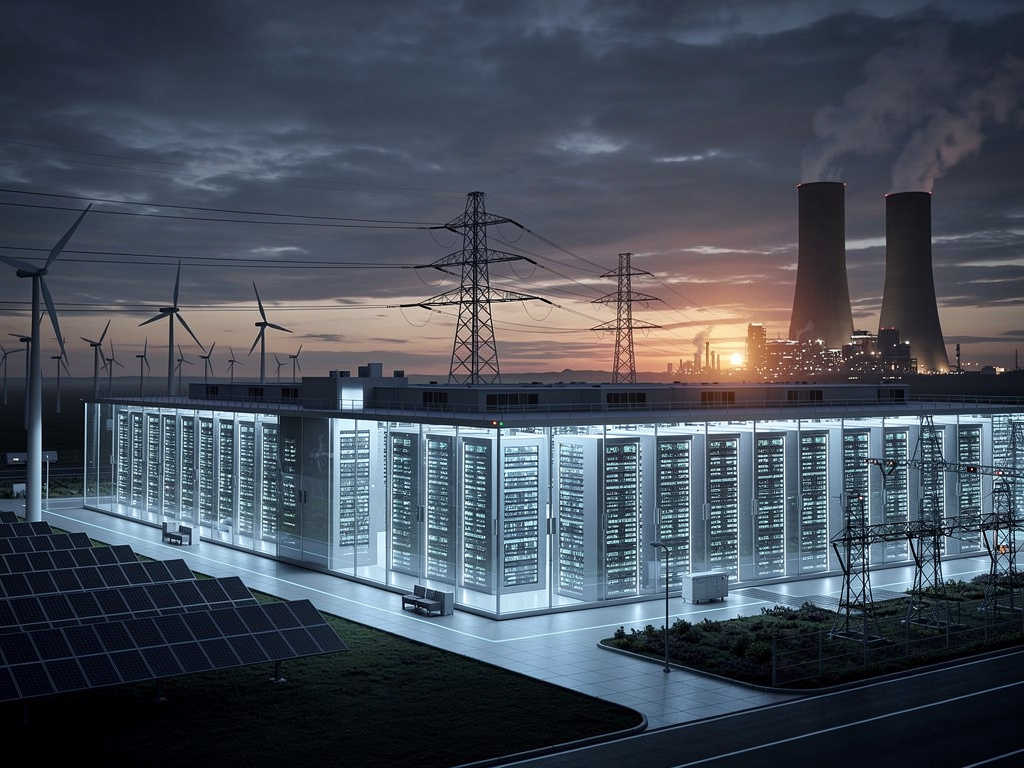
Microsoft built one of the most ambitious climate strategies in corporate America. In 2020 it vowed to become carbon negative by 2030. A year later it sharpened the focus with a target few others dared: match every kilowatt-hour of electricity it consumes with carbon-free power on the same grid, every hour of every day, by 2030.
That pledge, known inside the company as 100/100/0, went far beyond annual matching of renewables. It demanded real-time alignment in a world where wind dies at dusk and solar vanishes at night. Executives saw it as a signal to markets and utilities alike. Now the signal is flickering.
According to people familiar with internal talks, Microsoft is weighing whether to delay or abandon the hourly target altogether. Bloomberg first reported the discussions. The reason is simple and overwhelming. Artificial intelligence has exploded electricity demand inside data centers faster than clean power can scale.
GeekWire laid out the stakes in sharp detail. Microsoft’s carbon footprint jumped 23.4 percent between 2020 and 2024, driven largely by surging energy needs and the carbon-heavy materials used to build new facilities. (GeekWire).
Short pause. The numbers tell a story of ambition colliding with physics.
Chief Sustainability Officer Melanie Nakagawa struck a measured tone in recent statements. “Microsoft remains committed to its company goals to be carbon negative, water positive, zero waste, and protect ecosystems,” she said. “In 2025, we met a milestone on this journey by matching 100% of our annual global electricity consumption with renewable energy.” Yet she left room for adjustments. “Any adjustments we make are part of our disciplined approach — not a change in our long-term ambition.”
That annual victory came after the company contracted more than 40 gigawatts of renewable power across dozens of countries. It recently added 1.2 gigawatts of solar and battery storage in Wisconsin through deals with We Energies. Those projects won’t deliver until late 2028. By then new AI data centers will already be online and hungry.
TechCrunch captured the tension. Microsoft’s rush to expand Azure capacity for AI workloads has sparked internal debate over whether the hourly pledge now acts as an impediment rather than an inspiration. (TechCrunch).
But the pressure runs deeper than one company. The International Energy Agency reported that global data center electricity use rose 17 percent in 2025. AI-specific facilities grew even faster, far outpacing the 3 percent rise in overall world electricity demand. Projections show data center consumption doubling by 2030 while AI-focused demand triples. (IEA).
Inside the United States the strain shows up on utility bills and in grid operators’ forecasts. Lawrence Berkeley National Laboratory estimates U.S. data centers could consume between 6.7 and 12 percent of national electricity by 2028. In parts of Virginia they already approach 40 percent of total load. Natural gas plants are being revived or newly constructed to fill gaps that intermittent renewables cannot cover around the clock.
Microsoft’s own capital spending reveals the scale. Chief Financial Officer Amy Hood has guided investors toward nearly $190 billion in total outlays this fiscal year, with data center and AI hardware costs exceeding $40 billion in the current quarter alone. Those facilities don’t run on hope. They run on electrons that must be available without interruption.
So the company has explored alternatives. It held exclusive talks with Chevron and Engine No. 1 about developing a gas-powered plant in Texas to support a data center campus. It has also deepened interest in nuclear power. Small modular reactors and restarts of existing plants offer the 24/7 carbon-free profile that wind and solar struggle to match without enormous battery storage.
Reuters noted the broader industry shift. Commitments written before ChatGPT’s debut in late 2022 now look increasingly difficult against post-AI realities. (Reuters).
Microsoft isn’t alone. Amazon, Meta, and Google face similar calculations. All have signed massive renewable power purchase agreements. All have watched their emissions rise as data center fleets expand. The Financial Post observed that the appeal of natural gas has grown as firms scramble to secure firm power. (Financial Post).
Critics see hypocrisy. Environmental groups argue that retreating from the hourly target would weaken pressure on utilities to build truly clean capacity. They point to Microsoft’s earlier pause in future carbon removal credit purchases, first reported by The New York Times in April, as another sign of softening resolve. (The New York Times).
Nakagawa pushed back on that view. The company continues to review its approach “as markets mature, policy environments evolve, and emerging innovative solutions scale.” She insists carbon removal remains part of the portfolio even if procurement volumes adjust.
Yet the math is unforgiving. Training and running large language models consumes orders of magnitude more power than traditional cloud workloads. A single hyperscale AI data center can draw 100 megawatts or more — enough for a small city. Multiply that across dozens of campuses under construction and the demand becomes continental.
Recent analyses reinforce the point. The IEA’s deeper work on energy and AI shows accelerated servers, the chips that power model training and inference, now drive almost half the net growth in data center electricity use. Their consumption is projected to rise 30 percent annually in baseline scenarios. (IEA Energy and AI report).
Utilities find themselves caught between eager tech customers offering long-term contracts and local residents worried about higher bills. In some states data center interconnection requests have topped hundreds of gigawatts. Not all will be built. Enough will to force new generation online quickly.
That speed favors sources already permitted and ready. Natural gas turbines can come up faster than most renewable-plus-storage combinations. Nuclear restarts or new small reactors take years but deliver the steady output AI systems crave.
Discussions on X reflect the split. Some users hail nuclear as the only realistic path to 24/7 carbon-free power at scale. Others warn that any walk-back from Microsoft’s pledge will slow the transition and lock in fossil dependence for decades.
The company has not made a final call. Talks continue. A spokesperson told reporters Microsoft keeps pursuing opportunities to maintain its annual matching goal. The hourly commitment, harder by an order of magnitude, sits in the balance.
What happens next will ripple. Microsoft’s original pledge helped spur corporate climate action and clean energy markets. A retreat, even partial, could cool that momentum. Or it could force a more honest conversation about what 24/7 carbon-free power actually requires in an AI-driven economy: new transmission, better storage, faster permitting, and yes, firm low-carbon sources like nuclear.
Either way the era of easy climate targets has ended. Demand is no longer theoretical. It arrives every second in the form of queries, training runs, and inference calls. Servers don’t wait for the wind to blow. They compute. And the grid must answer.
Microsoft’s choice will not settle the debate. It will, however, reveal how one of the world’s most powerful technology companies balances its two most urgent priorities: powering the future of intelligence and protecting the planet that intelligence hopes to improve.


 WebProNews is an iEntry Publication