
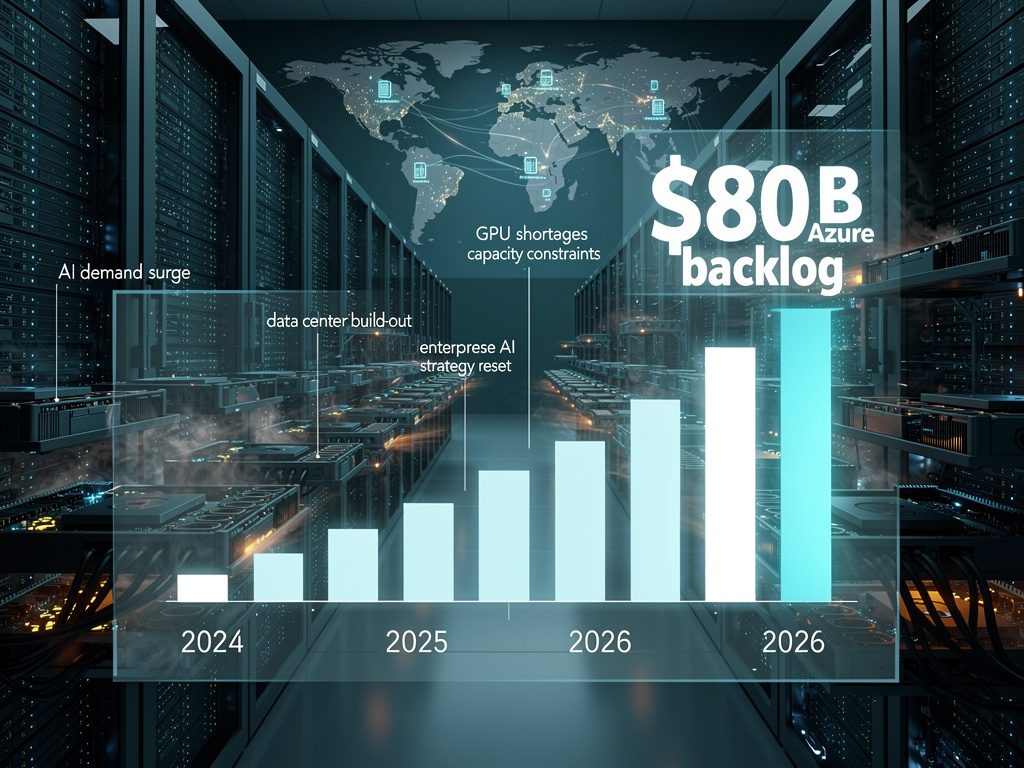
Microsoft’s cloud computing division faces an extraordinary challenge that illuminates the seismic shift occurring in enterprise technology: an $80 billion backlog of Azure orders that won’t be fulfilled until 2026. This staggering figure, revealed in recent financial disclosures, represents more than just delayed deliveries—it’s a stark indicator of how artificial intelligence is fundamentally reshaping the economics and infrastructure requirements of cloud computing at a scale the industry has never witnessed.
The backlog stems primarily from the explosive demand for AI computing power, particularly following Microsoft’s strategic partnership with OpenAI. According to Business Insider, the company cannot build data centers fast enough to meet customer requirements for running large language models and other AI workloads. This capacity constraint has created a waiting list that extends years into the future, forcing enterprises to reconsider their AI deployment timelines and potentially seek alternative solutions.
The magnitude of this backlog exceeds the annual revenue of many Fortune 500 companies and represents approximately one-third of Microsoft’s total commercial cloud revenue for fiscal year 2024. Industry analysts suggest this phenomenon isn’t unique to Microsoft—Amazon Web Services and Google Cloud are experiencing similar pressures, though neither has disclosed figures of comparable scale. The situation has profound implications for the competitive dynamics of cloud computing, potentially reshaping market share distributions and forcing a fundamental rethinking of capacity planning across the sector.
The Infrastructure Bottleneck Behind the Numbers
The root cause of Microsoft’s capacity crisis lies in the specialized hardware requirements for AI workloads. Unlike traditional cloud computing tasks that can run on standard servers, AI training and inference require high-performance graphics processing units (GPUs) and specialized AI accelerators. Nvidia’s H100 and upcoming H200 chips have become the gold standard for these workloads, but supply constraints have created a global shortage. Microsoft, despite being one of Nvidia’s largest customers, cannot secure enough chips to meet demand.
Data center construction timelines compound the problem. Building a modern hyperscale data center capable of supporting AI workloads typically requires 24 to 36 months from groundbreaking to operational status. These facilities demand extraordinary power infrastructure—often requiring 100 megawatts or more per facility—and sophisticated cooling systems to manage the heat generated by dense GPU clusters. Microsoft has announced plans to invest over $50 billion in data center infrastructure over the next fiscal year, but even this massive capital expenditure cannot immediately resolve the capacity shortage.
The energy requirements present an additional constraint that extends beyond Microsoft’s control. Many regions where the company seeks to build data centers face power grid limitations that cannot support the electrical demands of AI-optimized facilities. This has forced cloud providers to become increasingly involved in energy infrastructure development, including investments in renewable energy projects and, in some cases, nuclear power initiatives. The timeline for bringing new power generation capacity online often exceeds the construction timeline for the data centers themselves, creating a cascading series of bottlenecks.
OpenAI Partnership Intensifies Capacity Pressures
Microsoft’s exclusive cloud partnership with OpenAI has become both a strategic advantage and an operational challenge. The relationship gives Microsoft privileged access to cutting-edge AI models and positions Azure as the platform of choice for enterprises building on OpenAI’s technology. However, it also commits Microsoft to providing substantial computing resources to support OpenAI’s research and development activities, as well as serving the millions of users accessing ChatGPT and other OpenAI products through Microsoft’s infrastructure.
The computational requirements for training and running large language models are staggering. Training GPT-4, for instance, reportedly required thousands of GPUs running continuously for months. Serving inference requests—the process of generating responses to user queries—at scale demands maintaining large clusters of GPUs in constant operation. As OpenAI continues developing more sophisticated models and as adoption of AI assistants accelerates across enterprise and consumer markets, these requirements grow exponentially rather than linearly.
This dynamic creates a complex prioritization challenge for Microsoft. The company must balance capacity allocation between its own AI initiatives, including Copilot integration across its product suite, OpenAI’s requirements, and the demands of third-party Azure customers who are building their own AI applications. Some enterprise customers have reportedly expressed frustration at delays in accessing GPU capacity, raising questions about whether Microsoft’s OpenAI partnership inadvertently disadvantages other Azure users.
Market Implications and Competitive Dynamics
The capacity constraints affecting Microsoft and its competitors are fundamentally altering the competitive dynamics of cloud computing. For years, the cloud market operated on the assumption of virtually unlimited scalability—customers could provision resources on demand with minimal lead time. The AI era has shattered this assumption, introducing scarcity into a market previously characterized by abundance. This shift advantages established players with existing infrastructure while creating opportunities for specialized providers focused on AI workloads.
Smaller cloud providers and AI-focused infrastructure companies are positioning themselves as alternatives for enterprises unable to access capacity from the hyperscalers. Companies like CoreWeave, which specializes in GPU-optimized cloud infrastructure, have attracted billions in investment and are rapidly expanding capacity. These specialized providers can often move more quickly than the hyperscalers, leasing existing data center space and installing GPU clusters in months rather than years. However, they lack the global reach, comprehensive service portfolios, and enterprise relationships that make Microsoft, Amazon, and Google the default choices for most large organizations.
The capacity crunch is also influencing merger and acquisition activity in the sector. Data center operators with available power capacity and suitable facilities have become attractive acquisition targets. Microsoft and its competitors are exploring various strategies to accelerate capacity expansion, including partnerships with traditional data center providers, investments in modular data center designs that can be deployed more rapidly, and even exploring unconventional locations for facilities where power is more readily available.
Financial Performance Despite Constraints
Paradoxically, Microsoft’s capacity constraints have not prevented strong financial performance in its cloud division. Azure revenue growth remains robust, with the company reporting double-digit percentage increases quarter after quarter. The backlog itself represents future revenue that provides visibility into sustained growth extending years into the future. Investors have generally viewed the capacity constraints as a high-quality problem—evidence of demand exceeding supply rather than any fundamental weakness in Microsoft’s competitive position.
The company’s pricing power has strengthened as a result of the supply-demand imbalance. With customers willing to wait years for capacity and limited alternatives available, Microsoft has maintained premium pricing for AI workloads. This has contributed to margin expansion in the Azure business, offsetting some of the pressure from the massive capital expenditures required for infrastructure expansion. However, this pricing advantage may prove temporary as new capacity comes online and competition intensifies.
Microsoft’s financial guidance reflects confidence that the capacity situation will improve over the coming years. The company has provided detailed roadmaps showing significant capacity additions scheduled for 2025 and 2026, which should allow it to work through much of the current backlog. However, executives have cautioned that demand continues to grow, and the company expects capacity to remain a constraining factor for the foreseeable future, even as new data centers come online.
Strategic Responses and Long-Term Outlook
Microsoft is pursuing multiple strategies to address the capacity challenge beyond simply building more data centers. The company has invested heavily in software optimizations that increase the efficiency of AI workloads, allowing more inference requests to be served with the same hardware. Techniques like model quantization, which reduces the precision of calculations without significantly impacting output quality, can dramatically reduce the computing resources required to run large language models.
The company is also diversifying its hardware strategy, reducing dependence on Nvidia by developing custom AI accelerators and expanding partnerships with alternative chip providers. Microsoft’s Maia AI accelerator, announced in 2023, is designed specifically for the company’s AI workloads and could eventually reduce reliance on third-party GPUs. However, developing competitive custom silicon requires years of investment, and Nvidia’s technological lead remains substantial. Any meaningful shift away from Nvidia GPUs will be measured in years rather than quarters.
Looking ahead, the resolution of Microsoft’s capacity constraints will likely reshape the cloud computing market in lasting ways. The era of unlimited on-demand scalability may give way to a new model where capacity planning and long-term commitments become standard practice for AI workloads. Enterprises may need to forecast their AI computing requirements years in advance and commit to reserved capacity, similar to how companies approach other critical infrastructure decisions. This shift would represent a fundamental change in how cloud computing operates, with implications extending far beyond Microsoft’s current $80 billion backlog.
The situation also highlights the broader infrastructure challenges facing the AI revolution. The technology industry’s ambitious vision for artificial intelligence—with AI assistants embedded in every application and AI capabilities available to every enterprise—depends on computing infrastructure that simply doesn’t exist yet. Building that infrastructure requires not just capital investment, but also solutions to challenges involving energy supply, semiconductor manufacturing capacity, and skilled workforce availability. Microsoft’s backlog is merely the most visible symptom of constraints that will shape the pace and trajectory of AI adoption for years to come.


 WebProNews is an iEntry Publication