
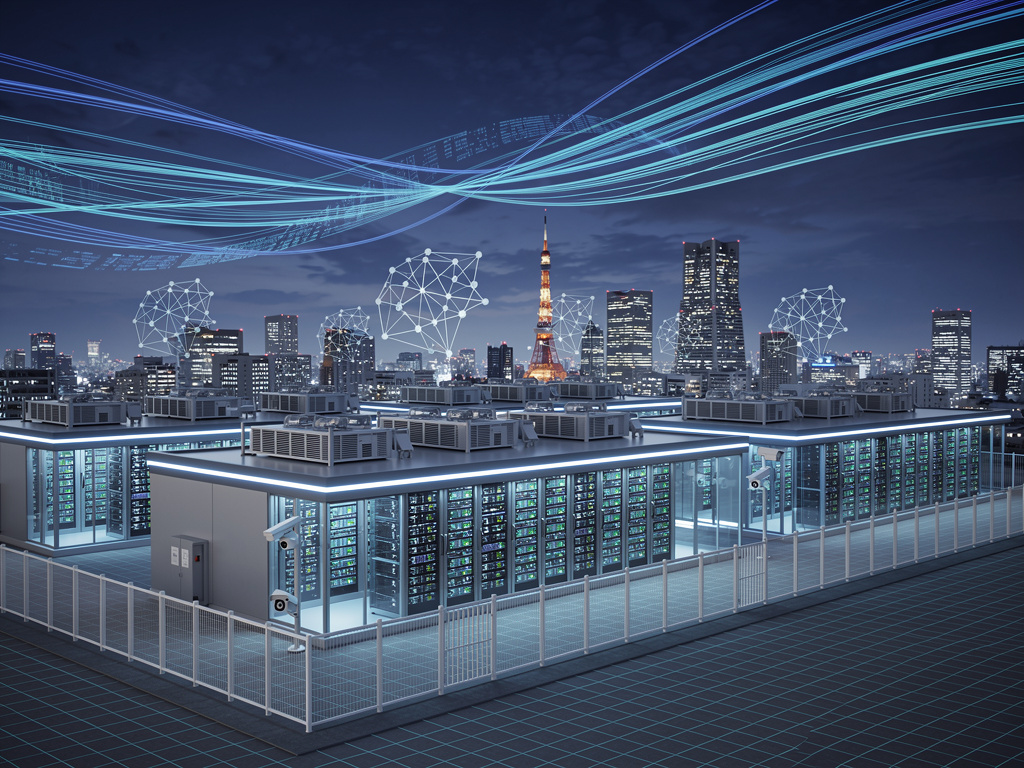
Microsoft is pouring roughly $10 billion into Japan over the next two years, a sweeping commitment that covers artificial intelligence infrastructure, cybersecurity operations, and workforce development. The investment, announced during a meeting between Microsoft Vice Chair Brad Smith and Japanese Prime Minister Shigeru Ishiba, signals a deepening entanglement between American hyperscalers and the strategic technology ambitions of allied Asian democracies.
This isn’t philanthropy. It’s positioning.
According to Slashdot, the investment will fund the construction of new data centers, expand AI research capabilities, and strengthen Japan’s cyber defense posture — all while tightening Microsoft’s grip on one of Asia’s most important enterprise technology markets. The announcement came as Japan faces mounting cybersecurity threats, particularly from state-linked actors in China, North Korea, and Russia, and as the country embarks on an ambitious push to modernize its digital government and defense infrastructure.
Brad Smith, speaking alongside Prime Minister Ishiba, framed the commitment in terms of mutual benefit. “Japan is one of the most important countries in the world for Microsoft, and this investment reflects our confidence in Japan’s future as a leader in AI and cybersecurity,” Smith said, according to reporting from Reuters. The two discussed how the funds would be deployed across multiple prefectures, with a particular emphasis on building GPU-dense data center capacity to support the training and deployment of large language models.
Japan has been aggressively courting hyperscale cloud investment for the past 18 months. And Microsoft is far from the only suitor. Google, Amazon Web Services, and Oracle have all announced major expansions in the country. But the scale of Microsoft’s commitment — $10 billion over just two years — puts it at the top of the pack in terms of sheer capital deployment.
Why Japan? Why now?
The answer sits at the intersection of geopolitics, industrial policy, and the raw physics of AI compute demand. Japan’s government, under both the current Ishiba administration and its predecessors, has made digital transformation a national priority. The country’s Ministry of Economy, Trade and Industry (METI) has been actively subsidizing semiconductor fabrication and data center construction, offering tax incentives and streamlined permitting to attract foreign capital. Tokyo wants to ensure that its companies — from Toyota to SoftBank to NTT — have domestic access to the AI infrastructure they need, rather than depending entirely on compute capacity located in the United States or Southeast Asia.
There’s also a security dimension that can’t be ignored. Japan’s National Center of Incident Readiness and Strategy for Cybersecurity (NISC) has been sounding alarms about the sophistication and frequency of cyberattacks targeting Japanese critical infrastructure. A significant portion of Microsoft’s investment is earmarked for expanding its cybersecurity operations in the country, including threat intelligence sharing, incident response capabilities, and training programs designed to build a larger domestic cybersecurity workforce. Japan currently faces a shortage of an estimated 110,000 cybersecurity professionals, according to government figures — a gap that leaves both public and private sector networks exposed.
Microsoft’s move also dovetails with the broader U.S.-Japan alliance framework. The two countries have been deepening their cooperation on technology and defense, particularly since the 2023 bilateral summit where leaders agreed to collaborate on next-generation semiconductors, quantum computing, and AI. Washington views Japan as a critical node in its strategy to maintain technological superiority over China, and private-sector investments like Microsoft’s serve as a commercial complement to government-level agreements.
The Data Center Buildout and What It Means for AI Competition in Asia
At the core of this investment is infrastructure. Microsoft plans to significantly expand its Azure cloud region footprint in Japan, adding hyperscale data center capacity in both the Tokyo and Osaka regions. These facilities will be equipped with the latest Nvidia GPU clusters — the same hardware underpinning the most advanced AI models being developed by OpenAI, Microsoft’s close partner.
The buildout matters because AI training and inference workloads are extraordinarily compute-intensive, and latency matters. Japanese enterprises running AI applications need data centers physically close to their operations. Financial services firms in Tokyo, manufacturers in Nagoya, and logistics companies in Osaka all benefit from local compute. So do government agencies that face data sovereignty requirements mandating that certain categories of information remain within Japanese borders.
Microsoft isn’t just building empty shells, either. The company plans to staff these facilities and the surrounding operations with thousands of new employees, many of them Japanese nationals trained through a workforce development initiative that’s part of the broader investment package. Smith indicated that Microsoft would partner with Japanese universities and vocational schools to create AI and cybersecurity training programs, with a goal of upskilling 3 million people over the next several years.
That workforce commitment is significant. Japan’s tech labor market is tight, with an aging population and relatively low immigration creating persistent talent shortages. By investing in training, Microsoft accomplishes two things: it builds goodwill with the Japanese government, and it creates a pipeline of workers who are fluent in Microsoft’s own tools and platforms. A generation of Japanese AI engineers trained on Azure is a generation of engineers likely to keep using Azure.
The competitive implications extend beyond Japan’s borders. As Microsoft, Google, and AWS race to build out AI infrastructure across Asia, the country that secures the most compute capacity earliest will have an advantage in attracting AI startups, research institutions, and enterprise customers. Singapore, Malaysia, Indonesia, and South Korea are all vying for the same investment dollars. Japan’s combination of political stability, strong rule of law, reliable power grid, and deep pool of engineering talent makes it an attractive destination — but it’s not the cheapest. Land and construction costs in the Tokyo metropolitan area are among the highest in the world, and electricity prices, while stable, are elevated compared to some Southeast Asian alternatives.
Microsoft appears willing to absorb those costs in exchange for strategic positioning. The company’s Azure revenue in Japan has been growing at double-digit rates, driven by demand from both traditional enterprises and a new wave of AI-native startups. Locking in data center capacity now, before the next wave of demand hits, is a bet that the AI boom has years of growth ahead of it.
There are risks. Construction timelines for hyperscale data centers can stretch to 18-24 months or longer, and supply chain constraints on critical components — transformers, cooling systems, and especially GPUs — could delay deployments. Power availability is another concern. Japan shut down most of its nuclear fleet after the 2011 Fukushima disaster, and while several reactors have restarted, the country still relies heavily on imported natural gas for electricity generation. Data centers are voracious consumers of power, and Microsoft will need to work closely with Japanese utilities to ensure adequate supply.
The cybersecurity component of the investment deserves particular attention. Microsoft’s Threat Intelligence Center has been one of the most prolific publishers of research on state-sponsored cyber operations, and the company has been increasingly vocal about threats emanating from Chinese-linked hacking groups. In Japan, where tensions with Beijing over Taiwan and the East China Sea are a persistent concern, having a major American cybersecurity partner embedded in the country’s digital infrastructure carries both commercial and strategic value.
But it also raises questions about dependency. Some Japanese policymakers and industry leaders have expressed concern about relying too heavily on American cloud providers for critical national infrastructure. NTT, Fujitsu, and NEC — Japan’s homegrown technology champions — have their own cloud and cybersecurity offerings, and there’s an ongoing debate within METI about how to balance foreign investment with domestic industrial capacity. Microsoft’s investment will likely intensify that conversation.
For now, though, the money is flowing. And in the global race to build the physical infrastructure that AI requires, $10 billion buys a lot of concrete, copper, and compute. Microsoft is making a long-term bet that Japan will be one of the most important AI markets in the world. Given the country’s industrial base, its alliance with the United States, and its government’s willingness to spend, that bet looks well-placed.
The question isn’t whether the investment will happen. It’s whether it will be enough.


 WebProNews is an iEntry Publication