
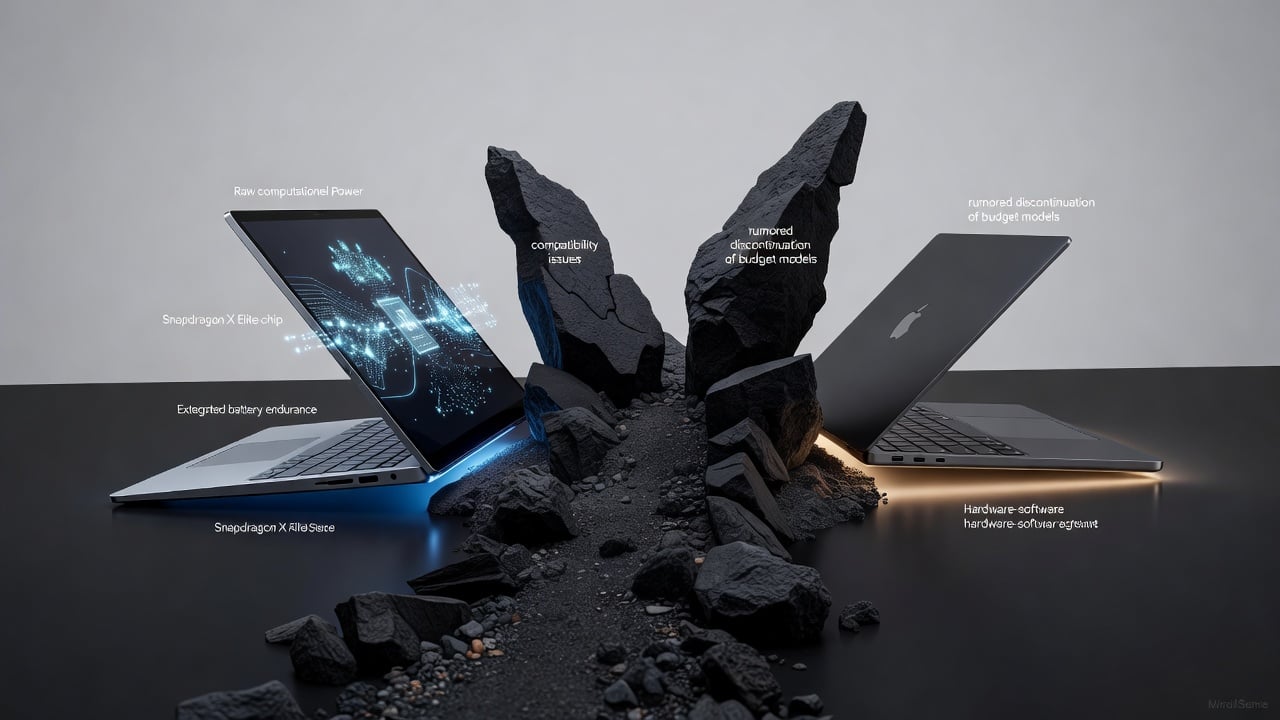
Microsoft has taken direct aim at Apple’s MacBook Pro with its latest Surface Laptop 7 models, positioning the new Windows machines as superior alternatives for professionals seeking power and efficiency. The company’s marketing emphasizes the Snapdragon X Elite processor’s capabilities against Apple’s M-series chips, yet industry observers suggest this confrontation faces significant obstacles. Adding to the pressure, reports indicate Microsoft may phase out its more budget-friendly Surface Laptop models, a move that could further complicate its position in the competitive laptop market.
The Surface Laptop 7 arrives with considerable fanfare from Redmond. Equipped with Qualcomm’s Snapdragon X Elite or X Plus chips, the devices promise exceptional battery life alongside strong performance metrics that Microsoft claims can outperform comparable MacBook systems in several key areas. During launch events, executives highlighted benchmark results showing the Snapdragon-powered Surfaces handling video editing, multitasking, and creative workloads with notable speed while maintaining impressive power efficiency. The company positioned these laptops as direct challengers to Apple’s popular MacBook Air and Pro lines, arguing that Windows users no longer need to compromise on either performance or portability.
TechRadar’s analysis points out that while Microsoft’s claims contain merit on paper, translating those specifications into market success presents multiple challenges. Apple has spent years refining its silicon architecture, creating tight integration between hardware and software that delivers consistent real-world performance. The MacBook Pro, particularly models with M3 and upcoming M4 chips, benefits from years of optimization that allow applications to run efficiently across Apple’s ecosystem. Windows on ARM, despite recent advances through Windows 11, still encounters compatibility hurdles that can affect certain professional applications.
Microsoft’s approach with the Surface Laptop 7 focuses heavily on artificial intelligence features. The devices include dedicated neural processing units capable of running advanced AI models locally, a capability the company believes will differentiate its products from competitors. Features like enhanced video conferencing tools, intelligent productivity assistants, and automated content creation capabilities form central elements of Microsoft’s pitch. These AI integrations aim to provide practical advantages for business users who spend considerable time in Microsoft 365 applications, where Copilot features can accelerate workflows and reduce manual tasks.
Yet the battle against Apple’s established dominance requires more than impressive specifications. Apple has cultivated a loyal following among creative professionals, developers, and students who value the MacBook’s build quality, display technology, and consistent software updates. The MacBook Pro’s Liquid Retina XDR displays set high standards for color accuracy and brightness, areas where the Surface Laptop 7’s screens, while excellent, face direct comparison. Additionally, Apple’s MacOS has developed a reputation for stability and security that many users prefer over Windows, despite Microsoft’s substantial improvements in recent years.
The rumored decision to discontinue more affordable Surface Laptop variants raises additional concerns about Microsoft’s overall strategy. For years, the Surface line has included options at various price points, allowing the company to reach different market segments. The entry-level models provided accessible entry into the premium laptop category, often serving as gateway products that introduced users to Microsoft’s hardware ecosystem. Removing these options could limit the Surface brand’s appeal and potentially cede ground to competitors offering more budget-conscious alternatives.
This potential shift aligns with Microsoft’s broader focus on premium computing experiences, particularly as the company doubles down on AI capabilities that require more powerful hardware. However, the move risks alienating customers who appreciated having Surface quality at lower price points. Competitors like Dell, HP, and Lenovo have successfully offered Windows laptops across multiple tiers, providing options that range from basic productivity machines to high-performance workstations. Microsoft’s rumored consolidation of the Surface Laptop lineup might force potential buyers toward these third-party alternatives rather than the company’s own branded products.
Performance comparisons between the Surface Laptop 7 and MacBook Pro reveal a complex picture. In certain synthetic benchmarks, the Snapdragon X Elite demonstrates impressive multi-core performance that can rival or exceed Apple’s M3 Pro chip. Battery life tests have shown the Surface devices achieving exceptional runtime, sometimes surpassing Apple’s offerings in web browsing and video playback scenarios. These results support Microsoft’s assertions that the new Surfaces can compete effectively with MacBooks in mobile productivity contexts.
Real-world application performance tells a more nuanced story. Professional software packages, particularly those used in video production, 3D modeling, and software development, often perform differently on ARM-based Windows systems compared to x86 architectures or Apple’s optimized environment. While many popular applications have been recompiled for ARM, some specialized tools still rely on emulation layers that can impact performance. Adobe’s creative suite, for instance, has made significant progress in native ARM support, but certain plugins and legacy features may not deliver identical experiences across platforms.
The software compatibility situation continues to improve as developers adapt to the growing ARM-based computing segment. Microsoft has invested heavily in Prism, its translation layer that allows x86 applications to run on ARM processors with minimal performance penalties. Recent updates have enhanced this technology considerably, though power users who depend on specific niche applications may still encounter occasional limitations. Apple faced similar challenges during its transition from Intel to Apple Silicon, eventually achieving near-universal compatibility through its Rosetta translation system.
Microsoft’s marketing strategy around the Surface Laptop 7 emphasizes freedom from Apple’s walled garden approach. The company highlights the flexibility of Windows, the ability to run traditional desktop applications, and the openness of the platform compared to MacOS. This messaging targets users who feel constrained by Apple’s ecosystem or prefer the customization options available in Windows. The approach attempts to frame the Surface as a more practical choice for professionals who need to work across different platforms and file formats.
Despite these arguments, Apple maintains several advantages that extend beyond raw performance metrics. The company’s vertical integration allows for optimizations that are difficult for Microsoft and its hardware partners to match. From custom display drivers to power management systems, Apple controls every aspect of the user experience in ways that create consistent advantages. The MacBook Pro’s speakers, keyboard, trackpad, and overall build quality have set benchmarks that Microsoft’s Surface devices strive to equal but sometimes fall short of matching completely.
The timing of Microsoft’s challenge coincides with Apple’s preparation for its next generation of MacBook processors. Rumors suggest the M4 series will bring substantial improvements in both performance and efficiency, potentially widening the gap between the two platforms in certain categories. Apple’s consistent annual updates to its silicon roadmap create ongoing pressure for competitors to match or exceed each new release. This cycle of continuous advancement has helped Apple maintain its position as the premium laptop leader despite increasing competition from Windows manufacturers.
Microsoft’s investment in the Surface brand reflects a long-term commitment to hardware development that extends beyond simply competing with Apple. The company uses its own devices to demonstrate the capabilities of Windows and to drive innovation that eventually benefits the broader PC industry. Features pioneered in Surface products often appear in other manufacturers’ laptops, creating indirect influence on the market. This strategy has proven successful in areas like touchscreen interfaces, detachable designs, and high-quality displays.
The AI capabilities integrated into the Surface Laptop 7 represent Microsoft’s strongest differentiator in the current market. While Apple has begun incorporating AI features into its devices, Microsoft’s extensive experience with cloud-based AI services gives it an advantage in delivering sophisticated tools that combine local processing with backend intelligence. The Copilot features built into Windows 11 on these new Surfaces aim to provide tangible productivity gains that users can immediately appreciate. From automatic meeting transcription to intelligent document summarization, these tools target specific pain points in professional workflows.
Market reception of the Surface Laptop 7 will likely determine whether Microsoft’s aggressive positioning against Apple yields results. Early reviews have been largely positive regarding the devices’ build quality, display performance, and battery life. Critics have praised the comfortable keyboard and responsive trackpad while noting that the ARM-based architecture delivers the promised efficiency gains. However, some reviewers have mentioned that certain applications still feel less optimized compared to their Mac counterparts, particularly in creative fields where Apple has long maintained strong support.
The potential discontinuation of lower-priced Surface models could signal a strategic retreat from certain market segments. Microsoft may have decided that competing in the budget laptop category dilutes its brand message and diverts resources from its premium AI-focused initiatives. This approach mirrors Apple’s own strategy of maintaining higher average selling prices across its product lines. While this can improve profit margins, it also limits total addressable market and may allow competitors to capture customers who would have previously considered Surface devices.
Looking ahead, the competition between Microsoft’s Surface lineup and Apple’s MacBook series will continue evolving as both companies advance their respective technologies. Microsoft’s success depends on its ability to not only match Apple’s performance but also to address the perception gaps that have historically favored the MacBook Pro among certain user groups. The integration of advanced AI features may prove decisive if Microsoft can demonstrate clear advantages in everyday professional tasks.
The Surface Laptop 7 represents Microsoft’s most serious attempt yet to challenge Apple’s dominance in the premium laptop segment. By focusing on efficiency, AI capabilities, and direct performance comparisons, the company has crafted a compelling narrative around its new devices. However, overcoming Apple’s established advantages in software optimization, ecosystem integration, and brand perception requires sustained effort across multiple areas. The rumored changes to the Surface product lineup add another layer of complexity to Microsoft’s strategy, potentially affecting its ability to reach diverse customer segments.
Success in this competitive arena will ultimately be measured by market share gains, customer satisfaction ratings, and the ability to attract users who might have otherwise chosen MacBooks. Microsoft has made significant strides with its ARM-based Windows initiative, creating devices that genuinely compete with Apple’s offerings in meaningful ways. Whether these technical achievements translate into broader market acceptance remains to be seen, but the Surface Laptop 7 clearly establishes that Microsoft is committed to competing aggressively in the premium laptop space.
The coming months will reveal how effectively Microsoft can translate its technical specifications and AI features into actual sales momentum. As both companies continue refining their approaches to modern computing demands, consumers stand to benefit from the intensified competition driving innovation across the industry. The battle between Surface and MacBook has entered a new phase, one defined by artificial intelligence capabilities, power efficiency, and the ongoing quest for the ideal balance between performance and portability in professional computing devices.


 WebProNews is an iEntry Publication