
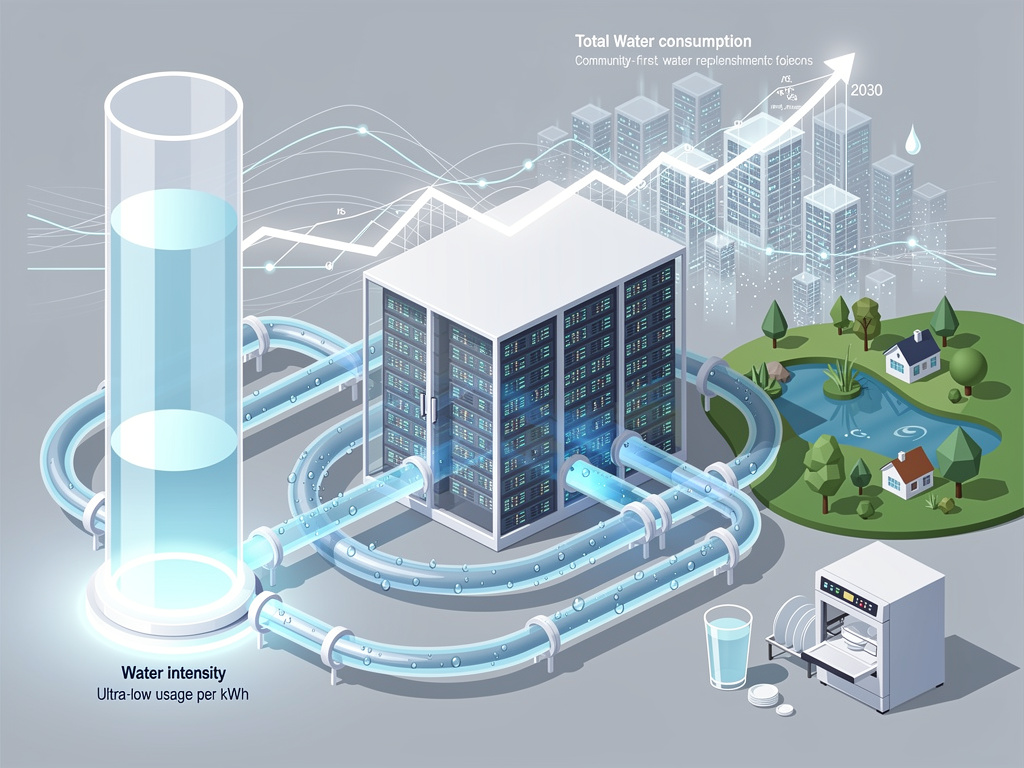
Microsoft has cut the water intensity of its data centers by nearly 90 percent since its first facilities opened in the early 2000s. The company now reports 0.27 liters per kilowatt-hour. That figure stands roughly three times better than the industry average.
But the gains come against a backdrop of surging demand. AI training and inference require massive compute clusters. Those clusters generate heat that must be managed. And water remains central to many cooling strategies even as the company shifts designs.
Closed-loop systems promise near-zero ongoing consumption for new builds, yet overall projections show total water use rising sharply by 2030.
The latest disclosure landed Wednesday in a detailed blog post from Microsoft. Its data centers have improved water-use effectiveness from 2.3 liters per kilowatt-hour two decades ago to 0.27 liters per kilowatt-hour in 2025. Microsoft Blog calls the progress the result of continuous innovation in cooling technologies combined with operational tweaks such as higher temperature set points and real-time weather analytics.
Short. Direct. The metric matters because it normalizes consumption against the actual work performed. A data center running more efficiently can support greater workloads without proportional resource draw. Microsoft says it has achieved a 25 percent reduction in water-use intensity since its 2022 baseline. That puts the company more than halfway toward a 40 percent improvement target by 2030.
And in fiscal 2025 the company replenished more fresh water globally than it withdrew. The accomplishment advances its long-standing pledge to become water positive. Over $500 million has flowed into more than 75 water and wastewater projects since 2020. One example near Leesburg, Virginia, directed more than $25 million toward local sewer upgrades so communities would not shoulder added costs.
Yet the picture grows more complicated when absolute volumes enter the discussion. A January report from The New York Times revealed internal forecasts that once projected Microsoft’s annual data-center water needs reaching 28 billion liters by 2030. That compared with 7.9 billion liters in 2020. After the newspaper’s inquiries, Microsoft revised the estimate downward to 18 billion liters. The new number still represents a 150 percent increase from 2020 levels. Those projections exclude more than $50 billion in additional data-center deals signed last year.
Regional stresses stand out. In the Phoenix area, already facing two decades of drought, earlier estimates pointed to 3.3 billion liters by 2030. The revised figure sits at 2 billion liters after facilities began running at higher temperatures. Near Jakarta, a city sinking partly because of aquifer depletion, the projection dropped from 1.9 billion liters to 664 million liters. Microsoft no longer publishes 2026 estimates for individual locations.
Satya Nadella addressed the issue head-on at the company’s Build 2026 conference in early June. “The cooling loop is filled once, and the data center can operate effectively with zero water consumption,” he said. “The daily water usage over the course of an entire year is roughly equivalent to what a single restaurant would use.” PCMag covered the remarks in detail.
The technology behind that claim relies on closed-loop, direct-to-chip cooling. Liquid circulates between servers and chillers without evaporation. No constant draw from municipal supplies. Microsoft says the approach can save 125 million liters of water per year per data center. Early pilots began in 2024. Next-generation facilities will expand the design. Chip-level cooling delivers precise temperature control while eliminating the water loss typical of traditional evaporative systems.
But not every facility operates this way yet. The existing fleet still mixes strategies. Many sites rely primarily on fans. They add evaporative cooling only when outside air exceeds 85 degrees Fahrenheit. Roughly 90 percent of Microsoft’s owned data centers now use low-water or zero-water cooling methods. The company audits operations, expands use of reclaimed water, and harvests rainwater where feasible. In Quincy, Washington, 74 percent of water comes from non-potable sources. Singapore reaches 99 percent.
Public concern has grown louder. Communities near proposed sites worry about strain on local water systems, higher electricity rates, and persistent noise from cooling equipment. Some localities have imposed moratoriums. Others demand greater transparency. Microsoft’s response carries the label Community-First AI Infrastructure. The approach promises no increase in local power prices, full replenishment of water use within the same watershed, stronger tax bases, and more jobs. The company now lists community permission as a primary design criterion.
Judy Priest, corporate vice president and CTO of cloud operations and innovation, and Steve Solomon, vice president of datacenter engineering, issued a joint statement. “We continue to advance datacenter innovations that reduce water use intensity while supporting the growing performance demands of cloud and AI services,” they said. GeekWire reported the comments alongside the efficiency milestone.
Industry-wide the pressure is mounting. North American data centers consumed nearly 1 trillion liters of water in 2025, according to market research cited by Reuters. Investors have pressed Amazon, Microsoft, and Google for more granular site-by-site disclosures. Many operators now report total usage without breaking it down by location. Microsoft provides fleet-wide WUE figures but faces the same criticism that absolute consumption still climbs with capacity.
Critics point out a subtle accounting issue. Closed-loop designs reduce water consumption at the data center itself. Yet the electricity powering those facilities often comes from natural-gas plants or other sources that consume water upstream. Microsoft counts only direct usage. The full lifecycle picture remains harder to pin down. One recent X discussion noted that shifting the burden to power plants simply moves the resource demand off the books.
Still, the engineering progress is real. From the earliest air-cooled halls with high evaporation rates to today’s liquid-cooled racks that recirculate the same fluid for years, the trajectory shows clear improvement. Microsoft’s average WUE in the Americas stood at 0.34 liters per kilowatt-hour last year. In Europe, the Middle East, and Africa it reached 0.03. The variation reflects climate, infrastructure, and design choices.
So what does this mean for the next wave of AI infrastructure? New facilities in Wisconsin, for instance, are projected to use about as much water annually as a typical restaurant. That matches Nadella’s restaurant comparison and suggests the closed-loop model can scale. But the fleet as a whole will keep expanding. Total withdrawals may continue their upward path even as intensity falls.
Microsoft insists the two trends can coexist. Digital growth and responsible water management, executives argue, are not mutually exclusive. The company has restored oxbow wetlands in the Midwest to create natural water storage. It deploys AI-driven leak detection in Arizona and Nevada. These steps aim to leave communities better off, not burdened.
Whether that narrative holds will depend on execution over the coming years. Regulators, investors, and residents are watching the numbers closely. Efficiency gains of 90 percent sound impressive until multiplied by the sheer scale of new AI clusters. The test for Microsoft, and the industry, is whether innovation in the server room can outpace the appetite of the workloads it serves.
Recent coverage reinforces the tension. On the same day Microsoft published its efficiency update, discussions on X highlighted how water has become the dominant topic in data-center debates, representing 31 percent of highly shared posts. Operators including Nvidia have also emphasized warm-liquid recirculation, yet power demand remains the larger long-term constraint.
The story is far from settled. Microsoft has demonstrated that dramatic reductions in water intensity are achievable. The question now is whether those reductions, combined with targeted replenishment projects, can satisfy communities facing real scarcity while the company races to build the infrastructure demanded by artificial intelligence.


 WebProNews is an iEntry Publication