
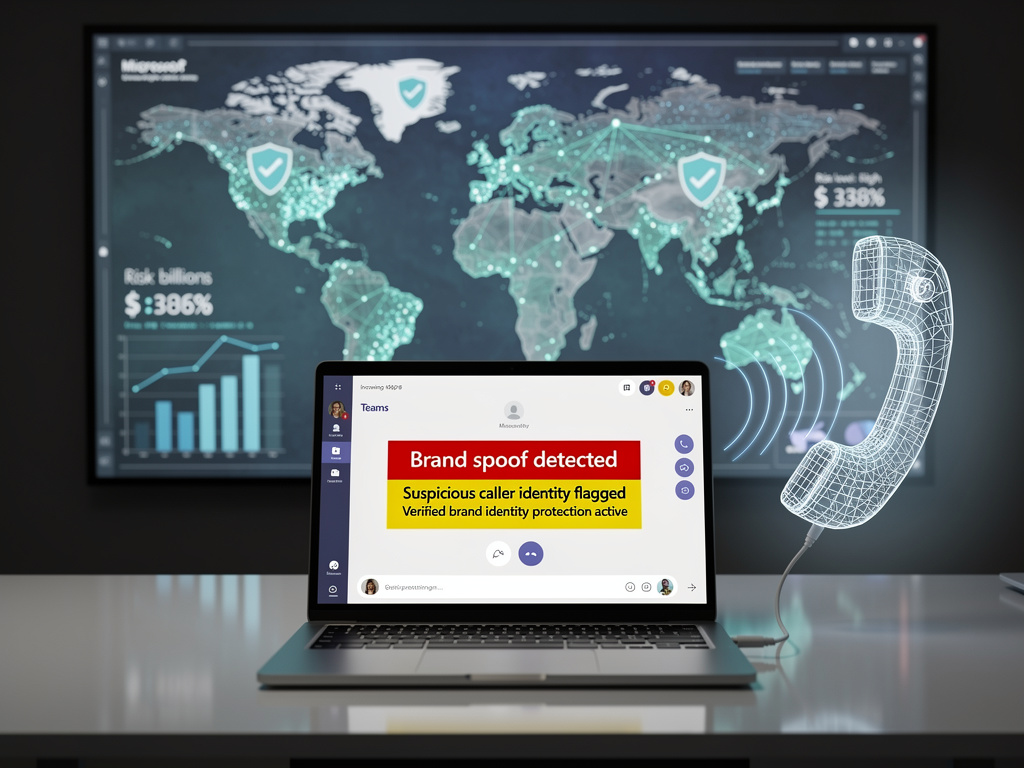
In a direct response to the escalating threat of voice-based phishing attacks, Microsoft is deploying a new digital sentry within its ubiquitous Teams platform. The company is rolling out a feature designed to alert users when an incoming call may be from an imposter spoofing a legitimate corporate brand, a move aimed at thwarting a new generation of sophisticated social engineering schemes that are costing businesses billions.
The new safeguard, slated for a global release in May 2024, will display a “Possible brand spoof” warning on incoming calls from external numbers that attempt to impersonate a known organization. The enhancement, detailed in Microsoft’s official product roadmap, is designed to give employees a crucial moment of hesitation before engaging with a potentially malicious actor. As reported by TechRadar, this feature leverages a back-end system of verified brand identities to distinguish authentic calls from fraudulent ones, marking a significant step in hardening the defenses of one of the world’s most popular communication hubs.
A Proactive Defense in an Era of Escalating Voice Threats
The initiative arrives not a moment too soon. While email-based phishing has long been the primary vector for corporate infiltration, threat actors are increasingly turning to the telephone. This tactic, known as “vishing” (voice phishing), exploits the inherent trust people place in a direct phone conversation. Attackers, often armed with personal data from previous breaches and aided by AI-powered voice-cloning technology, can convincingly impersonate executives, IT support staff, or representatives from trusted vendors like banks and even Microsoft itself.
The financial and operational damage from these attacks is staggering. The Federal Bureau of Investigation’s Internet Crime Complaint Center (IC3) has consistently warned of the rise of Business Email Compromise (BEC) and its variants, which include vishing. The FBI’s 2023 Internet Crime Report revealed that BEC schemes resulted in over $2.9 billion in reported losses for victims, underscoring the severe financial risk. As per a notice from the FBI, criminals are increasingly using virtual meeting platforms to direct victims to fraudulent websites under the guise of customer support, making in-app warnings like Microsoft’s a critical line of defense.
Under the Hood: Leveraging Verified ID and Azure’s Backbone
Microsoft’s new defense mechanism is more than a simple caller ID lookup. It is built upon the company’s broader identity verification framework, which likely includes elements of Microsoft Entra Verified ID and the robust infrastructure of Azure Communication Services. The system works by checking an incoming call against a registry of businesses that have established their legitimate identity with Microsoft. If a call purports to be from a verified brand but originates from a number not associated with that brand’s official profile, the system flags it as suspicious.
This approach mirrors the evolution of web security, where browsers use SSL/TLS certificates to verify a website’s identity and warn users of potential imposters. By applying a similar principle of cryptographic verification to voice calls within its ecosystem, Microsoft is aiming to create a higher standard of trust. This is part of a larger push by the company to secure its communication platforms, which serve as the central nervous system for millions of organizations and have become a prime target for corporate espionage and financial fraud.
Extending Trust Beyond the Corporate Firewall
A key challenge in combating spoofed calls is that many originate from the Public Switched Telephone Network (PSTN)—the traditional circuit-switched telephone network. To address this, the telecommunications industry has been implementing the STIR/SHAKEN framework, a set of protocols designed to cryptographically sign and verify caller ID information for calls carried over IP networks. This helps carriers confirm that a call is truly from the number it claims to be from.
Microsoft’s new feature acts as a complementary layer of security. While STIR/SHAKEN verifies the *number*, Microsoft’s brand verification system authenticates the *organization* associated with that number. This is a crucial distinction. A scammer could use a technically valid, non-spoofed number (a so-called “burner phone”) to impersonate a brand. Microsoft’s system would still flag this call if the number isn’t registered to that specific brand, providing a level of protection that number-centric verification alone cannot. As noted by the Federal Communications Commission, robust call authentication is a key pillar in the fight against illegal robocalls and scams, and Microsoft’s enterprise-focused solution builds directly on this principle.
A Strategic Move in the Unified Communications Arms Race
The introduction of brand spoofing detection is also a calculated competitive move. The Unified Communications as a Service (UCaaS) market, dominated by players like Microsoft Teams, Zoom, and Cisco Webex, is fiercely competitive. While features and usability have long been the main battlegrounds, security and compliance are increasingly becoming key differentiators for enterprise customers. By positioning Teams as a more secure platform, Microsoft can better appeal to organizations in highly regulated industries like finance, healthcare, and government.
Competitors are not standing still. Zoom, for instance, has heavily invested in security features, including advanced encryption and security settings, following public scrutiny early in its rapid growth. According to a security-focused whitepaper on its website, Zoom emphasizes its commitment to a frictionless and secure user experience. However, Microsoft’s approach of directly integrating a brand verification system into the call experience is a novel tactic that could set a new standard for security in the UCaaS sector, forcing rivals to develop similar capabilities to keep pace.
Implementation and the Road Ahead for IT Administrators
The feature will be enabled by default, requiring no immediate action from IT administrators to activate the basic protection. This frictionless rollout ensures that all users benefit from the enhanced security from day one. However, the system’s effectiveness will depend on the breadth of Microsoft’s verified brand directory. The company will likely need to onboard a vast number of businesses to ensure comprehensive coverage and minimize the risk of both false positives (flagging a legitimate call) and false negatives (missing a spoofed one).
For corporate IT departments, the new warning system serves as a powerful tool but not a panacea. It must be accompanied by continuous user education. Employees need to be trained to recognize the warning, understand its significance, and know the proper procedure for handling a potentially fraudulent call—namely, to not share sensitive information and to report the incident through official channels. The next phase of this technology could involve offering administrators more granular control, reporting dashboards on flagged calls, and integration with other security tools like Security Information and Event Management (SIEM) systems for a more holistic view of potential threats.
This new feature represents a critical evolution in the ongoing battle to secure corporate communications. As threat actors refine their methods, technology platforms must move beyond passive defenses and provide active, intelligent warnings that empower users to be the last line of defense. By embedding trust and verification directly into the call experience, Microsoft is not just protecting its users; it is attempting to reshape the security expectations for an entire industry, where the authenticity of every interaction can no longer be taken for granted.


 WebProNews is an iEntry Publication