
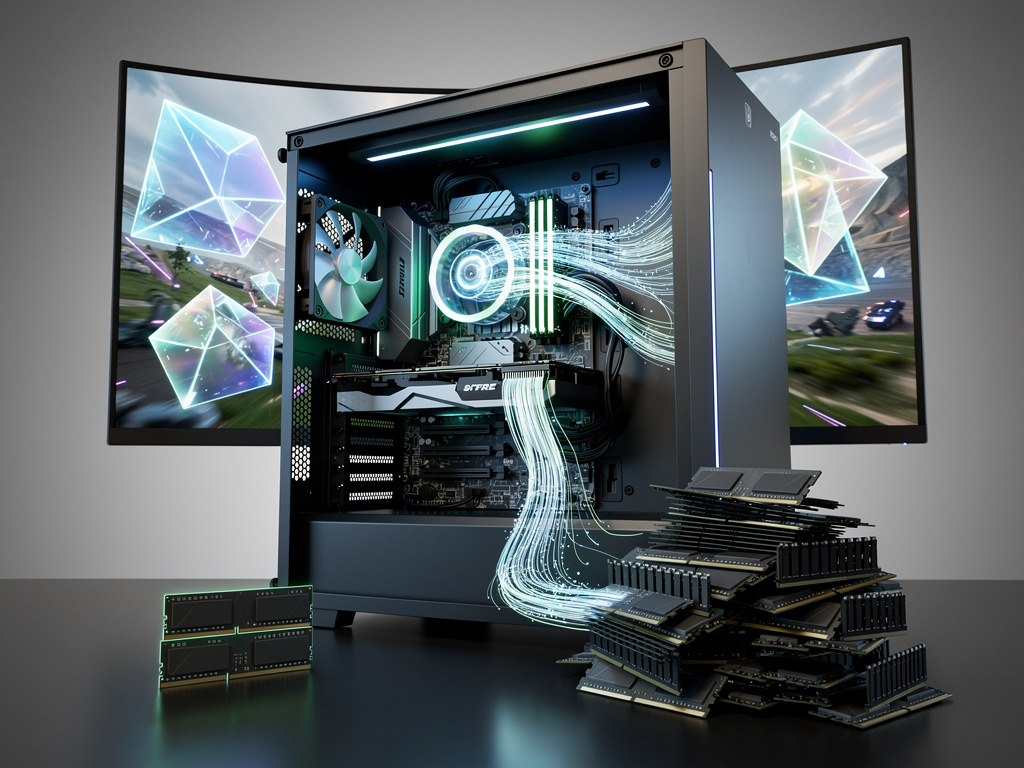
For years, the question of how much RAM a PC gamer truly needs has sparked heated debates across forums, subreddits, and tech review channels. Now, Microsoft has weighed in with a definitive recommendation that may settle the argument — at least for the foreseeable future. In a recent update to its official Copilot+ PC specifications page, the software giant has explicitly stated that 32GB of RAM is the ideal amount for gaming, calling into question the growing trend of consumers splurging on 64GB configurations in pursuit of marginal performance gains.
The recommendation, first spotted and reported by Digital Trends, represents a notable shift in how Microsoft communicates hardware guidance to consumers. Rather than simply listing minimum requirements, the company is now actively advising gamers on where to allocate their hardware budgets. The message is clear: for the vast majority of gaming workloads in 2025, 32GB of RAM delivers the performance headroom you need, and doubling that figure yields diminishing returns that most players will never notice in practice.
Microsoft’s Official Stance and What It Means for Consumers
Microsoft’s updated guidance comes at a time when RAM prices have become increasingly accessible, tempting many builders and buyers to max out their memory configurations simply because they can. A 64GB DDR5 kit that would have cost upward of $300 two years ago can now be had for significantly less, making the upgrade seem like an easy decision. But Microsoft’s recommendation suggests that the calculus isn’t as straightforward as price alone might indicate. The company’s internal testing and telemetry data, gathered from millions of Windows machines worldwide, apparently supports the notion that 32GB provides sufficient breathing room for modern AAA titles, background applications, and even light content creation tasks running alongside games.
The distinction matters because RAM that sits unused is, functionally, wasted money. While it’s true that modern games are becoming more memory-hungry — titles like Star Wars Outlaws, The Last of Us Part I, and Hogwarts Legacy can consume 16GB or more during peak gameplay — the jump from 32GB to 64GB rarely translates into measurable frame rate improvements or reduced stuttering. According to the analysis by Digital Trends, most games simply don’t scale their performance beyond the 32GB threshold, and the operating system itself doesn’t require the additional capacity for gaming-centric workloads.
The Technical Reality Behind Diminishing Returns
Understanding why 64GB doesn’t meaningfully outperform 32GB in gaming requires a brief examination of how modern games interact with system memory. Most game engines are designed to manage their memory pools efficiently, loading assets into RAM as needed and streaming them from storage when the active memory allocation is sufficient. With 32GB, there is ample space for the game itself, the operating system, background services like Discord or streaming software, and a comfortable buffer for texture streaming and asset decompression. The bottleneck in modern gaming performance almost always lies elsewhere — in the GPU, CPU single-thread performance, or storage speed — rather than in raw RAM capacity beyond 32GB.
There are, of course, legitimate use cases for 64GB or even 128GB of system memory. Professional video editors working with 4K and 8K timelines, data scientists running large models, software developers compiling massive codebases, and users running multiple virtual machines simultaneously will all benefit from higher memory configurations. Microsoft’s guidance appears carefully targeted at the gaming audience specifically, acknowledging that the needs of creative professionals and enterprise users are fundamentally different. The company is essentially telling gamers: invest your money where it will actually improve your experience, whether that’s a better graphics card, a faster SSD, or a higher-refresh-rate monitor.
How the Industry Arrived at the 32GB Standard
The evolution of RAM recommendations in gaming has followed a remarkably predictable trajectory. A decade ago, 8GB was considered the gold standard for PC gaming. By 2018, 16GB had become the consensus recommendation among hardware reviewers and system builders. Now, in 2025, the industry has collectively shifted toward 32GB as the new baseline — a transition accelerated by the demands of newer game engines, the overhead of Windows 11, and the increasing prevalence of background AI features built into the operating system through Microsoft’s Copilot integration.
This progression has historically been driven by a combination of factors: rising game complexity, increasing operating system overhead, and falling memory prices that make the next tier of capacity economically viable for mainstream consumers. What makes Microsoft’s current recommendation particularly noteworthy is its specificity. The company isn’t merely suggesting that 32GB is “enough” — it’s actively discouraging the 64GB upgrade for gaming purposes, a stance that puts it somewhat at odds with the marketing efforts of memory manufacturers who naturally benefit from consumers purchasing higher-capacity kits. Companies like Corsair, G.Skill, and Kingston have been aggressively marketing 64GB DDR5 kits to gamers, often emphasizing future-proofing as a key selling point.
The Future-Proofing Fallacy and Smart Budget Allocation
The concept of future-proofing is perhaps the most compelling argument in favor of 64GB, and it deserves serious scrutiny. Proponents argue that buying more RAM now will extend the useful life of a gaming PC, delaying the need for upgrades as games become more demanding. There is some historical validity to this reasoning — those who bought 16GB systems in 2015 when 8GB was standard did enjoy a longer period of relevance. However, the counterargument is equally compelling: by the time games routinely require more than 32GB, other components in the system — the CPU, GPU, and motherboard — will likely need upgrading as well, at which point the RAM can be replaced alongside everything else.
Moreover, the pace of DDR5 development means that the 64GB kit you buy today may be significantly outperformed by newer, faster modules available in two or three years. DDR5 speeds continue to climb, with mainstream kits now reaching 8000 MT/s and beyond, and future memory controllers in next-generation CPUs from AMD and Intel are expected to support even higher frequencies natively. Buying a modest 32GB kit at today’s best speeds and upgrading later may ultimately provide a better overall experience than locking in 64GB at speeds that will seem pedestrian by 2027 or 2028.
What Gamers Should Actually Prioritize in 2025
Microsoft’s recommendation implicitly raises a broader question about how gamers should allocate their hardware budgets. If $100 to $150 can be saved by choosing 32GB over 64GB, where should that money go instead? The answer, according to most hardware analysts and benchmarking data, is almost always the graphics card. The GPU remains the single most impactful component for gaming performance, and redirecting funds from excess RAM to a higher-tier graphics card — stepping up from an RTX 4070 to an RTX 4070 Ti Super, for example — will produce far more tangible improvements in frame rates, visual fidelity, and overall gaming experience.
Storage is another area where reallocated funds can make a meaningful difference. A high-speed NVMe SSD with DirectStorage support can dramatically reduce load times and improve texture streaming in supported titles. Similarly, investing in a quality CPU cooler to maintain boost clocks, or a better monitor to actually display the frames your hardware is producing, can yield more perceptible improvements than additional RAM sitting idle in your DIMM slots.
A Pragmatic Message in an Era of Excess
Microsoft’s decision to publish specific RAM guidance for gamers reflects a maturing approach to consumer hardware recommendations. Rather than defaulting to the “more is better” ethos that has long dominated PC enthusiast culture, the company is offering pragmatic, data-informed advice that prioritizes real-world performance over theoretical headroom. It’s a message that may not sit well with the segment of the PC gaming community that takes pride in maxed-out specifications, but it’s one grounded in empirical reality.
For the average gamer building or buying a new PC in 2025, the takeaway is straightforward: 32GB of fast DDR5 RAM is the sweet spot. It provides ample capacity for today’s most demanding titles, leaves room for multitasking and background applications, and avoids the diminishing returns that come with higher configurations. Microsoft has essentially given gamers permission to stop worrying about whether they have enough RAM and start focusing on the components that will actually make their games look and run better. In a market that often encourages overconsumption, that’s a refreshingly grounded perspective — and one that your wallet will appreciate.


 WebProNews is an iEntry Publication