
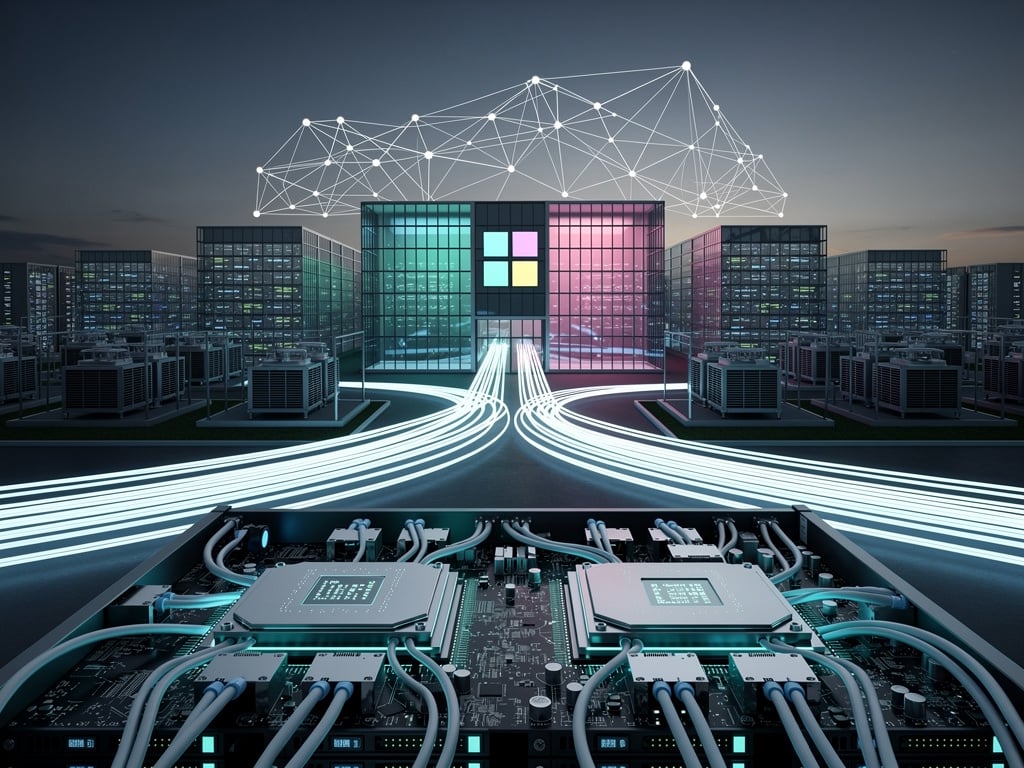
Microsoft has spent years and more than $100 billion tied closely to OpenAI. Now the software giant moves to stand apart. The shift shows in new models, custom chips and a revised partnership that gives both sides room to breathe.
At its Build conference this week in San Francisco, Microsoft plans to showcase a fresh lineup of homegrown AI systems. These include a new coding model set for release soon. The moves mark what The Information has called the company’s AI independence day. Executives want control over the stack that powers Azure and Copilot. They no longer wish to depend so heavily on one partner.
But the relationship with OpenAI endures. In April the two companies amended their deal. Microsoft stays OpenAI’s primary cloud provider. OpenAI products ship first on Azure unless Microsoft opts out. The license for OpenAI’s models and products now runs non-exclusive through 2032. Microsoft no longer pays revenue share to OpenAI. OpenAI continues to share revenue with Microsoft through 2030, though a cap applies. “While this amendment simplifies the partnership, the work we’re doing together remains ambitious,” the companies said in a joint statement on the Microsoft Blog. From gigawatts of data-center capacity to next-generation silicon and cybersecurity, collaboration continues.
The Hardware Push for Control
Dependence on Nvidia GPUs has long weighed on costs and supply. Microsoft responds with its own silicon. In January it unveiled the Maia 200 AI accelerator. Built on TSMC’s 3-nanometer process with more than 140 billion transistors, the chip targets inference for large language models. It delivers roughly 10 petaFLOPS at FP4 and 5 petaFLOPS at FP8. Memory hits 216 GB of HBM3e with 7 TB/s bandwidth.
Microsoft claims about 30% better performance per dollar than its prior Azure hardware. Against rivals, the numbers look strong. The chip offers three times the FP4 performance of Amazon’s Trainium 3. Its FP8 performance stands competitive with or ahead of Google’s TPU v7. The goal stays clear. Reduce long-term reliance on third-party chips by designing more in-house. Satya Nadella, Microsoft’s CEO, already has chips sitting in inventory, held back by power shortages that plague data-center buildouts.
These chips feed massive infrastructure plans. Microsoft eyes $140 billion in AI-related capital expenditures for its fiscal year ending in June. Data centers sprout across the U.S. and abroad. In January the company launched a “community-first” approach to siting new facilities, promising not to drive up local electricity bills, according to a TechCrunch report. Similar pledges accompany expansions in Australia, Portugal and India.
Power constraints bite everywhere. Executives scramble for sites with enough electricity. Some projects face delays. Yet the spend continues. Analysts watch whether returns justify the outlay. So far investors give Microsoft the benefit of the doubt. Its stock has climbed on news of the new models and independence signals.
Talent Hunt and Startup Deals
Models matter as much as metal. Microsoft wants its own frontier systems ready by next year. To get there it shops for startups. In May Reuters reported the company talks with several AI firms to gain talent and technology. Discussions include Inception, a small outfit founded by a Stanford team in mid-2024. The startup explores diffusion methods for large language models, an alternative to the transformer approach that dominates today. Microsoft’s venture arm M12 backed Inception’s seed round late last year.
Earlier Microsoft considered buying Cursor, a code-generation tool. It walked away over regulatory worries tied to GitHub Copilot. SpaceX later struck a deal with Cursor. The talent market burns hot. Top researchers command tens of millions in compensation. Competition comes from Elon Musk’s xAI and others. Five people familiar with the talks told Reuters that Microsoft prepares for a future less dependent on OpenAI. Three said the acquisitions could speed delivery of a competitive foundation model.
Mustafa Suleyman, head of Microsoft’s AI group, has spoken openly about targeting self-sufficiency after the October 2025 partnership revision and the April update. In-house models for speech, voice and images already launched earlier this year. They challenge offerings from OpenAI and Google alike, reported EMarketer.
The strategy carries risks. Building frontier models from scratch demands enormous compute and data. Microsoft already invested heavily in OpenAI. Court testimony from Michael Wetter put the figure above $100 billion. Tensions have surfaced before over contracts and competition. The amended deals in late 2025 and April 2026 eased some frictions. Microsoft gained permission to build competing models. OpenAI won flexibility to work across clouds.
Still, the partnership holds strategic value. OpenAI benefits from Azure scale and Microsoft’s distribution. Microsoft keeps access to top models through 2032 and shares in OpenAI’s growth as a major shareholder. Neither side wants a clean break. They simply refuse to bet everything on one another.
Developers at Build will see the results. New coding tools promise to boost productivity inside GitHub and Visual Studio. Speech and image models expand Copilot’s reach. The message to customers is control. Enterprises can run Microsoft’s models on Azure without licensing worries from a single upstream provider.
Yet questions linger. Can homegrown models match GPT-level performance? Will custom chips deliver enough efficiency to offset the billions poured into data centers? Power availability remains the binding constraint. Some analysts warn the entire industry faces an economics test. Hundreds of billions flow into infrastructure. Returns must follow.
Microsoft bets they will. Its Azure growth stays strong. Copilot adoption climbs inside Fortune 500 companies. The company positions itself as the reliable infrastructure layer for the AI age, less a pure reseller of OpenAI technology and more an independent player with options.
And the independence push doesn’t stop at models and chips. Recent reports show talks for additional infrastructure deals, including a large pact with IREN for AI cloud capacity. Community relations matter too. Brad Smith, Microsoft’s vice chair, outlined a five-point plan in January to partner with U.S. localities as data centers multiply.
The coming months will test execution. Build offers the first public look at the new stack. Investors and customers will judge whether Microsoft’s bet on self-reliance pays off or whether the OpenAI alliance, even loosened, remains the smarter path. For now the company pursues both. It keeps the partnership. It builds its own future. The balance defines the next chapter in enterprise AI.


 WebProNews is an iEntry Publication