
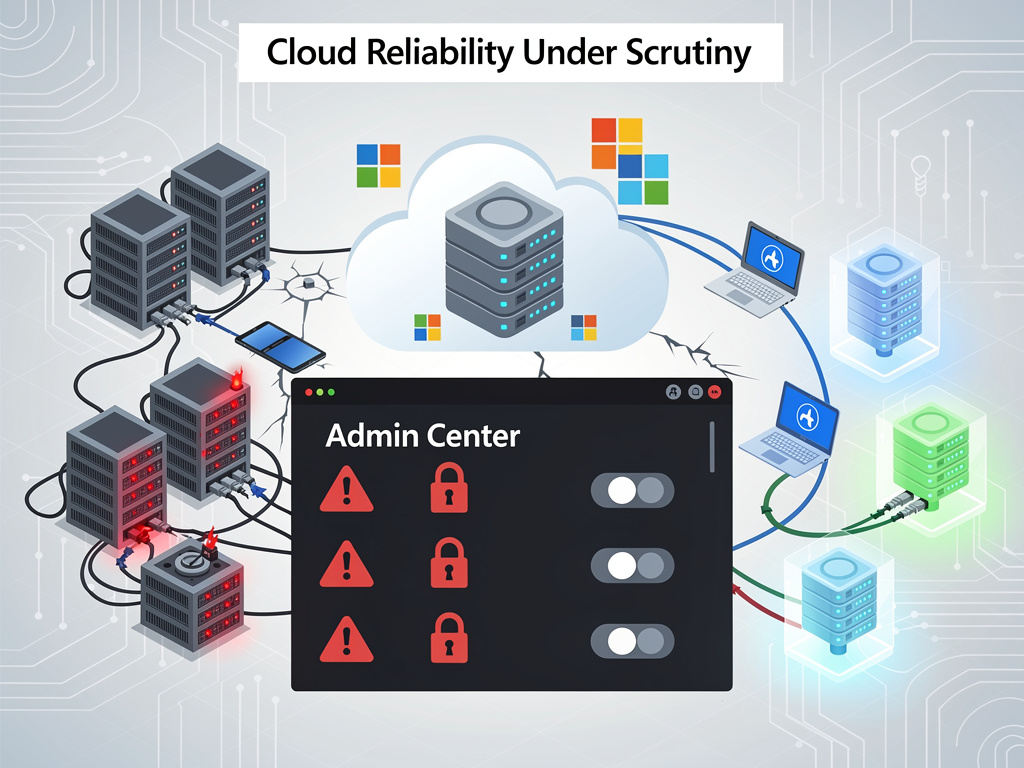
For several tense hours on a February morning in 2026, IT administrators across the globe found themselves locked out of one of the most critical dashboards in enterprise technology. The Microsoft 365 admin center — the nerve center through which organizations manage users, licenses, security policies, and service health — went down, leaving thousands of technology professionals unable to perform routine and urgent administrative tasks alike.
The outage, which Microsoft acknowledged and tracked under incident identifier MO1012599, served as yet another stark reminder of the fragility that underpins even the most robust cloud infrastructure. For industry insiders who have watched Microsoft’s cloud reliability record with increasing scrutiny over the past two years, the incident raised familiar and uncomfortable questions about redundancy, communication, and the hidden risks of centralized cloud administration.
What Happened: A Timeline of the Disruption
According to reporting by TechRepublic, the outage began during business hours and affected access to the Microsoft 365 admin center, the web-based portal that serves as the primary management interface for organizations running Microsoft 365 services. Administrators reported being unable to log in to the portal, encountering error messages, or experiencing severely degraded performance that rendered the console effectively unusable.
Microsoft confirmed the issue through its official service health channels and via posts on social media, attributing the disruption to an infrastructure problem that the company’s engineering teams were actively investigating. The incident was assigned tracking ID MO1012599, and Microsoft provided periodic status updates as its teams worked to identify the root cause and restore full functionality. While core Microsoft 365 productivity services such as Outlook, Teams, and SharePoint appeared to remain operational for end users during the event, the inability to access the admin center meant that IT departments were unable to manage those services — a distinction that matters enormously in enterprise environments.
The Real-World Impact on Enterprise IT Operations
To understand why an admin center outage is so consequential, one must appreciate the breadth of functions that flow through this single portal. The Microsoft 365 admin center is where IT teams add and remove users, assign and revoke licenses, configure security and compliance policies, manage multi-factor authentication settings, review service health advisories, and respond to security incidents. When the admin center goes offline, none of these tasks can be performed through the standard graphical interface.
For large enterprises with thousands of employees, even a few hours without admin access can cascade into significant operational disruptions. New employee onboarding stalls because accounts cannot be provisioned. Departing employees retain access to sensitive systems because their credentials cannot be revoked. Security teams cannot adjust conditional access policies in response to emerging threats. Help desk tickets pile up with no resolution path. As TechRepublic noted, the outage left IT administrators essentially flying blind, unable to see or manage the health and configuration of their organization’s cloud environment.
PowerShell and API Workarounds: A Partial Safety Net
Experienced administrators familiar with Microsoft’s PowerShell modules and Graph API were in a somewhat better position during the outage. Many routine admin center tasks — such as user management, license assignment, and policy configuration — can also be performed via command-line tools and programmatic interfaces that do not depend on the web portal’s front-end infrastructure. During the February incident, some IT professionals reported on X (formerly Twitter) that PowerShell cmdlets and Microsoft Graph API calls continued to function even while the admin center portal was inaccessible.
However, this workaround is far from universal. Many organizations, particularly small and mid-sized businesses, rely exclusively on the graphical admin center for management tasks. Their IT staff may lack the scripting expertise or pre-configured automation to pivot seamlessly to command-line alternatives during an emergency. This gap highlights a broader vulnerability in the Microsoft 365 ecosystem: the admin center’s web interface is a single point of failure for a vast number of organizations that have not invested in alternative management pathways.
A Pattern of Cloud Reliability Concerns
The February 2026 outage did not occur in isolation. Microsoft’s cloud services have experienced a series of high-profile disruptions over the past several years that have eroded confidence among enterprise customers and industry analysts. In July 2024, a faulty CrowdStrike update caused widespread Windows system crashes that, while not directly a Microsoft cloud outage, exposed the interconnected fragility of the Windows ecosystem. In late 2024 and into 2025, Microsoft 365 services experienced multiple outages affecting Teams, Outlook, and Exchange Online, each prompting renewed debate about the resilience of hyperscale cloud platforms.
Microsoft has publicly committed to improving the reliability of its cloud infrastructure, investing billions in data center expansion and redundancy. The company has also enhanced its service health communication tools, providing more granular and timely incident updates through the admin center itself — an irony not lost on administrators who could not access those updates during the February outage. Industry observers have noted that while Microsoft’s transparency around incidents has improved, the frequency and scope of disruptions remain a concern for organizations that have migrated mission-critical workflows entirely to the cloud.
The Communication Gap During Downtime
One of the most persistent criticisms leveled at Microsoft during cloud outages is the challenge of communicating service health information when the primary communication channel — the admin center’s service health dashboard — is itself affected. During the February 2026 incident, administrators who could not access the admin center were forced to rely on Microsoft’s status page, social media posts on X, and third-party monitoring services like Downdetector to piece together the scope and status of the outage.
This communication gap is not a new problem, but it remains an unsolved one. Microsoft has taken steps to diversify its incident communication channels, including email notifications, the Microsoft 365 Service Health Status page, and integration with third-party IT service management platforms. Yet when the admin center itself is the affected service, the irony of needing to check the admin center to learn that the admin center is down continues to frustrate IT professionals. Several administrators posted on X during the February incident expressing exasperation at the circular nature of Microsoft’s service health reporting during portal outages.
Lessons for IT Leaders and Cloud Strategy
For CIOs, IT directors, and cloud architects, the February 2026 outage reinforces several strategic imperatives. First, organizations should invest in PowerShell and Graph API competency within their IT teams, ensuring that critical administrative functions can be performed even when the web portal is unavailable. Scripted automation for common tasks — user provisioning, license management, security policy enforcement — should be developed, tested, and maintained as part of a broader operational resilience plan.
Second, organizations should establish out-of-band communication and monitoring capabilities that do not depend on Microsoft’s own infrastructure. Third-party monitoring tools, independent status pages, and pre-established communication protocols for cloud outages can significantly reduce the confusion and downtime that accompany admin center disruptions. Third, enterprises should revisit their cloud risk assessments to account for the possibility that management plane outages — as distinct from data plane outages — can paralyze IT operations even when end-user services remain nominally functional.
Microsoft’s Path Forward Under Scrutiny
Microsoft has not yet published a detailed post-incident review of the February 2026 admin center outage, though the company has historically released root cause analyses for major incidents within weeks of resolution. Industry insiders will be watching closely for details on what specifically failed, whether the root cause was related to a code deployment, infrastructure failure, or configuration change, and what architectural improvements Microsoft plans to implement to prevent recurrence.
The broader question for the industry is whether the current model of centralized cloud administration — in which a single web portal serves as the management gateway for tens of millions of users worldwide — is architecturally sound for the scale at which Microsoft 365 now operates. With more than 400 million paid seats globally, the blast radius of any admin center outage is enormous. As organizations continue to deepen their dependence on Microsoft’s cloud ecosystem, the expectation for near-perfect reliability in both the data plane and the management plane will only intensify.
For now, IT administrators who lived through the February 2026 outage are doing what they always do after a cloud disruption: updating their runbooks, testing their PowerShell scripts, and hoping the next incident doesn’t arrive before they’ve finished.


 WebProNews is an iEntry Publication