
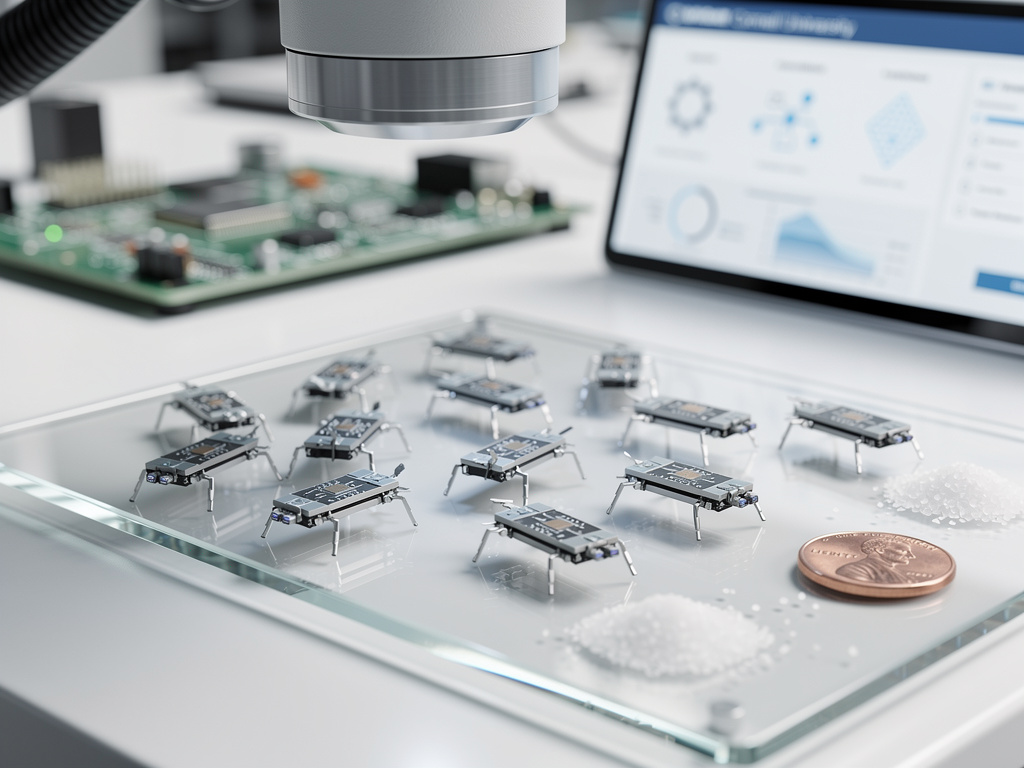
In a breakthrough that pushes the boundaries of robotics and nanotechnology, researchers have successfully created programmable autonomous robots measuring less than one millimeter in diameter—smaller than a grain of salt. These microscopic machines, developed by a team at Cornell University, represent a significant leap forward in the field of microrobotics, with potential applications ranging from targeted drug delivery to environmental monitoring and industrial manufacturing at unprecedented scales.
The achievement, reported by Slashdot, marks a pivotal moment in the evolution of robotics technology. Unlike previous microscale devices that required external control or tethered power sources, these new robots can operate autonomously, making decisions and navigating their environment without constant human intervention. The development addresses one of the most persistent challenges in microrobotics: creating devices that are simultaneously small enough to perform delicate tasks at the cellular level while sophisticated enough to operate independently.
The Cornell team’s innovation lies in their novel approach to integrating multiple functional components—sensors, actuators, computing elements, and power systems—into a single device no larger than a paramecium. This integration required reimagining traditional robotics architecture and developing new fabrication techniques that could work at such diminutive scales. The researchers utilized advanced semiconductor manufacturing processes, similar to those used in computer chip production, to create these intricate mechanical systems.
Engineering Challenges at the Microscale
Creating autonomous functionality in such a constrained space presented formidable engineering obstacles. Traditional robotic components simply cannot be miniaturized beyond certain physical limits while maintaining their functionality. Motors, batteries, and circuit boards that power conventional robots would dwarf these microscopic machines. The Cornell researchers had to develop entirely new approaches to locomotion, power generation, and information processing.
The solution involved leveraging principles from multiple scientific disciplines. For locomotion, the team incorporated photoresponsive materials that change shape when exposed to specific wavelengths of light, allowing the robots to move in response to optical signals. This eliminates the need for traditional motors and mechanical actuators. Power is derived from the robot’s environment through a combination of photovoltaic cells and chemical energy harvesting, removing the requirement for bulky batteries.
Perhaps most impressively, the robots incorporate rudimentary computing capabilities through analog circuits etched directly into their silicon bodies. These circuits enable the devices to process sensory information and make basic decisions about movement and task execution. While far less sophisticated than digital computers, these analog systems provide sufficient intelligence for the robots to navigate obstacles, respond to environmental cues, and perform predetermined tasks without external guidance.
Fabrication Breakthroughs Enable Mass Production
One of the most significant aspects of this development is the scalability of the manufacturing process. The researchers adapted techniques from the semiconductor industry, allowing them to produce thousands of these microrobots simultaneously on a single silicon wafer. This approach not only makes the technology economically viable but also opens possibilities for deploying swarms of these devices to work collaboratively on complex tasks.
The fabrication process begins with a standard silicon wafer, similar to those used in computer chip manufacturing. Using photolithography and other microfabrication techniques, the researchers pattern multiple layers of functional materials onto the wafer. These layers include the structural components that give the robot its shape, the photoresponsive materials that enable movement, the photovoltaic elements that generate power, and the circuit elements that provide computational capability. Once all layers are deposited and patterned, the individual robots are released from the wafer through a chemical etching process.
This manufacturing approach offers several advantages beyond mere scalability. The precision of semiconductor fabrication techniques ensures consistency across thousands of devices, with each robot possessing nearly identical capabilities and dimensions. This uniformity is crucial for applications requiring coordinated action among multiple robots. Additionally, the established infrastructure of the semiconductor industry means that production could potentially be ramped up rapidly if commercial applications emerge.
Medical Applications Promise Revolutionary Treatments
The medical field stands to benefit enormously from this technology. Microrobots of this size could navigate through the human bloodstream, delivering medications directly to diseased cells while leaving healthy tissue unaffected. This targeted approach could dramatically reduce the side effects associated with many current treatments, particularly in cancer therapy where chemotherapy drugs often damage healthy cells along with cancerous ones.
Beyond drug delivery, these microscopic machines could serve as mobile diagnostic tools, traveling through the body to detect early signs of disease. Equipped with appropriate sensors, they could identify chemical markers associated with cancer, infection, or other pathologies, potentially enabling diagnosis at much earlier stages than currently possible. The robots could also perform minimally invasive procedures, such as clearing arterial blockages or removing small tumors, all while being guided by external imaging systems.
Researchers envision deploying swarms of these microrobots to work collaboratively on complex medical tasks. Multiple robots could coordinate their actions to perform tissue repair, with some devices delivering growth factors while others provide structural scaffolding for new cell growth. This swarm approach could accelerate healing and enable treatments that are currently impossible with conventional medical technology.
Environmental Monitoring and Industrial Applications
Outside of medicine, these autonomous microrobots could revolutionize environmental monitoring and remediation. Deployed in water systems, they could detect pollutants at extremely low concentrations, providing early warning of contamination events. Their small size allows them to penetrate soil and sediment, monitoring conditions in places that are difficult or impossible to reach with conventional sensors.
In industrial settings, these robots could inspect manufacturing equipment from the inside, identifying wear and defects before they lead to failures. They could navigate through pipes, valves, and other components too small for human inspection or conventional robotic systems. In the electronics industry, swarms of microrobots could potentially assist in the assembly of next-generation devices, manipulating components at scales where human hands and even precision machinery struggle to operate effectively.
The agricultural sector could deploy these devices for precision farming applications, with robots monitoring soil conditions, detecting plant diseases at the cellular level, and even delivering nutrients or pesticides to individual plants. This precision could reduce chemical usage while improving crop yields, addressing both environmental and food security concerns.
Technical Limitations and Future Development
Despite their impressive capabilities, these first-generation microrobots face significant limitations. Their computational power, while remarkable for their size, remains extremely limited compared to even simple conventional computers. This restricts the complexity of tasks they can perform autonomously. The robots’ reliance on light for both power and control also constrains their operating environments, making them unsuitable for applications in dark or optically opaque settings without additional modifications.
Communication between robots and with external control systems presents another challenge. At such small scales, traditional wireless communication technologies become impractical. The Cornell team is exploring alternative approaches, including chemical signaling inspired by biological systems and acoustic communication methods. Developing robust communication protocols will be essential for coordinating swarms of these devices and retrieving data they collect.
Longevity and reliability also require further development. The robots’ tiny components are susceptible to damage from environmental factors, and their operational lifetime remains limited. For medical applications in particular, ensuring biocompatibility and developing methods for retrieving or safely disposing of the devices after they complete their tasks will be crucial before clinical deployment becomes feasible.
Regulatory and Ethical Considerations
As with any transformative technology, the development of autonomous microrobots raises important regulatory and ethical questions. For medical applications, these devices will need to undergo rigorous safety testing and gain approval from regulatory bodies like the FDA. The novelty of the technology means that existing regulatory frameworks may need adaptation to adequately assess the risks and benefits of these microscopic autonomous systems.
Privacy and security concerns also emerge, particularly as these robots gain more sophisticated sensing and communication capabilities. In environmental or industrial applications, ensuring that the devices cannot be repurposed for surveillance or other unintended uses will require careful consideration. The potential for these technologies to be weaponized, though the robots are currently far too simple for such applications, will likely draw attention from defense and security agencies.
The broader societal implications of autonomous systems operating at scales invisible to the human eye merit thoughtful discussion. As these technologies mature, establishing clear guidelines for their deployment, monitoring, and control will be essential to ensure they serve beneficial purposes while minimizing potential risks. The scientific community, policymakers, and the public will need to engage in ongoing dialogue about appropriate uses and necessary safeguards.
The Road Ahead for Microrobotics
The Cornell team’s breakthrough represents just the beginning of what promises to be a rapidly evolving field. Researchers worldwide are now likely to accelerate their own microrobotics programs, building on these foundational achievements. We can expect to see rapid improvements in the capabilities of these devices, with enhanced computational power, more sophisticated sensors, and improved autonomy emerging in the coming years.
Integration with other cutting-edge technologies could amplify the impact of microrobotics. Combining these devices with artificial intelligence and machine learning could enable them to adapt to complex, changing environments and learn from experience. Advances in materials science may yield new functional materials that expand the range of tasks these robots can perform. Biotechnology integration could create hybrid systems that blur the line between engineered devices and biological organisms, opening entirely new application domains.
The economic implications of scalable microrobotics technology are substantial. Industries from healthcare to manufacturing to environmental services could see fundamental transformations in how they operate. New companies focused on microrobotics applications are likely to emerge, while established corporations will need to consider how these technologies might disrupt their existing business models. Investment in the sector is expected to accelerate as the technology moves from laboratory demonstrations to practical applications.
As these microscopic autonomous robots transition from scientific curiosity to practical tools, they exemplify how advances in multiple disciplines—materials science, semiconductor engineering, robotics, and computer science—can converge to create capabilities that seemed like science fiction just years ago. While significant technical challenges remain before these devices become commonplace, the foundation has been laid for a future where swarms of invisible robots work quietly in the background, monitoring our health, protecting our environment, and enabling manufacturing processes at scales previously unimaginable. The grain of salt, once simply a metaphor for something tiny and insignificant, may soon represent one of the most powerful technological tools humanity has ever created.


 WebProNews is an iEntry Publication