
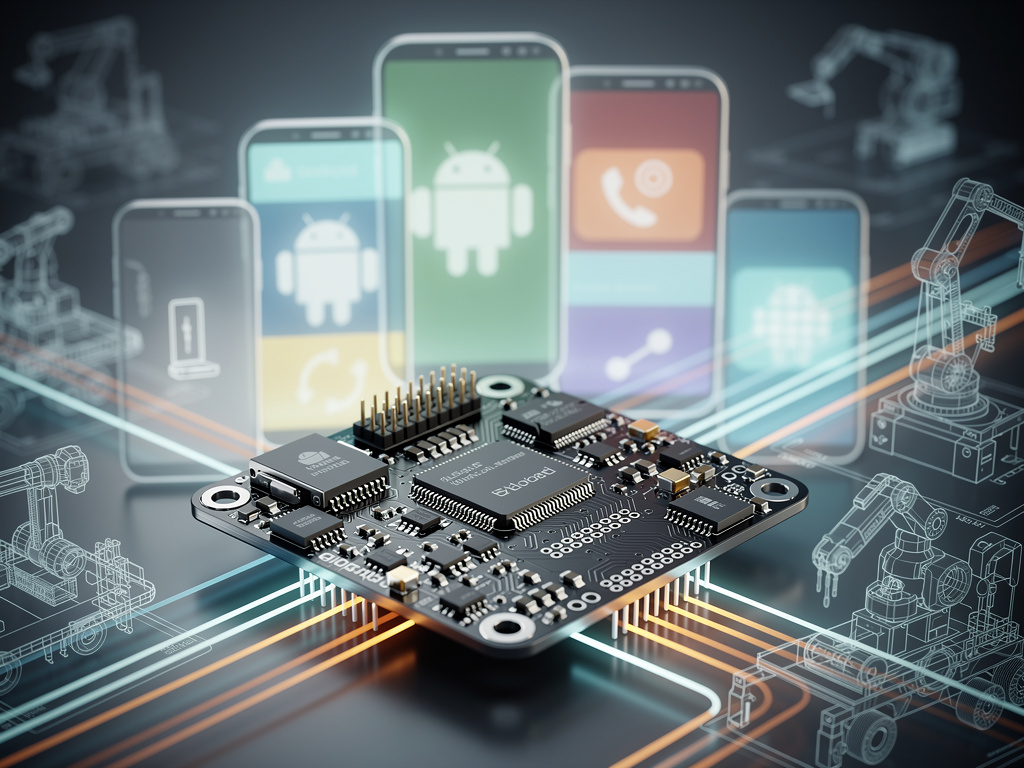
The embedded systems world is witnessing a paradigm shift as developers introduce graphical operating systems to hardware previously confined to command-line interfaces and basic displays. MicroPythonOS, a new graphical operating system built on the MicroPython framework, is bringing Android-like user experiences to microcontrollers, fundamentally altering how engineers approach embedded application development and potentially democratizing access to sophisticated embedded interfaces.
According to CNX Software, MicroPythonOS represents a significant departure from traditional microcontroller programming by providing a complete graphical environment that mimics smartphone operating systems. The platform includes a home screen, application launcher, settings menu, and multi-tasking capabilities—features typically associated with far more powerful hardware. This development arrives at a critical juncture when the Internet of Things market continues expanding and developers seek more intuitive ways to create user-facing embedded applications.
The system’s architecture leverages MicroPython’s efficiency while adding a comprehensive graphical layer that handles window management, touch input processing, and application lifecycle management. Unlike traditional embedded GUI frameworks that require extensive low-level programming, MicroPythonOS abstracts much of this complexity, allowing developers to focus on application logic rather than display driver intricacies. The framework supports multiple concurrent applications, background processes, and even notification systems—capabilities that push the boundaries of what developers expect from resource-constrained microcontrollers.
Technical Architecture Enables Desktop-Class Features on Minimal Hardware
The technical implementation of MicroPythonOS demonstrates remarkable engineering efficiency. The system runs on microcontrollers with as little as 512KB of RAM and 4MB of flash storage, hardware specifications that would have seemed impossibly limited for graphical operating systems just a few years ago. The developers achieved this through aggressive optimization of the MicroPython interpreter, careful memory management, and a modular architecture that loads only necessary components into RAM at any given time.
The rendering engine employs a framebuffer-based approach with hardware acceleration support for compatible display controllers. This allows the system to maintain smooth animations and transitions even on relatively modest ARM Cortex-M series processors. The touch input system includes gesture recognition, multi-touch support on compatible hardware, and an event-driven architecture that efficiently manages user interactions without consuming excessive processor cycles during idle periods.
Application Development Model Mirrors Modern Mobile Platforms
MicroPythonOS introduces an application development model that will feel familiar to mobile developers while remaining accessible to embedded systems engineers. Applications are packaged as self-contained modules with manifest files describing permissions, resource requirements, and system integration points. This approach enables a level of modularity and code reuse previously difficult to achieve in embedded development, where applications were typically monolithic firmware images.
The platform includes a comprehensive API that exposes system services including file management, network connectivity, sensor integration, and inter-application communication. Developers can create applications using standard Python syntax and libraries, dramatically reducing the learning curve compared to traditional embedded C programming. The system also supports a plugin architecture, allowing third-party developers to extend core functionality without modifying the operating system itself.
Hardware Support Spans Popular Development Boards and Production Platforms
Initial hardware support for MicroPythonOS targets widely-used development platforms including ESP32-based boards, STM32 microcontrollers with sufficient memory, and Raspberry Pi Pico variants. The system requires displays with at least 320×240 pixel resolution, though it scales effectively to larger screens including 480×320 and 800×480 configurations commonly found in industrial applications. Touch input is supported through resistive and capacitive touchscreens, with the system automatically detecting and configuring appropriate drivers.
The hardware abstraction layer design means porting to new platforms primarily involves implementing board-specific drivers for display, touch, and storage interfaces. This modular approach has already enabled community members to create ports for less common hardware configurations, expanding the ecosystem beyond the officially supported platforms. The system’s flexibility extends to display orientation, pixel density handling, and even support for multiple display configurations on single-board computers with sufficient processing power.
Performance Benchmarks Reveal Surprising Capabilities and Limitations
Performance testing reveals both the impressive capabilities and inherent constraints of running a graphical operating system on microcontroller hardware. On an ESP32-S3 running at 240MHz with 8MB of PSRAM, the system achieves application launch times under 500 milliseconds and maintains 30 frames per second during UI animations. Memory profiling shows the base system consuming approximately 180KB of RAM, leaving substantial headroom for applications on boards with 512KB or more of available memory.
However, the system does exhibit limitations when handling computationally intensive tasks or rapid screen updates. Video playback capabilities are restricted to low-resolution, low-framerate content, and complex graphics rendering can cause noticeable lag on lower-end hardware. These constraints are inherent to the hardware platform rather than software inefficiency, and the developers have implemented intelligent throttling and priority systems to maintain UI responsiveness even under heavy application load.
Real-World Applications Demonstrate Practical Viability
Early adopters have deployed MicroPythonOS in various practical applications that showcase its versatility. Industrial control panels benefit from the intuitive interface, allowing operators to interact with machinery through familiar touch gestures rather than physical buttons or cryptic command sequences. Home automation projects leverage the multi-application architecture to create unified control interfaces that manage lighting, climate, and security systems from a single device.
Educational institutions have shown particular interest in the platform as a teaching tool. The combination of Python programming, graphical interface development, and embedded systems concepts provides a comprehensive learning environment. Students can progress from simple applications to complex multi-threaded programs while working with actual hardware, bridging the gap between software development and physical computing in ways that traditional embedded education often struggles to achieve.
Security Considerations and System Integrity Mechanisms
The MicroPythonOS developers have implemented several security features despite the resource constraints of the target hardware. Application sandboxing prevents individual programs from accessing system memory or interfering with other applications, though the implementation is necessarily lighter than what desktop operating systems provide. A permission system controls access to sensitive resources including network interfaces, file system areas, and hardware peripherals.
The system includes cryptographic signature verification for application packages, allowing developers to ensure only authorized code executes on their devices. This feature proves particularly valuable in commercial deployments where device integrity and security are paramount. However, the limited processing power available means complex encryption operations can impact system performance, requiring developers to balance security requirements against responsiveness needs.
Development Ecosystem and Community Growth
The project has cultivated an active development community contributing applications, hardware ports, and system enhancements. An online repository hosts dozens of applications ranging from system utilities to games, demonstrating the platform’s flexibility. The documentation includes comprehensive API references, hardware integration guides, and tutorials that lower barriers to entry for developers new to either embedded systems or Python programming.
Development tools include an emulator that runs on desktop computers, allowing developers to test applications without hardware and accelerating the development cycle. The emulator accurately reproduces the memory constraints and performance characteristics of target hardware, helping developers identify optimization opportunities before deployment. Integration with popular code editors through language server protocols provides code completion, error checking, and debugging capabilities that rival mainstream development environments.
Market Implications for Embedded Systems Industry
MicroPythonOS arrives as the embedded systems industry grapples with increasing complexity and user experience expectations. Traditional embedded development required specialized knowledge and significant time investment to create even basic graphical interfaces. By providing a complete, ready-to-use graphical environment, the platform could accelerate product development cycles and enable smaller teams to create sophisticated embedded applications.
The system’s open-source nature and permissive licensing make it viable for both hobbyist projects and commercial products. Several companies have already begun evaluating the platform for production devices, attracted by the reduced development costs and faster time-to-market compared to building custom interfaces from scratch. The ability to update applications over-the-air without replacing entire firmware images provides operational flexibility particularly valuable in deployed IoT devices.
Future Development Roadmap and Technical Challenges
The development team has outlined an ambitious roadmap including enhanced graphics capabilities, improved power management for battery-operated devices, and expanded hardware support. Planned features include a visual application builder that would allow non-programmers to create basic applications through drag-and-drop interfaces, potentially opening embedded development to an even broader audience. Network service integration aims to enable cloud connectivity, remote management, and data synchronization capabilities.
Technical challenges remain, particularly around optimizing performance on the lower end of supported hardware and managing the growing codebase complexity. The team continues refining the memory management system to support larger applications while maintaining system stability. Balancing feature additions against the core principle of running on resource-constrained hardware requires careful architectural decisions and sometimes difficult tradeoffs between capability and efficiency. As the platform matures and the community grows, MicroPythonOS represents a compelling vision for the future of embedded systems development—one where creating sophisticated, user-friendly interfaces becomes accessible to developers regardless of their embedded systems expertise.


 WebProNews is an iEntry Publication