
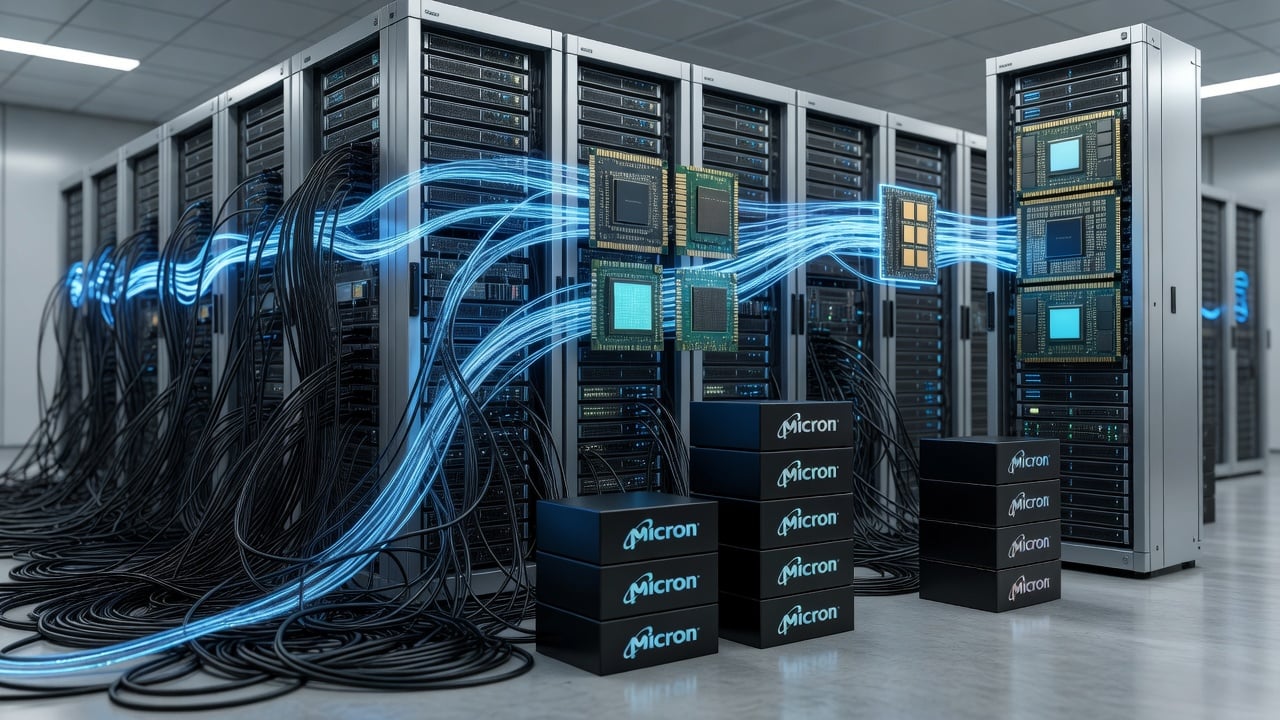
Sanjay Mehrotra delivered a blunt message to investors and customers alike. Supply shortages in memory and storage products will take considerable time to ease. Even with gradual industry improvements expected in 2028, no clear view exists on when production will match surging demand.
The CEO of Micron Technology made those remarks during the company’s recent earnings call. They landed with force. Shares of the Boise, Idaho-based chipmaker had already rocketed higher on blowout quarterly results. Revenue hit $41.46 billion in the latest period. That marked more than a fourfold jump from a year earlier. Adjusted profit soared past Wall Street forecasts. Yet Mehrotra’s caution about persistent tightness served as both validation and warning.
AI data centers sit at the heart of this imbalance. High-bandwidth memory, or HBM, has become the critical component inside advanced accelerators from Nvidia and others. Micron stands as one of only three suppliers capable of producing it at scale, alongside SK Hynix and Samsung. The company has sold out its entire 2026 HBM output under long-term agreements. It can meet only 50% to two-thirds of what key customers request in the medium term. The Motley Fool reported Mehrotra’s exact words: “Our customers are recognizing that supply shortages in memory and storage will take considerable time to improve, even as we expect industry supply to improve gradually in 2028.”
Those contracts now total $22 billion in commitments. They lock in pricing and volume for hyperscalers, enterprises, and other buyers. Such deals shield Micron from the brutal cyclical swings that once defined the memory business. But they also signal how desperate buyers have grown. Prices for conventional DRAM and NAND have doubled in some segments. Gross margins hover near 85% in HBM. Goldman Sachs analysts project compression by 2028 as new capacity from all three suppliers finally arrives. 24/7 Wall St. outlined the bull case for triple-digit percentage gains if demand holds.
Mehrotra described AI as still in its “first innings.” He pointed to recent demonstrations at Nvidia’s GTC conference. Inference workloads are expanding rapidly. They require faster memory, more tokens, and larger models. Each leap in capability pulls more DRAM and HBM into servers. Data-center bit demand is forecast to more than double in 2026. Server shipments should grow in the high teens. AI-accelerated servers will climb faster still.
But the story does not stop at the data center. Mehrotra highlighted humanoid robotics as a potential multi-decade catalyst. Each robot could need roughly 10 times the memory of a Level 2+ autonomous vehicle. That demand wave may arrive before 2030. On-device AI in consumer electronics adds another layer. Device refresh cycles pent up for years could accelerate as Apple, Samsung, and others embed more intelligence. X users and analysts have amplified these comments in recent days, with one post noting robotics could create outsized memory needs that few models fully price in.
Micron’s response has been aggressive. The company raised capital expenditure plans. Fourth-quarter capex guidance sits around $10 billion. Full-year 2026 spending could approach $20 billion or more. New fabs in Idaho will begin producing leading-edge DRAM and HBM wafers in mid-2027, with meaningful output delayed until 2028 after qualification. HBM4 is ramping twice as fast as the prior generation. Over $1 billion in HBM4 revenue has already shipped. Next-generation 1γ DRAM and G9 NAND nodes are on track to become the company’s highest-volume technologies ever.
Yet manufacturing complexity has risen sharply. Stacking memory dies for HBM consumes far more capacity per unit than traditional products. The trade-off ratio with DDR5 reaches three-to-one or higher in future generations. That dynamic squeezes overall industry supply even as AI pulls harder. Wccftech captured Mehrotra’s view that memory has become a strategic asset. More of it, and faster, is required for AI systems to deliver full performance.
Wall Street has taken notice. Micron’s market value crossed $1 trillion earlier this year. The stock has climbed more than 700% in the past 18 months. UBS analyst Timothy Arcuri lifted his price target dramatically. Goldman Sachs set a $400 target but flagged margin pressure ahead. Analysts broadly expect memory demand to outpace supply for at least the next two years. Recent Reuters coverage noted Micron’s Q3 profit growth topping 1,000% and revenue nearly tripling year-over-year. Reuters detailed the $22 billion in customer commitments and guidance that beat estimates.
The Wall Street Journal reported revenue of $41.46 billion against expectations of roughly $35.9 billion. Profit reached $28.24 billion. Shares jumped in after-hours trading. Executives told investors they see the crunch extending past 2027. Long-term agreements with “very large customers” aim to preserve today’s elevated pricing.
Risks remain. A sudden slowdown in AI spending by big tech could shift the balance. New supply from competitors might arrive sooner than expected. Geopolitical tensions around Taiwan and South Korea add uncertainty to the global chip supply chain. Micron’s heavy bet on U.S. fabrication offers some insulation but requires massive investment. And memory has historically been a brutally competitive field once capacity catches up.
Still, current signals point to sustained strength. Strategic supply deals with Anthropic and others underscore confidence. HBM cannot fill current orders. Conventional DRAM and NAND markets stay tight. Robotics and edge AI represent upside that few forecasts capture fully. Mehrotra’s message was clear. The transformation of the memory industry by AI is structural. Customers get it. Suppliers are racing to respond. The shortages, for now, are here to stay. And that reality continues to reshape valuations, capital plans, and competitive dynamics across the semiconductor sector.


 WebProNews is an iEntry Publication