
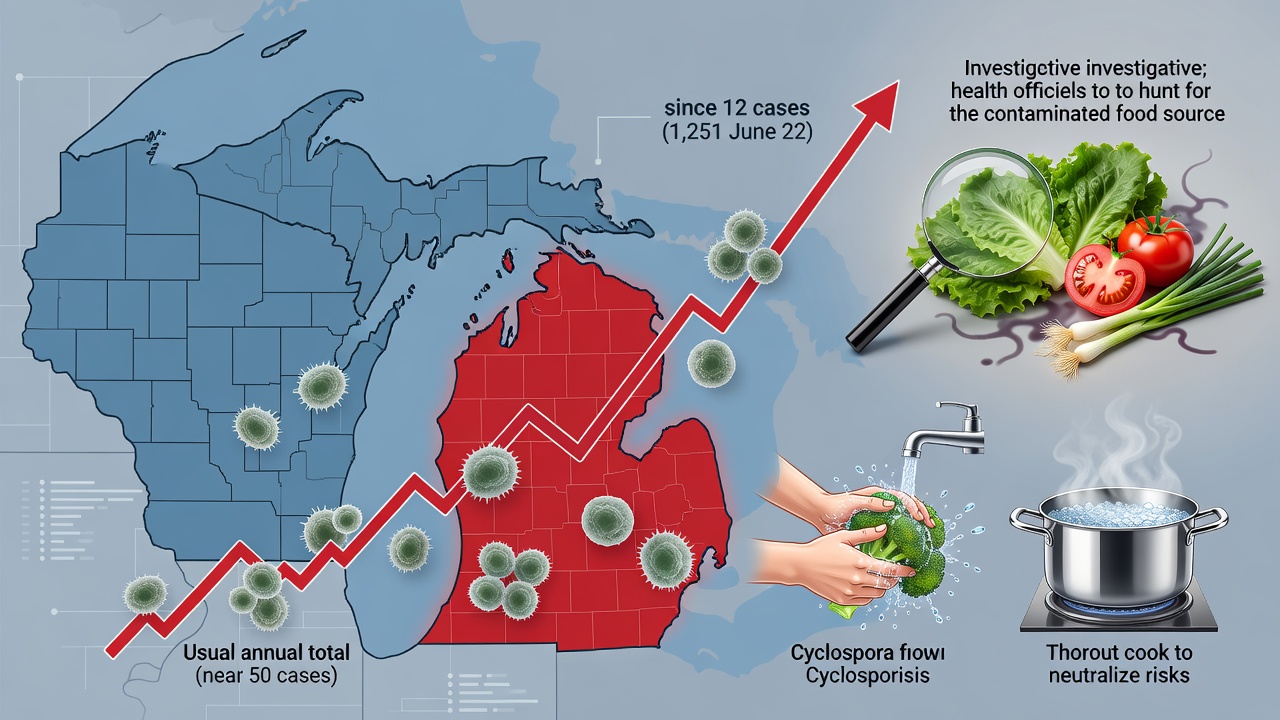
Michigan health officials are scrambling. A parasitic infection rarely seen at scale has surged to 1,251 confirmed cases since late June. The culprit? Cyclospora cayetanensis. This microscopic protozoan triggers prolonged bouts of watery diarrhea that can leave patients dehydrated and exhausted for weeks.
Numbers tell a stark story. The Michigan Department of Health and Human Services (michigan.gov) logged just two cases on June 22. By July 4 the tally hit 572. Then came the steep climb. Officials recorded 239 new cases in a single day on July 8. Another 159 arrived on July 9 alone. Forty-four people have required hospitalization so far. And the count keeps rising.
Compare that to normal years. Michigan typically sees about 50 cases of cyclosporiasis annually. This outbreak already exceeds that figure by a factor of 25 in one month. The state has never witnessed anything like it. Investigators still have no confirmed source.
The parasite spreads through food or water tainted with feces. Once outside the body the organism needs one to two weeks in the environment before it becomes infectious to humans. Symptoms usually appear about a week after ingestion though the range stretches from two days to more than two weeks. Patients suffer frequent and sometimes explosive bowel movements. Nausea follows. Fatigue sets in. Stomach cramps and bloating round out the misery. Without treatment the illness can drag on for a month or longer. Dehydration poses the greatest immediate threat.
Doctors treat it with the antibiotic combination trimethoprim-sulfamethoxazole sold under the brand name Bactrim. Yet prevention matters more. Health authorities urge extra care with produce linked to past outbreaks. Buy whole heads of lettuce rather than bagged mixes. Discard the outer two or three leaves. Wash the rest thoroughly under running water. Trim green onions and peel away outer layers before cleaning. Scrub cilantro basil and snow peas the same way. Raspberries present special problems because the parasite clings stubbornly. Cooking them eliminates risk. Frozen berries carry lower odds though freezing does not guarantee safety. In short thorough washing helps. Cooking works best.
Southeastern Michigan bears the heaviest burden. Monroe Lenawee Washtenaw and Wayne counties report the highest concentrations. Cases have spread to more than two dozen additional counties including the city of Detroit. The outbreak does not stop at the state line. Northwestern Ohio reports more than 500 cases with Lucas County alone at 306 according to recent tallies cited by CBS News. Public health teams on both sides of the border now coordinate their efforts.
This event dwarfs typical seasonal patterns. Nationally the United States records between 2,000 and 5,000 cyclosporiasis cases each year. Most occur during the warm months of June and July when fresh produce consumption peaks and contamination risks rise. Yet Michigan’s sudden spike stands out even against that backdrop. The Ars Technica report highlighted how quickly the numbers accelerated once testing and awareness increased.
State officials contact every positive patient. They gather detailed food histories in hopes of spotting a common thread. So far nothing definitive has emerged. Past national outbreaks have traced back to imported berries herbs or leafy greens. Contaminated irrigation water or poor hygiene among field workers often plays a role. But speculation remains off limits until evidence appears.
Dr. Natasha Bagdasarian Michigan’s chief medical executive called the situation the largest outbreak of this parasitic illness the state has ever seen according to The Detroit News. Her team works with local health departments and the Michigan Department of Agriculture and Rural Development. The pace of new reports has slowed slightly in recent days. Experts caution that publicity may drive more people to seek testing inflating numbers further.
But the core challenge persists. Pinpointing the exact vehicle of transmission proves difficult. The parasite’s two-week maturation period creates a long lag between exposure and illness. By the time patients seek care memories of specific meals fade. Produce supply chains cross multiple states and countries. Tracing every leaf of lettuce or sprig of cilantro taxes even well-resourced investigators.
Meanwhile hospitals in affected areas manage a steady flow of patients. Most recover with antibiotics and fluids. A small percentage experience complications especially older adults or those with weakened immune systems. The 44 hospitalizations reported so far reflect serious cases. Actual numbers could run higher given that many mild infections go undiagnosed.
Public health messaging emphasizes simple steps. Wash hands before preparing food. Rinse all fresh produce even items with inedible skins. These measures reduce risk though they cannot eliminate it entirely when contamination occurs early in the supply chain.
The outbreak arrives amid broader national attention to cyclosporiasis. The Centers for Disease Control and Prevention has monitored clusters in multiple states this season though none approach Michigan’s scale. ABC News noted the event ranks among the largest in the country in recent years. That context raises questions about food safety protocols and imported produce standards.
Researchers recall the 1993 Milwaukee cryptosporidium outbreak that sickened more than 400,000 people through the municipal water system as detailed in a landmark New England Journal of Medicine study. While the current parasite differs the parallel underscores vulnerabilities in modern supply systems. Water treatment has improved dramatically since then. Foodborne routes now dominate cyclosporiasis transmission.
Still gaps remain. Global fresh produce trade moves millions of tons annually. Inspections cannot catch every microscopic threat. And climate patterns that extend warm seasons may expand the parasite’s viable window. Michigan’s experience offers a live case study in rapid response and its limitations.
Health departments continue daily updates. They stress that case counts represent a moving target. New reports arrive even as earlier ones undergo verification. The goal stays clear. Identify the source. Stop the spread. Prevent future clusters through better data and targeted guidance.
For now Michigan residents face an unwelcome summer companion. Explosive diarrhea. Lingering fatigue. Uncertainty about what landed on their plates. Officials promise continued vigilance. The public for its part can only follow the hygiene advice and hope the investigation yields answers soon.
Additional recent coverage from The Guardian confirms the exponential growth and notes similar increases reported in neighboring states. Those accounts reinforce how quickly awareness and testing can amplify official statistics once an outbreak gains attention.


 WebProNews is an iEntry Publication