
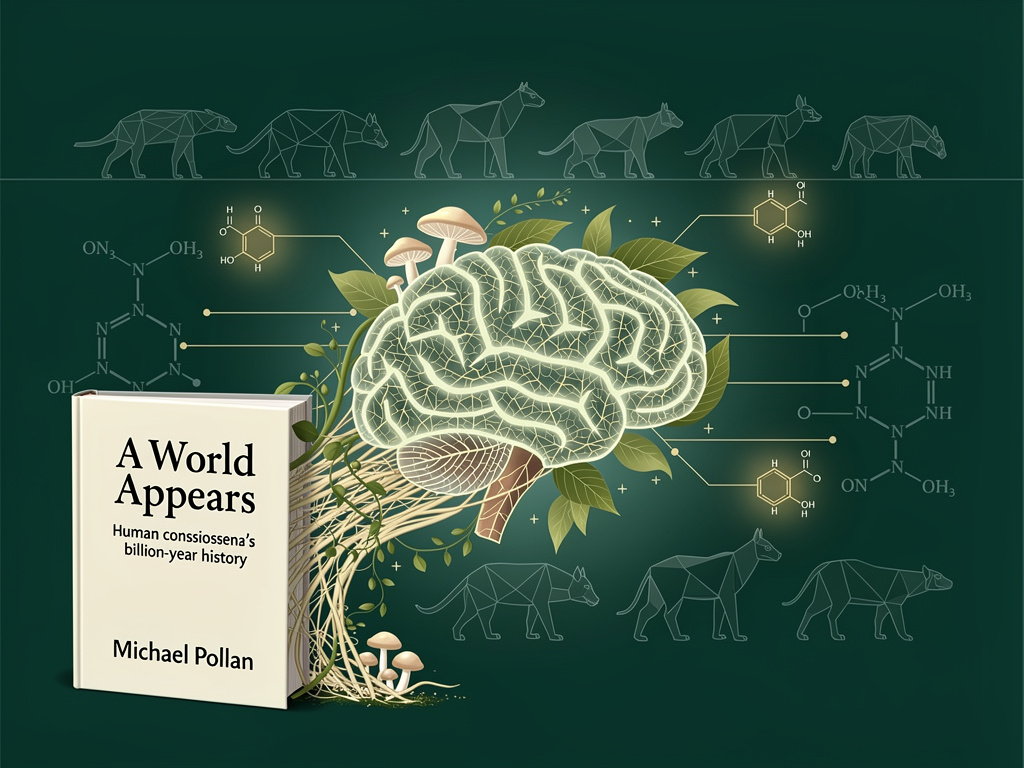
Michael Pollan, the bestselling author who reshaped how millions of Americans think about food, agriculture, and psychedelics, is now turning his attention to perhaps the most ambitious question of his career: How did human consciousness itself come into being? His forthcoming book, A World Appears: How the Mind Emerged from Chemistry and Nature, set for release on July 1, argues that the story of awareness — of minds waking up to the world around them — is deeply intertwined with the molecular ingenuity of plants and fungi.
An excerpt published by Wired offers a substantial preview of Pollan’s thesis, which weaves together evolutionary biology, neuroscience, philosophy of mind, and organic chemistry into a sweeping narrative about the emergence of subjective experience. The book represents a natural extension of Pollan’s previous works — The Botany of Desire, The Omnivore’s Dilemma, and How to Change Your Mind — but pushes further into territory that has long been considered the exclusive province of philosophers and theoretical neuroscientists.
From Serotonin to Sentience: The Chemical Thread Running Through All Conscious Life
At the heart of Pollan’s argument is a molecule that most people associate with mood regulation: serotonin. As detailed in the Wired excerpt, Pollan traces serotonin’s history back roughly a billion years, long before brains existed. The molecule first appeared in single-celled organisms, where it performed functions related to signaling and environmental responsiveness. Pollan writes that serotonin and its chemical relatives — including tryptophan, the amino acid from which it is derived — form a kind of molecular bridge between the plant kingdom and the animal kingdom, a shared chemical vocabulary that predates the split between the two lineages.
This is not merely a biochemical curiosity, Pollan contends. It is a clue to the origins of consciousness itself. Plants produce a vast array of psychoactive compounds — psilocybin, DMT, mescaline — that happen to fit with extraordinary precision into the serotonin receptors in animal brains. The conventional explanation is evolutionary coincidence: plants evolved these molecules to deter herbivores or attract pollinators, and their resemblance to neurotransmitters is accidental. Pollan finds this explanation insufficient. He suggests that the deep homology between plant alkaloids and animal neurotransmitters points to something more fundamental about the chemistry of awareness.
The “Hard Problem” Gets a Botanical Makeover
Philosophers have long grappled with what David Chalmers famously called the “hard problem” of consciousness: Why does subjective experience exist at all? Why isn’t the universe populated by biological robots that process information without any inner life? Pollan does not claim to solve this problem, but he reframes it in a way that may prove productive. Rather than asking why consciousness exists, he asks what chemical and biological conditions gave rise to it — and whether those conditions can be found not just in brains but in the broader chemistry of life on Earth.
In the excerpt, Pollan describes visiting laboratories where researchers are studying the effects of psychedelic compounds on neural activity. He recounts conversations with neuroscientists who have observed that psilocybin, the active compound in magic mushrooms, appears to increase the complexity and entropy of brain activity — essentially making the brain more interconnected and less predictable. Some researchers believe this heightened state of neural complexity may resemble the conditions under which consciousness first emerged in early animal brains. Pollan draws a provocative line from these findings: if a fungal molecule can reliably alter the quality and intensity of human consciousness, then consciousness may be more chemical in nature than we typically assume.
Plants as Architects of the Mind
One of the more striking claims in the book, as previewed by Wired, is that plants and fungi have played an active role in shaping animal consciousness over evolutionary time. Pollan builds on the work of ethnobotanist Terence McKenna, whose “stoned ape” hypothesis proposed that the ingestion of psilocybin mushrooms by early hominids may have accelerated the development of language, imagination, and symbolic thought. While McKenna’s theory has been widely dismissed by mainstream science as speculative, Pollan treats it with more nuance, arguing that even if the specific mechanism McKenna proposed is unlikely, the broader idea — that psychoactive plant compounds influenced the evolution of animal minds — deserves serious consideration.
Pollan is careful to distinguish between strong and weak versions of this claim. The strong version would hold that psychoactive molecules directly drove the evolution of consciousness. The weak version, which Pollan seems to favor, is that these molecules provided a kind of chemical scaffold that made certain forms of neural complexity possible. He points out that serotonin receptors are among the most ancient and conserved features of animal nervous systems, suggesting that the chemical pathways through which psychedelics operate are not peripheral to consciousness but central to it.
A Writer’s Willingness to Sit With Uncertainty
What distinguishes Pollan’s approach from that of many popular science writers is his willingness to acknowledge the limits of current knowledge. He does not pretend that neuroscience has solved the mystery of consciousness, nor does he offer a tidy theory of his own. Instead, he presents a series of observations and connections that, taken together, suggest the story of consciousness is far more entangled with the chemistry of the natural world than most scientific accounts acknowledge. He writes with the curiosity of a journalist and the patience of a naturalist, spending pages on the evolutionary history of a single molecule before zooming out to consider its implications for the nature of mind.
The book also reflects Pollan’s personal experiences with psychedelics, which he first wrote about in How to Change Your Mind (2018). In that book, he described his own experiments with psilocybin, LSD, and 5-MeO-DMT, and reported profound alterations in his sense of self and his relationship to the natural world. In A World Appears, he returns to these experiences but frames them differently — not as therapeutic interventions or spiritual adventures, but as data points in a larger inquiry about the nature of consciousness. He describes moments during psychedelic sessions when the boundary between self and world seemed to dissolve, and he asks whether these experiences might offer a glimpse of a more primitive form of awareness, one that preceded the evolution of the ego and the sense of a separate self.
The Scientific Community’s Mixed Reception
Not all scientists are likely to embrace Pollan’s thesis. The idea that plant chemistry played a formative role in the emergence of consciousness is difficult to test empirically, and some researchers may view it as an overreach — a literary conceit dressed up in scientific language. Neuroscientists who study consciousness tend to focus on neural correlates — specific patterns of brain activity associated with conscious experience — rather than on the evolutionary origins of the molecules involved. Pollan’s approach, which emphasizes chemistry over circuitry, represents a different way of thinking about the problem, one that may be more appealing to biologists and chemists than to cognitive scientists.
Still, there are signs that the scientific mainstream is becoming more receptive to the kinds of questions Pollan raises. Research into psychedelics has undergone a remarkable renaissance in recent years, with institutions like Johns Hopkins, Imperial College London, and NYU conducting rigorous clinical trials on psilocybin-assisted therapy for depression, PTSD, and addiction. The FDA has granted “breakthrough therapy” designation to psilocybin for treatment-resistant depression, and several states and cities have moved to decriminalize or legalize psychedelic substances. This growing body of research has made it increasingly difficult to dismiss psychoactive plant compounds as mere curiosities or recreational drugs. They are, as Pollan argues, windows into the fundamental chemistry of consciousness.
Why This Book Arrives at a Particular Moment
The timing of A World Appears is significant. Public interest in both consciousness studies and psychedelic science is at a high point, driven by a convergence of clinical research, policy reform, and cultural fascination. At the same time, advances in artificial intelligence have reignited debates about the nature of mind and whether consciousness requires a biological substrate. Pollan’s book implicitly addresses this question by grounding consciousness firmly in organic chemistry — in the specific molecules that plants and animals have been exchanging for hundreds of millions of years. If he is right that consciousness is deeply tied to the chemistry of serotonin and its relatives, then the prospect of machine consciousness becomes considerably more complicated.
Pollan has built a career on the idea that the boundaries between humans and the rest of the natural world are more porous than we like to believe — that our food, our medicines, and our mental lives are shaped by organisms we tend to overlook. With A World Appears, he extends this argument to its logical extreme: that consciousness itself may be a gift from the plant and fungal kingdoms, a chemical inheritance that connects every sentient being on Earth to the molecular creativity of nature. Whether or not readers find his thesis fully persuasive, the questions he raises are among the most profound that science and philosophy can ask.


 WebProNews is an iEntry Publication