
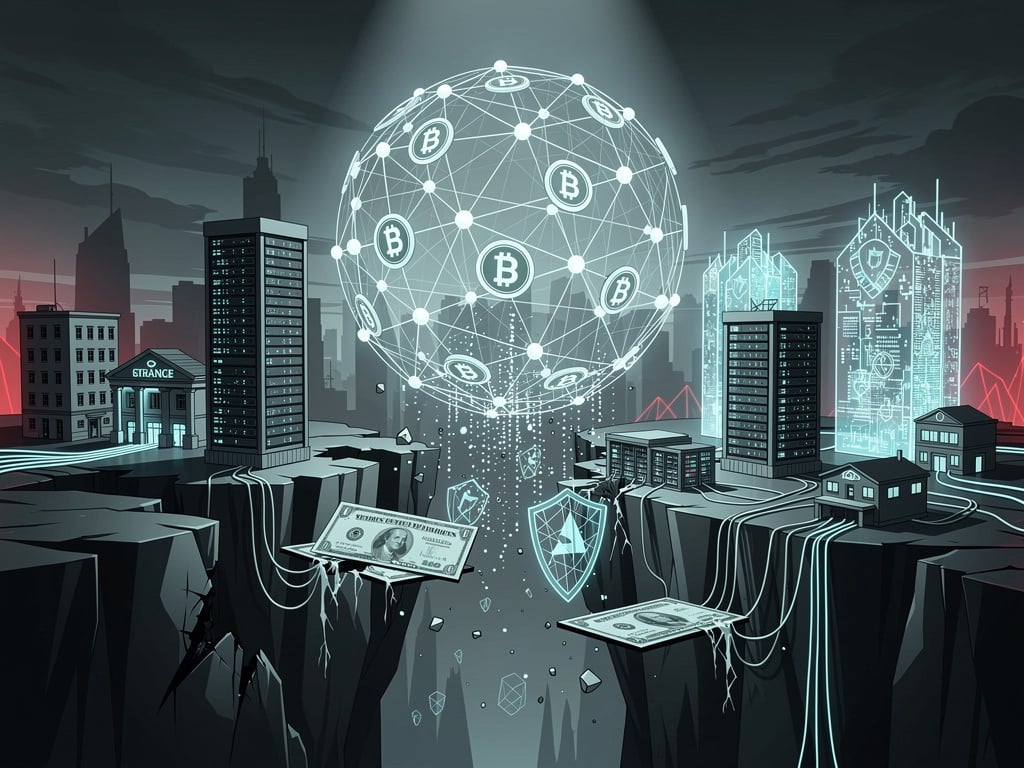
Michael Burry sees trouble ahead. The investor who bet against the housing market before the 2008 crisis now warns that a Securities and Exchange Commission proposal could fracture equity trading and expose ordinary investors to new hazards. He doesn't mince words.
"We may be headed full-on to a Snow Crash cyber-punk future," Burry wrote this week on his Substack, Cassandra Unchained. "This may be the point in time that needs to be stopped from going forward by some future being."
But regulators have one job. Do not open scary doors. That's Burry's blunt advice in a follow-up comment. The stakes feel high. And the proposal in question aims to let tokenized versions of U.S. stocks trade on blockchain platforms much like cryptocurrencies.
The SEC's so-called innovation exemption would create two tracks. Companies could authorize their own tokenized shares. Third parties could also create versions without issuer consent. Those unofficial tokens might skip voting rights or dividends. They would still offer instant blockchain proof of ownership. Yet the split raises immediate questions about what holders actually control.
Fragmentation follows. Traditional stock exchanges operate from 9:30 a.m. to 4 p.m. ET on weekdays. Crypto markets run nonstop. The same underlying security could trade in disconnected venues with prices that drift apart. Buyers in one market might overpay without realizing the discrepancy. Liquidity could scatter. Price discovery might suffer.
Burry's Warning Draws on Dystopian Fiction
Burry didn't stop at general criticism. He invoked Neal Stephenson's 1992 novel Snow Crash, a tale of corporate enclaves, virtual reality, and fractured society. The reference lands with force for those who track his commentary. It signals his fear that embedding digital value in tokens could erode long-term relationships between companies and shareholders. Humanity itself might feel devalued in the process. Short sentences. Stark images. That's his style.
His Substack post arrived days after Bloomberg reported the SEC was readying the exemption as soon as mid-May 2026. The agency later delayed those plans following pushback. Yet the idea lingers. It reflects broader efforts under new leadership to give crypto firms clearer rules for tokenized assets. Bloomberg detailed the delay on May 22, 2026.
Burry isn't alone in his skepticism. Citadel Securities, the trading powerhouse led by Ken Griffin, sent a letter to the SEC in December 2025. The firm argued the changes would fragment liquidity and undermine investor protections built over decades. Traditional exchanges like Nasdaq, NYSE, and Cboe also voiced concerns. They see risks to orderly markets and the central role of registered exchanges.
Daniel Labovitz, CEO of Green Impact Exchange, spelled out the mechanics in comments to Business Insider. "The tokens may not represent actual ownership of the company, and token holders may not get all the benefits of the share," he said. He added that disconnected markets invite divergence. "Some buyers will overpay for their token." Those observations match Burry's broader alarm.
Consider the mechanics. A tokenized stock lives on a blockchain. Transfers happen peer-to-peer with near-instant settlement. No central custodian needed in theory. Proponents argue this cuts costs, boosts access, and extends trading hours for global investors. They point to experiments already underway in other jurisdictions.
Critics counter with practical failures. Volatility spikes in crypto are well documented. Manipulation remains a persistent issue despite enforcement actions. What happens when a tokenized share of a blue-chip company swings wildly overnight while the official exchange is closed? Retail investors chasing momentum could get burned. Institutions might exploit the gaps. The nightmare Burry describes starts to feel concrete.
Burry closed his hedge fund Scion Asset Management in late 2025. He deregistered with the SEC that November after returning outside capital. The move freed him from some disclosure rules and compliance burdens. He told Bloomberg he remained active in markets but on his own terms. His new Substack lets him speak more freely. Recent posts have targeted AI valuations and other perceived bubbles. The tokenized-stock critique fits his pattern of spotting structural weaknesses others overlook.
The SEC's January 2026 staff statement on tokenized securities tried to draw lines. It clarified that the format of a security, on-chain or off, doesn't change its status under federal laws. Registration requirements still apply unless an exemption fits. Yet the innovation exemption would loosen some of those strictures for crypto-native platforms. Third-party wrappers could operate with lighter oversight. That flexibility excites innovators. It worries traditionalists who remember past experiments that blurred lines between securities and commodities.
Market structure experts note another complication. Options on tokenized shares could emerge. The original Yahoo Finance piece referenced options market dynamics, though the core debate centers on equity tokenization itself. Layered derivatives on already fragmented tokens multiply complexity. Pricing models break down. Clearing and settlement grow murkier. Burry's history with credit default swaps during the housing crisis gives his caution extra weight. He understands how interconnected instruments can amplify shocks.
So far the SEC has held back. Industry letters and exchange lobbying appear to have bought time. But the direction seems set. Chair Paul Atkins has signaled openness to crypto innovation. A future rule could still arrive. When it does, investors will face choices. Stick with conventional shares on regulated exchanges? Or venture into tokenized versions with 24/7 availability but uncertain rights?
Burry's call to stop the momentum before it accelerates resonates with some. Others dismiss it as reflexive bearishness from a famed contrarian. The data on crypto volatility offers support for his view. Bitcoin and ether have seen 50% drawdowns in months. Traditional stocks experience them over years. Tokenized equities might import that tempo into Main Street portfolios.
And the human element matters. Long-term shareholders engage with management through votes and dialogue. Token holders on decentralized platforms might lack easy channels for that. Relationships dissolve into code. Burry's "no long-term personal relationships" line captures the shift. It echoes his wider critique of modern finance that prioritizes speed and speculation over stewardship.
Recent coverage reinforces the tension. Forbes explored the prospect of parallel stock markets on May 19, 2026. It outlined how the exemption could let crypto platforms list tokenized shares alongside traditional ones. The piece noted the SEC's taxonomy that distinguishes issuer-authorized tokens from third-party ones. Rights "may or may not" match. That ambiguity sits at the heart of the debate.
Trading firms worry about best execution. If prices diverge across venues, brokers face tough decisions on where to route orders. Best-price rules could conflict with blockchain immediacy. Arbitrageurs would jump in. Yet the costs of constant monitoring might outweigh benefits for smaller players. The market could bifurcate into sophisticated participants who navigate both worlds and everyone else left with inferior outcomes.
Burry's track record demands attention. He spotted the subprime mortgage flaws when few others did. His Scion fund posted outsized returns in that period. Later bets have mixed results. He has called bubbles in various assets over the years. Not all materialized on his schedule. Timing remains his acknowledged weakness. The thesis, though, often proves durable.
Here the thesis is straightforward. Rushing to merge traditional equities with crypto infrastructure without ironclad safeguards invites disorder. Liquidity fragments. Protections erode. Volatility transfers. Investors pay the price. Simple. Direct. And backed by his public record of skepticism toward unchecked financial experimentation.
Whether the SEC ultimately proceeds remains unclear. Delay signals caution. Pushback from established players carries influence. Still, the innovation exemption concept won't vanish. Technology marches forward. Blockchain offers real efficiencies in settlement and transparency when applied carefully. The question is whether regulators can thread the needle. Burry doubts it. He thinks the door should stay shut.
That leaves market participants to prepare. Fund managers might assess exposure to any tokenized products that launch. Brokers could update client disclosures about multi-venue risks. Regulators, for their part, must weigh innovation against the hard lessons of past market breaks. The 2008 crisis taught that interconnected systems can fail in unexpected ways. Burry lived that lesson up close. His warning carries the weight of experience.
Short term, the debate stays loud. Substack comments multiply. Industry letters circulate. Journalists track every hint of SEC movement. Long term, the outcome could reshape how Americans own public companies. Tokenized shares might become commonplace. Or they might remain a niche experiment confined to crypto enthusiasts. Burry hopes for the latter. He fears the former. His words serve as an early marker in what promises to be a contentious regulatory battle.


 WebProNews is an iEntry Publication