
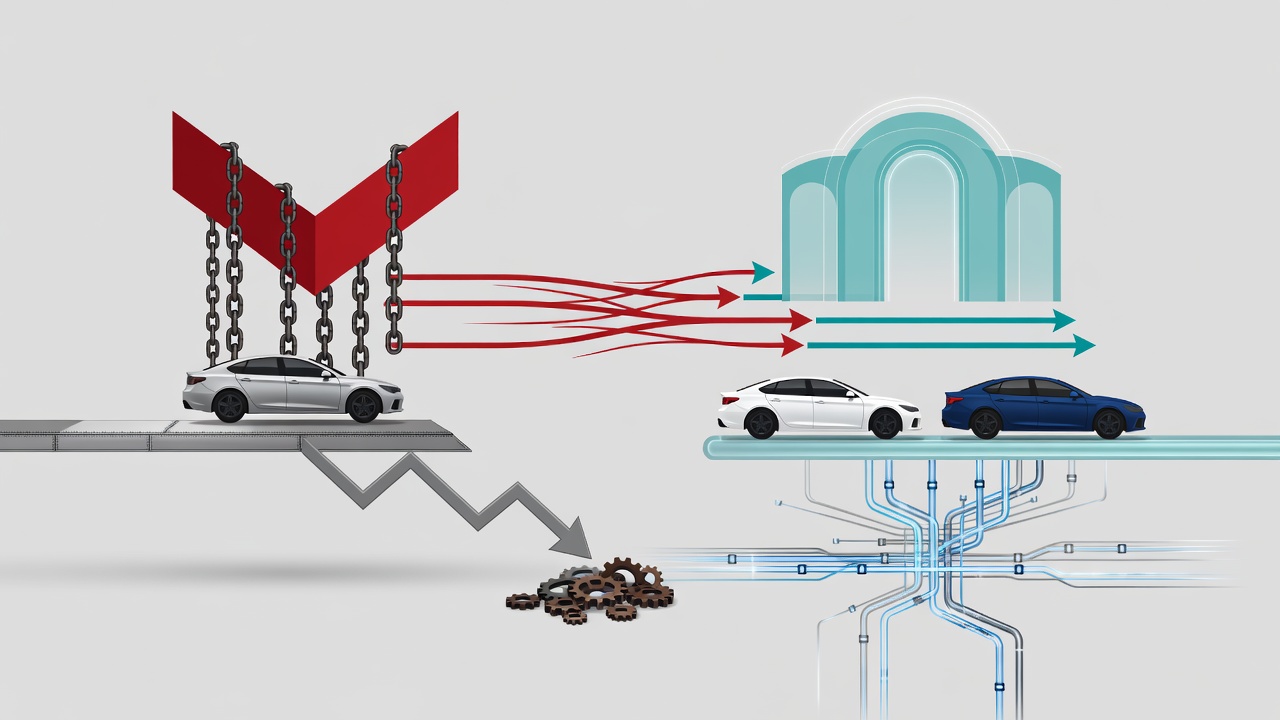
Mexican officials have a pointed message for negotiators in Washington. The current trade setup punishes vehicles assembled south of the border more than comparable cars shipped from South Korea or Japan. A $50,000 car made in Mexico faces $9,375 in tariffs. The same model from South Korea or Japan incurs just $7,500. That gap, they argue, distorts competition inside the North American market.
Mexico Presses Its Case Ahead of USMCA Review
The complaint lands at a delicate moment. The United States, Mexico and Canada are barreling past a July 1 milestone to renew their trade pact without agreement. Years of haggling lie ahead over autos, steel and rules of origin. Mexican Economy Minister Marcelo Ebrard has signaled the review will test the pact’s durability. So has his Canadian counterpart. Both countries still face 25% tariffs on many auto exports despite the USMCA framework.
But the specific disparity with Asian partners stings. South Korea operates without a full free-trade agreement with Mexico yet secures better treatment on certain finished vehicles entering the U.S. market. Japan benefits from its own 2025 bilateral deal with Washington that trims effective rates. Mexican plants, even those churning out models for export north, absorb higher effective burdens in the layered tariff regime. And the numbers add up fast across high-volume production lines.
Industry groups back the government’s stance. The Mexican Automotive Industry Association voiced concern as U.S. imports of Mexican vehicles and auto parts dropped 11.3% in the first quarter of 2026. That decline equals roughly $4.87 billion. Manufacturers have absorbed much of the added cost rather than raise sticker prices. Their capacity to keep doing so shrinks by the month. Pressure builds. Options narrow.
Óscar del Cueto, president of the American Chamber of Commerce of Mexico, put it plainly. Vehicles manufactured in Mexico sometimes face higher tariff burdens than those arriving from Europe. “If today we bring a vehicle from Europe into the United States, it pays lower tariffs than a vehicle shipped from Mexico to the United States,” he told Mexico Business News. The asymmetry undercuts the very integration USMCA was designed to protect.
Yet the picture is more tangled than a simple Mexico-versus-Asia split. The Trump administration struck deals last year with the EU, Japan and South Korea. Those agreements set most vehicle and parts tariffs at 15%, down from an initial 25%. Automotive News reported that automakers and suppliers view this 15% level as a potential floor for upcoming North American talks. Detroit’s Big Three object. They contend the lower rate on direct Asian imports gives foreign brands an edge over their own production in Mexico and Canada, which still contends with the full 25% on non-compliant volume.
Japanese and Korean producers have spent years building capacity in Mexico precisely to serve the U.S. market under preferential rules. Hyundai and Kia have poured $12.5 billion into Mexican operations since 2018. Japanese firms maintain extensive supply chains across the country. When U.S. tariffs hit North American trade, those investments suddenly look less secure. Bloomberg noted in February 2025 that Japanese automakers alone could lose $10 billion in profits from broader tariff actions. But the latest Mexican complaint flips the script. Local assembly no longer guarantees the clearest path to tariff relief.
Rules of origin sit at the center of the dispute. Current USMCA standards require 75% regional content for duty-free treatment, with separate wage thresholds that favor U.S. and Canadian facilities. The U.S. side has floated raising that to 82% overall while mandating 50% U.S. content specifically. Mexican negotiators resist. They see the changes as an attempt to force more production back across the northern border. Higher local content requirements would raise costs for plants in Mexico that source components from Asia. The tariff gap only compounds the problem.
Trade data tells part of the story. Asian auto exports to Mexico have remained relatively resilient despite broad tariffs Mexico itself imposed on many non-North American imports, sometimes reaching 50% on certain categories. Chinese, Korean and Indian vehicles still reach Mexican buyers, though at higher prices. South Korean parts and steel exports face exposure, yet companies route final assembly through Mexico to capture U.S. preferences where possible. The system rewards complexity. It punishes straightforward regional production.
Automakers on all sides scramble for clarity. Nissan, with significant Mexican output, has accelerated localization efforts inside the United States to blunt tariff effects. Its chairman of the Americas, Christian Meunier, noted the challenge of building affordable cars domestically. Labor costs differ sharply. Toyota, Honda and others with deep Mexican footprints watch the USMCA talks closely. Any shift in content rules or tariff application could reshape billion-dollar investment plans already announced to placate Washington.
Broader tensions linger. The U.S. maintains 25% duties on steel and aluminum from Mexico and Canada. Additional proposals circulate for layered tariffs tied to labor or environmental standards. One recent U.S. Trade Representative notice eyes extra duties of 10% or 12.5% on dozens of partners, including Mexico, for perceived failures on forced-labor enforcement. Exemptions exist for USMCA-compliant goods. Still, the cumulative weight erodes the pact’s original promise of frictionless regional trade.
Mexican officials aren’t alone in their frustration. Canadian counterparts share similar worries about autos and metals. Both governments push to extend the USMCA framework another 16 years while preserving zero tariffs within the bloc. They view the Asian tariff advantages as leverage. If South Korea and Japan can secure 15% access, why can’t integrated North American production receive equivalent or better treatment?
The answer may come down to politics as much as economics. Domestic U.S. manufacturers want stronger rules that favor American content and jobs. They see the existing pact as having allowed too much foreign sourcing. Mexican leaders counter that their country has become a vital link in the supply chain. Disrupt it, and prices rise for American buyers. Production shifts elsewhere. The gap Mexico highlights isn’t abstract. It translates into thousands of dollars per vehicle and, over time, decisions about where to build the next model.
Negotiators on all three sides face a long road. Past the July deadline, talks could stretch for years. Each round will test whether the tariff disparities can be smoothed or whether they become baked into a new normal. For now, Mexican automakers keep making their case. The math, they say, doesn’t lie. A $1,875 difference on a $50,000 car might seem modest until multiplied across hundreds of thousands of units. Then it becomes strategy. It becomes jobs. It becomes the future shape of North American auto manufacturing.


 WebProNews is an iEntry Publication