
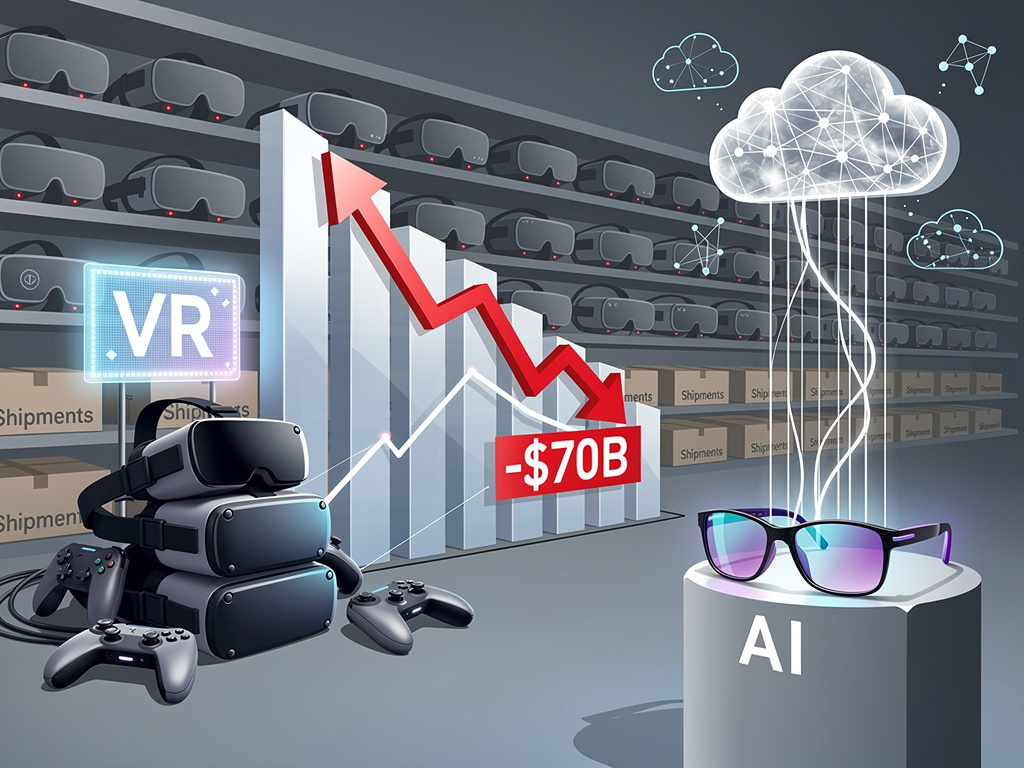
Meta Platforms Inc. has slashed about 10% of its Reality Labs workforce, roughly 1,000 to 1,500 jobs, while shuttering VR game studios and redirecting resources toward artificial intelligence and smart glasses. The moves, disclosed in January 2026, have sent shockwaves through the virtual reality sector, with developers and analysts warning of a prolonged downturn akin to past tech busts.
Reality Labs, responsible for Quest headsets and metaverse projects, has amassed over $70 billion in losses since late 2020. Meta’s chief technology officer Andrew Bosworth, who oversees the unit, acknowledged in recent statements that VR growth has lagged expectations. “We’re still continuing to invest heavily in this space, but obviously, VR is growing less quickly than we hoped,” Mr. Bosworth said, according to CNBC.
The pivot favors wearables like the Ray-Ban Meta smart glasses, co-developed with EssilorLuxottica. Meta aims to ramp production to 20 million units annually by year-end, up from 10 million, as sales have exceeded two million units. No new Quest headset was unveiled at the 2025 Connect event, signaling a stall in VR hardware pushes.
Studio Closures and Developer Fallout
Meta closed three internal studios—Twisted Pixel, Sanzaru Games and Armature Studio—while scaling back first-party game development to emphasize third-party content. Horizon Worlds, Meta’s social VR platform, is morphing into a mobile experience akin to Roblox, with its VR feed removed in software update v85 and enterprise support programs axed, per Android Central.
Third-party developers, heavily reliant on Meta’s app store, face uncertainty. Staff supporting external studios were cut, and funding for programs like Oculus Publishing diminished. “Several development studios have announced closures, some citing VR market challenges,” Android Central reported, noting layoffs even among top-selling game makers.
Jessica Young, an independent Horizon Worlds creator, captured the mood: “I can see how it feels like a VR winter.” Her sentiment echoes across X, where users like Robert Scoble lamented VR’s underperformance: “I thought VR would be a lot more popular than it turned out to be.”
Market Data Signals Sharp Decline
IDC forecasts VR headset shipments plunging 42.8% to 3.9 million units in 2025, while AI glasses surge 211.2% to 10.6 million. Analyst Jitesh Ubrani told CNBC, “The market has spoken,” deeming VR niche for gamers averse to bulky devices.
Apple’s Vision Pro, despite enterprise sales, halted consumer production in China due to weak demand. Broader game industry slumps compound woes, with VR likened to Atari’s 1983 collapse by Owlchemy Labs CEO Andrew Eiche.
Meta’s Economic Times coverage highlights tighter budgets for Quest amid experimental project cuts, prioritizing AI wearables over metaverse ambitions.
Exec Defenses and Contrarian Takes
Mr. Bosworth pushed back: “We’re going to let VR be what it is and what it does great,” vowing third-party ecosystem focus, per Android Central. Oculus founder Palmer Luckey, now at Anduril, called cuts “a good thing for the long-term health” of VR, noting Meta’s team dwarfs rivals “by about an order of magnitude.”
On X, Aakash Gupta reframed losses: Over 50% funded AR glasses R&D, now yielding Ray-Ban successes that tripled revenue in early 2025. Investors cheered, with Meta shares rising 4% post-announcement.
RP1 CEO Sean Mann criticized Meta’s gaming fixation: “Meta failed to realize how big VR could be if they adopted the bigger picture outside of gaming.” Enterprise VR shows ROI in training, though Meta ended related services.
Broader Industry Ripples
X posts from CIX warned Quest depreciation could elevate Valve’s Steam Frame. PLECTRUM SOFT highlighted studio shutdowns and poor sales. CNBC’s Sal Rodriguez succinctly declared, “VR winter is here.”
Digitimes reported Meta-EssilorLuxottica talks for 20 million glasses units, underscoring VR cutbacks. The New York Times noted reallocations to wearables from VR, amid Zuckerberg’s AI spending surge to $100 billion in 2026.
Delays plague advanced projects: Phoenix mixed-reality glasses slip to 2027, per TechCrunch, prioritizing quality over haste.
Paths Forward Amid Chill
Optimists eye Samsung Galaxy XR and enterprise gains. Eiche insisted, “VR is not going anywhere.” Yet dependency on Meta chills innovation, with chicken-and-egg content woes cited on X.
Meta vows sustained VR investment, but rightsized. Young fretted headset stagnation: “If Meta’s not putting out a new headset for another year or two, it’s going to feel stale.” As AI glasses boom, VR’s future hinges on non-Meta players breaking the cycle.


 WebProNews is an iEntry Publication