
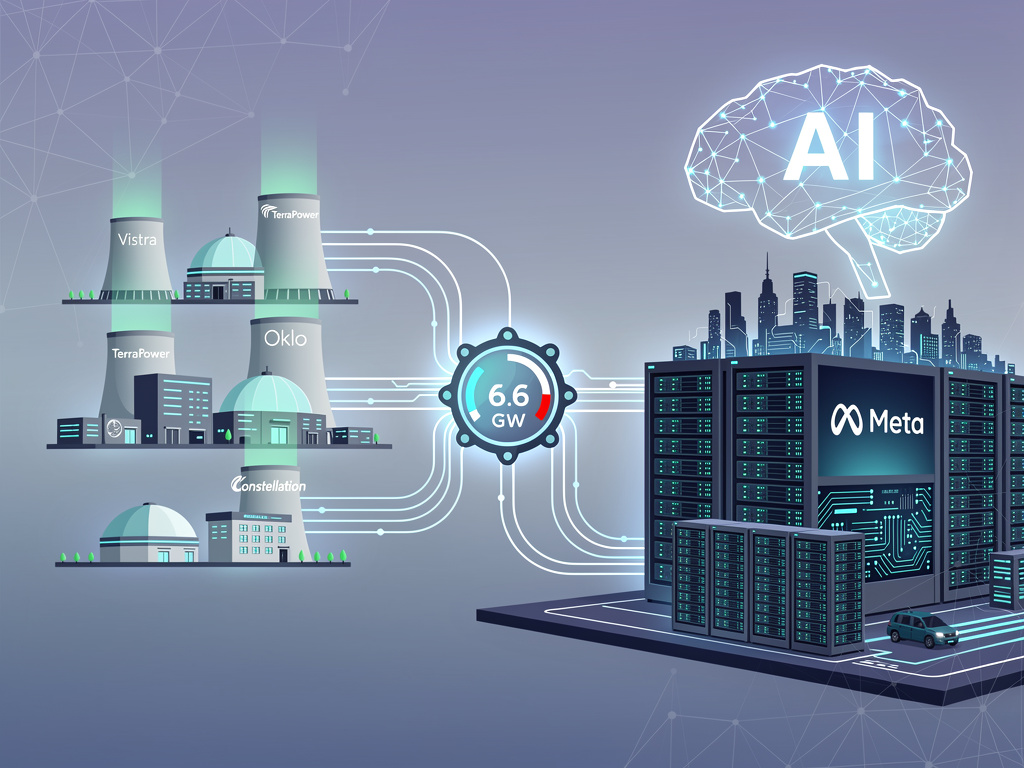
Meta Platforms Inc. has launched one of the most ambitious energy procurement strategies in corporate history, securing agreements that could deliver up to 6.6 gigawatts of nuclear power to fuel its artificial intelligence infrastructure. Announced on January 9, 2026, the deals with Vistra Corp., TerraPower LLC, Oklo Inc., and Constellation Energy Corp. position Meta as a pivotal player in reviving U.S. nuclear capacity amid surging AI-driven electricity demands.
The agreements encompass long-term power purchases from three existing Vistra nuclear plants in the U.S. heartland, alongside development support for advanced small modular reactors from TerraPower and Oklo. Meta’s official blog describes the pacts as ‘landmark agreements’ that will expand plant operations, advance nuclear technology, and create jobs in American communities. This move comes as Big Tech grapples with data center power needs projected to rival those of small countries.
Roots of the AI Energy Crunch
AI training and inference workloads have exploded power requirements for hyperscalers. Meta’s upcoming Prometheus AI supercluster, designed to push boundaries in model scale, demands reliable, carbon-free baseload power that intermittent renewables can’t fully provide. Industry analysts note that U.S. data centers could consume 8% of national electricity by 2030, per recent estimates.
Meta’s strategy builds on prior renewable commitments but shifts toward nuclear for its density and dispatchability. The Wall Street Journal reports the deals could power a city of five million homes, with Vistra shares surging as much as 16% following the announcement.
Dissecting the Deals
With Vistra, Meta signed 20-year power purchase agreements for output from plants in Illinois, Pennsylvania, and Texas, extending their operational lives. Constellation, the largest U.S. nuclear operator, is involved in capacity expansions, according to posts on X by Meta executive Joel Kaplan, who highlighted the firm’s role in making Meta ‘one of the most significant corporate purchasers of nuclear energy in American history.’
TerraPower, backed by Bill Gates, and Oklo, supported by Sam Altman, represent bets on next-generation reactors. These small modular designs promise faster deployment and lower costs. Meta’s commitments include funding for site development and licensing, accelerating projects slated for the late 2020s. Reuters detailed the Vistra portion, emphasizing the heartland focus.
Strategic and Economic Ripples
Joel Kaplan, Meta’s chief policy officer, posted on X: ‘Our agreements with Vistra, TerraPower, Oklo and Constellation… will help power our AI future, strengthen our country’s energy infrastructure, and provide clean.’ This post underscores alignment with national priorities under President Trump, crediting Secretary Wright for support.
The deals signal a broader tech exodus from natural gas dependence, with nuclear offering 24/7 output immune to weather variability. Vistra’s market cap jumped $10 billion in a day, per Bloomberg data, reflecting investor enthusiasm for nuclear revival.
Technical Edge of Modular Reactors
TerraPower’s Natrium reactor uses liquid sodium coolant for enhanced safety and efficiency, targeting 345 megawatts per unit with potential for co-located energy storage. Oklo’s Aurora microreactors, at 15-75 megawatts, aim for factory fabrication and rapid siting near data centers. Meta’s involvement de-risks these technologies, which have faced regulatory and financing hurdles. CNBC linked the pacts directly to Prometheus.
Uranium fuel supply chains are tightening, with prices doubling since 2023 due to AI hype. Meta’s scale could stabilize markets, encouraging mining restarts in Wyoming and Utah.
Regulatory and Policy Tailwinds
The Trump administration’s pro-nuclear stance, including streamlined NRC approvals, facilitates these projects. Meta’s announcement praised efforts for ‘American AI leadership & energy dominance.’ Bipartisan support grows as nuclear’s emissions profile aligns with net-zero goals.
Challenges persist: first-mover regulatory risks and waste management debates. Yet, Meta’s financial muscle—$50 billion in 2025 capex—positions it to navigate these.
Competitive Maneuvers in Big Tech
Microsoft’s reactivation of Three Mile Island with Constellation and Google’s SMR deals with Kairos Power set precedents. Amazon and Oracle scout similar paths. Meta’s 6.6 GW haul dwarfs peers, securing a decade-ahead supply. Bloomberg called Meta set to become ‘one of the world’s biggest corporate buyers of nuclear power.’
Site selections favor grid-constrained regions like Texas and the Midwest, minimizing transmission losses. Integration with Meta’s 100% renewable matching policy maintains sustainability credentials.
Workforce and Community Impacts
Projects promise thousands of high-wage jobs in construction, operations, and supply chains. Vistra plants employ hundreds each; expansions could double that. Meta emphasized ‘job growth in American communities’ on its blog.
Local opposition, often tied to safety fears, has waned post-Fukushima with advanced designs. Economic benefits—tax revenues, infrastructure upgrades—bolster support.
Long-Term Grid Transformation
By 2035, Meta’s nuclear fleet could offset 20 million tons of CO2 annually versus gas alternatives. This scales U.S. nuclear from 19% to higher shares of clean power. TechCrunch noted the trio of partners’ complementary strengths.
Rivals may accelerate, pressuring utilities to prioritize nuclear over coal retirements. Meta’s blueprint could redefine corporate energy strategies globally.


 WebProNews is an iEntry Publication