
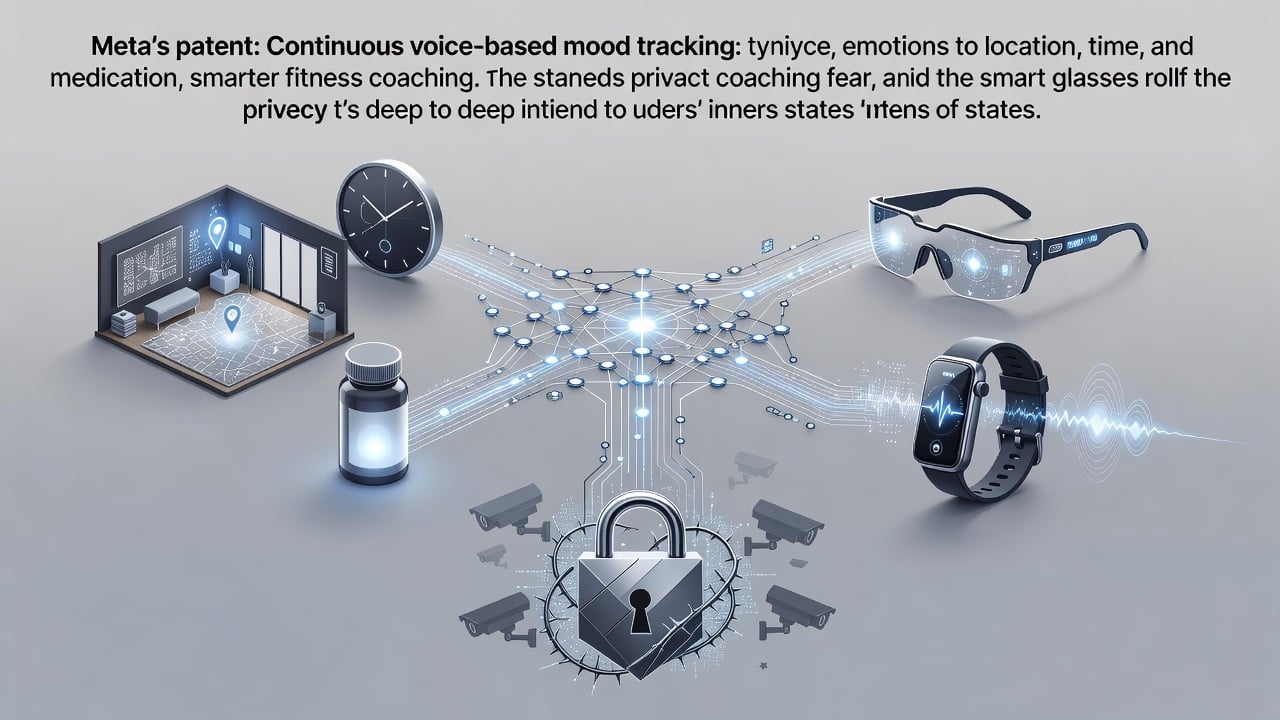
Meta has filed a patent for technology that would listen to users around the clock. It analyzes tone, sighs and laughter. Then it maps emotional states to location, time of day and even medication schedules. The system promises better fitness coaching. Privacy advocates call it something else entirely.
The patent application, published July 2, outlines a wearable device or everyday gadget equipped with microphones and sensors. It captures “audible communications” continuously. Machine learning models process pitch, pace, pauses and breathing patterns. Output? A persistent log of mood shifts. The Next Web first detailed how this goes far beyond occasional check-ins.
But why now? Meta sells millions of Ray-Ban smart glasses already. Those capture video and audio. Add voice-based emotion detection and the picture sharpens. A running diary of feelings tied to context. One example in the filing: a happier emotional state associated with a particular time of day or at a time when medication is taken.
The company frames it as helpful. AI coaches could adjust workout guidance based on detected frustration or fatigue. They might correct posture in real time. A human trainer can’t match that insight, Meta’s documents suggest. Yet the scope feels broader. “Continuous emotional monitoring on everyday devices,” the patent states, using “multimodal sensor inputs on synchronized timelines.”
Industry watchers spotted it quickly. Patentlyze highlighted the filing. Discussions exploded on X shortly after. One post from user @CR1337 laid out the details in stark terms. It noted the patent was filed in December 2025 and published this month. Always-on recording. No wake word required. Analysis of not just words but emotional cues. Correlation to location, activities, digital interactions and medication timing.
Meta’s response follows a familiar script. A spokesperson told 404 Media that “patents at Meta are often filed to disclose concepts that may or may not be implemented.” Standard language. It doesn’t erase the specificity. Or the history.
Remember Amazon’s Halo Band. Launched in 2020, it featured a microphone for tone of voice analysis. Backlash hit hard. The company removed the mics in the next version. Then it killed the entire product line in 2023. Meta now walks a similar path. Its glasses have sold seven million pairs. Two U.S. lawsuits accuse the firm of misleading consumers on footage handling. Kenyan data workers reportedly lost jobs after exposure to intimate recordings from those devices.
And the risks run deeper. Training such models requires human labelers. They would listen to strangers’ sighs, laughs and private mutterings. Assign mood scores. Teach the algorithm what sadness sounds like at home. Clinical research shows voice analysis can identify depression with 70 to 89 percent accuracy in some studies. Yet experts warn it’s not ready for consumer deployment. Accuracy falters across demographics. Bias creeps in. False positives could trigger unwanted interventions.
So what might this look like in practice? Imagine glasses that notice rising stress during a work call. They suggest a break. Or detect low mood in the evening and recommend a playlist or walk. Helpful on paper. But the data trove invites abuse. Advertisers could target based on emotional vulnerability. Insurers might adjust rates. Employers could monitor productivity through mood trends. The patent mentions tying readings to phone use and objects nearby. Context becomes total.
Critics on X didn’t hold back. One cybersecurity account called it a privacy nightmare. Persistent ambient listening tied to GPS data. Another post from @gridlogics noted the wearable AI angle for personalization. Yet personalization here means prediction of inner states. Meta already faces scrutiny over past experiments. In 2012, researchers manipulated the emotions of 700,000 Facebook users without consent. That was through news feeds. This operates on raw audio from your own voice.
Recent coverage adds weight. The Wall Street Journal reported five days ago on Meta flooding the market with smart glasses. Privacy advocates raise alarms over constant capture of sight and sound. The mood patent fits neatly into that strategy. Executives wear the devices publicly. Partnerships with celebrities like Kylie Jenner push adoption. Donations to veterans highlight accessibility. Yet the always-listening feature creates what one advocate termed a privacy sore spot.
Technical hurdles remain. Voice emotion AI must filter background noise. It needs to distinguish genuine cues from acting or fatigue. Models require massive datasets. Diversity matters. A system trained mostly on certain accents or ages will fail others. Meta’s vast user base offers data at scale. But consent questions loom large. Users might opt in for fitness perks. Do they understand the full recording scope?
Regulators watch closely. Europe’s GDPR and emerging AI rules could block deployment. U.S. lawmakers have grilled tech leaders on data practices before. A product that infers mental health from voice might trigger medical device classification. Liability follows. What if mood predictions lead to missed crises or wrongful assumptions?
Still, the momentum builds. Other firms experiment in this space. Wearables from Apple, Google and smaller startups incorporate biometric signals. Heart rate variability indicates stress. Sleep data predicts burnout. Voice adds another layer. Richer. More intrusive. Meta’s approach stands out for its ambient nature. No button press. Just always on.
The patent doesn’t guarantee a product. Many filings gather dust. This one, however, aligns with Meta’s push into wearable computing. CEO Mark Zuckerberg has bet big on glasses as the next computing platform. Emotion awareness could make them indispensable. Or intolerable. Users already balk at phone microphones. Glasses on the face feel closer. More personal.
One fragment stands out from the coverage. Always listening. Not triggered. All day. It echoes concerns from a decade ago about smart speakers. Those stayed in one place. These move with you. Record your world. Infer your feelings. The gap between fitness tool and surveillance device narrows.
Meta isn’t alone in exploring affective computing. Academics have published on voice-based depression detection for years. Commercial applications lagged due to ethics and accuracy. Now compute power and data abundance change the equation. The patent builds on that foundation. It adds context fusion. Time, place, activity. A full emotional profile emerges.
Whether it ships matters less than the signal. Meta sees value in mood data. So do advertisers, health firms and perhaps governments. The race accelerates. Patents serve as both shield and map. They protect ideas while revealing direction. This one points toward intimate, continuous monitoring.
Advocates urge caution. Demand transparency. Push for limits on retention and sharing. Users deserve controls. Granular ones. Not buried in terms of service. And independent audits of the models. Bias testing. Performance across groups.
For now the technology sits in patent limbo. Meta refines. Observes reactions. The conversation on X reflects public unease mixed with fascination. Some see utility for mental health tracking. Others foresee dystopia. Both views hold kernels of truth.
The patent’s detail on medication timing raises particular flags. It suggests health applications. Potential partnerships with pharma. Or wellness apps. Yet inferring from voice alone risks error. Correlation isn’t causation. A sigh might mean many things.
Amazon’s retreat offers a lesson. Consumer trust evaporated fast. Meta has more at stake. Its social platforms already harvest vast behavioral data. Adding physiological and emotional layers compounds the profile. The company says it prioritizes privacy. Actions and filings tell another story.
Industry insiders expect more such patents. From Meta. From rivals. The question isn’t if emotion AI arrives. It’s who controls it. How data gets protected. Whether users truly consent or simply accept defaults.
Short answer. The latter feels more likely. Long term. That acceptance carries consequences. For individuals. For society. Mood belongs to the self. When technology claims it, boundaries blur. Meta’s patent makes that claim explicit. The debate starts now.


 WebProNews is an iEntry Publication