
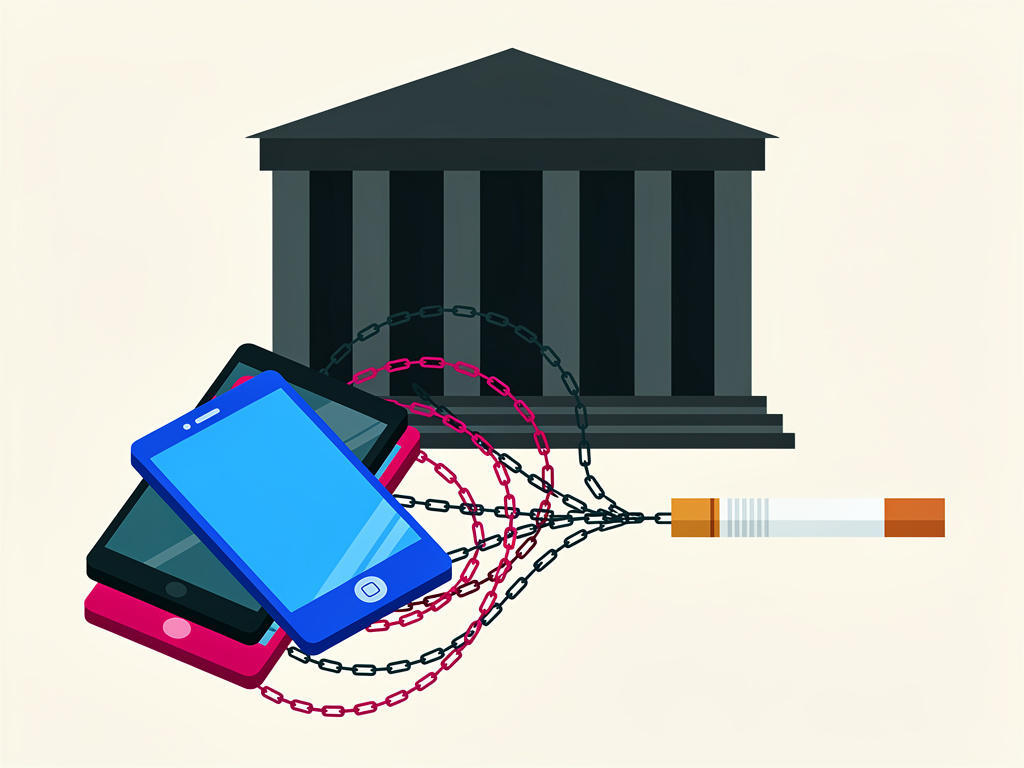
A federal judge in Oakland, California, has ruled that Meta Platforms must face trial over claims that its social media products — Instagram and Facebook — were deliberately designed to addict children and teenagers. The ruling, handed down by U.S. District Judge Yvonne Gonzalez Rogers, marks one of the most significant legal setbacks yet for the company founded by Mark Zuckerberg, and it lands at a moment when the tech giant is already contending with regulatory pressure on multiple fronts.
The decision doesn’t just allow a handful of claims to proceed. It permits a broad array of allegations to go forward, including claims rooted in product liability, negligence, and fraud. According to Yahoo Finance, Judge Gonzalez Rogers found that plaintiffs had presented sufficient evidence that Meta knowingly deployed features engineered to maximize engagement among minors — even when internal research suggested those features could cause psychological harm.
That’s a problem Meta can’t engineer its way out of.
The Weight of Internal Evidence
At the heart of the case is a trove of internal Meta documents — many of them leaked or surfaced during prior congressional hearings — that suggest company researchers understood the harmful effects of Instagram on teenage users, particularly adolescent girls. These documents, some dating back several years, describe how the platform’s algorithmic recommendations, infinite scroll design, and notification systems were calibrated to keep young users engaged for longer periods. The plaintiffs argue this wasn’t incidental. It was the business model.
Judge Gonzalez Rogers appeared to agree, at least in part. Her ruling noted that Meta’s own employees had flagged concerns about youth mental health and that the company had, in some instances, chosen not to implement proposed safeguards. That gap between knowledge and action is precisely what gives the plaintiffs’ case its legal teeth.
Meta, for its part, has consistently argued that its platforms provide significant social benefits and that it has invested billions in safety measures. A company spokesperson told reporters that Meta disagreed with the ruling and would continue to defend itself vigorously. The company has pointed to more than 30 tools and features it has introduced to support teen safety, including parental supervision controls and time management settings.
But the court wasn’t persuaded that those measures were sufficient — or sufficiently timely — to warrant dismissal.
The litigation is part of a massive multidistrict consolidation. Hundreds of lawsuits filed by families, school districts, and state attorneys general have been funneled into Judge Gonzalez Rogers’s courtroom. The scale alone is staggering. And the claims aren’t limited to Meta. TikTok, Snap, and YouTube have all faced similar allegations, though Meta has drawn the most concentrated fire given the volume of its internal research that has become public.
What makes this ruling particularly consequential is its treatment of Meta’s Section 230 defense. For years, tech companies have relied on Section 230 of the Communications Decency Act as a near-impenetrable shield against liability for user-generated content. The argument is straightforward: platforms host content but don’t create it, and therefore shouldn’t be held responsible for what users post. Judge Gonzalez Rogers, however, drew a distinction that could reshape how courts interpret the statute. She found that the claims at issue weren’t really about content at all. They were about product design — the algorithmic architecture, the engagement-maximizing features, the notification systems that pull users back in. That’s a design choice, not a publishing decision. And design choices, the court reasoned, fall outside Section 230’s protections.
This is not the first time a court has drawn this line, but it’s among the most authoritative and detailed articulations of the argument. If it holds up on appeal, it could open a significant new front of liability for every major social media company operating in the United States.
A Political and Regulatory Convergence
The timing of the ruling intersects with a broader political push to regulate children’s access to social media. The Kids Online Safety Act, which passed the Senate with overwhelming bipartisan support in 2024, has been gaining momentum in the House. Several states have already enacted their own versions of youth online safety legislation, with laws in Utah, Texas, and Florida imposing age verification requirements or parental consent mandates on social media platforms.
Surgeon General Vivek Murthy issued an advisory in 2023 warning that social media poses a “profound risk” to children’s mental health. He has since called for warning labels on social media platforms — a proposal that, while largely symbolic, reflects the depth of concern among public health officials. The American Psychological Association has echoed those warnings, publishing guidelines urging parents and policymakers to treat social media exposure among adolescents as a serious developmental concern.
Meta has tried to get ahead of this wave. The company announced in 2024 that it would default teen accounts on Instagram to restricted settings, limiting who can contact them and what content appears in their feeds. It also introduced “Teen Accounts,” which impose automatic protections for users under 16. These moves were widely seen as an attempt to preempt legislation and blunt legal exposure.
The court’s ruling suggests those efforts came too late to change the legal calculus. Plaintiffs’ attorneys have argued that Meta’s safety features are cosmetic — designed more for public relations than for genuine protection. They point to evidence that the company’s own data scientists found these tools were easy for teens to circumvent and that Meta did not aggressively enforce age requirements on its platforms.
So where does this go from here? The case is expected to proceed toward trial, though a settlement remains possible. The sheer number of plaintiffs — and the potential damages — create enormous financial exposure for Meta. Some legal analysts have compared the litigation to the tobacco industry lawsuits of the 1990s, both in its structure and in its potential to reshape an entire industry’s relationship with regulators and the public.
That comparison isn’t perfect. Tobacco companies sold a product that was inherently dangerous. Social media platforms offer services that billions of people use without apparent harm. But the analogy holds in one critical respect: both industries possessed internal research documenting risks to users, and both chose, at least for a time, to prioritize growth over disclosure.
Meta’s stock has been resilient despite the legal overhang, buoyed by the company’s aggressive push into artificial intelligence and its recovering digital advertising business. Wall Street has largely treated the youth addiction litigation as a manageable risk — a cost of doing business rather than an existential threat. But that assessment could change quickly if the case produces a large verdict or if the legal theories endorsed by Judge Gonzalez Rogers gain traction in other jurisdictions.
The discovery process alone could prove damaging. As the case moves toward trial, Meta will be compelled to produce additional internal documents — communications, research reports, strategy memos — that could further illuminate what the company knew and when it knew it. Every new document that surfaces becomes potential ammunition not just for this case, but for the dozens of state-level lawsuits and regulatory actions still winding through courts across the country.
For the broader technology industry, the implications extend well beyond Meta. If courts continue to reject Section 230 as a defense against design-based claims, every platform that uses algorithmic recommendations, autoplay features, or engagement-driven notifications could face similar exposure. TikTok, which has faced its own set of youth safety lawsuits, is watching this case closely. So is YouTube, which has already modified some of its recommendation algorithms for content viewed by minors.
The question isn’t whether social media companies will face accountability for their impact on young users. That question has been answered. The question now is how much accountability, and at what cost.
Judge Gonzalez Rogers’s ruling doesn’t resolve that question. But it ensures that a jury will eventually get the chance to weigh in. And for Meta, that prospect — a courtroom full of parents, internal documents, and expert testimony on adolescent mental health — may be more dangerous than any algorithm.


 WebProNews is an iEntry Publication