
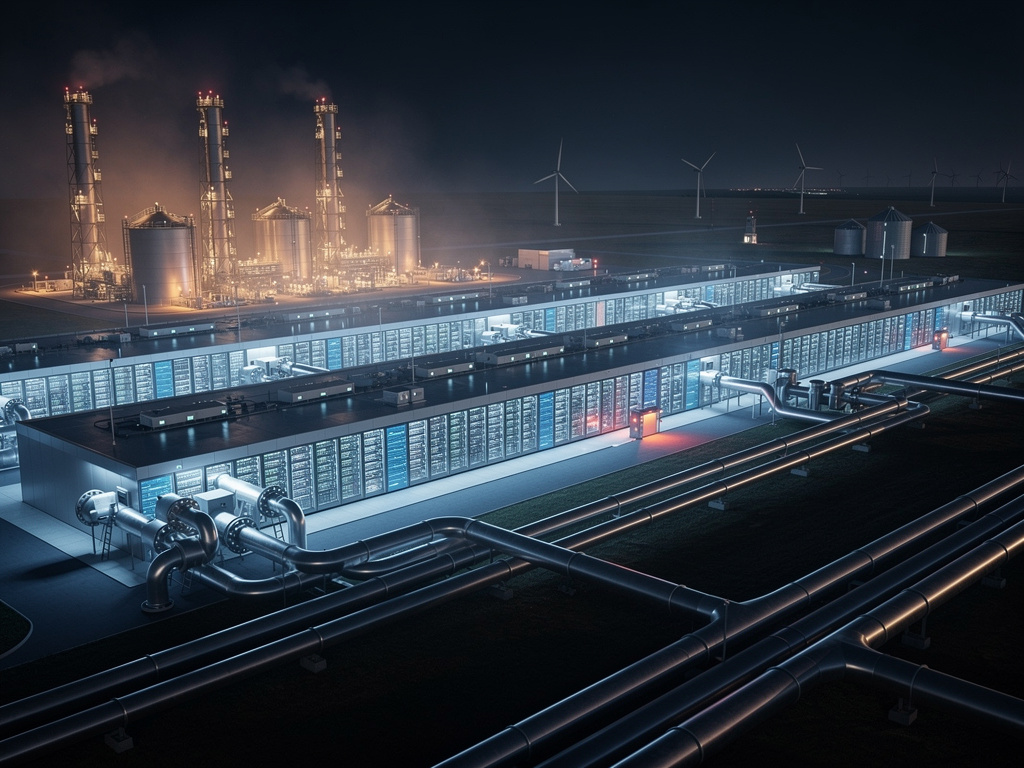
Meta Platforms has quietly assembled a natural gas portfolio so vast that the energy it plans to consume could power every home, business, and streetlight in South Dakota. Not someday. Not hypothetically. Right now, the company is locking in contracts and building infrastructure at a pace that has energy analysts, utility executives, and environmental groups scrambling to understand what it means for an already strained American power grid.
The numbers are staggering.
According to TechCrunch, Meta’s natural gas commitments for its data center operations have ballooned to a scale that matches the total electricity consumption of South Dakota — a state with roughly 900,000 residents. The company’s appetite for gas-fired power generation reflects a broader, industry-wide scramble among hyperscale cloud and AI companies to secure reliable baseload electricity, but Meta’s approach stands out for its sheer volume and velocity.
This isn’t an incremental expansion. It’s a land rush.
For years, Meta and its peers — Microsoft, Google, Amazon — marketed themselves as champions of renewable energy. They signed headline-grabbing power purchase agreements for wind and solar. They published glossy sustainability reports. And to be fair, those investments were real. But the explosive growth of artificial intelligence workloads has rewritten the energy calculus entirely. Training a single large language model can consume as much electricity as thousands of American homes use in a year. Inference — the process of running those models once they’re trained — is even more power-hungry at scale, because it never stops. The models run around the clock, fielding billions of queries, generating images, summarizing documents, writing code. Every one of those tasks draws power.
So Meta turned to natural gas.
The logic is straightforward, if uncomfortable for a company that once pledged to reach net-zero emissions across its value chain by 2030. Wind and solar are intermittent. Battery storage remains expensive and limited in duration. Nuclear power — the darling of tech-sector energy discourse over the past two years — takes a decade or more to build, and the advanced small modular reactors that companies like Microsoft have bet on haven’t yet produced a single commercial megawatt. Natural gas plants, by contrast, can be permitted, built, and brought online in two to three years. They run when you need them. They scale.
That pragmatism has consequences.
Meta’s gas-fired power plans add a massive new source of carbon dioxide emissions at precisely the moment the United States is supposed to be reducing them. The Inflation Reduction Act, signed into law in 2022, directed hundreds of billions of dollars toward decarbonizing the American economy. Yet here is one of the world’s most valuable companies effectively building a parallel fossil fuel infrastructure to feed its AI ambitions. The tension is obvious and unresolved.
Industry analysts have been tracking the trend for months. Data from the U.S. Energy Information Administration shows that natural gas demand from the power sector hit record levels in 2025, driven in significant part by data center construction. Grid operators in Virginia, Texas, Georgia, and Iowa — all states with heavy concentrations of hyperscale data centers — have reported that new gas-fired generation requests now dominate their interconnection queues. Meta’s projects span multiple states, though the company has disclosed few specifics publicly. Internal planning documents reviewed by TechCrunch suggest the company’s total contracted and planned gas capacity could exceed 2 gigawatts — enough to rank Meta among the largest industrial gas consumers in the country.
Two gigawatts. To put that in context, the average U.S. nuclear reactor produces about 1 gigawatt. Meta is building the equivalent of two nuclear plants’ worth of gas-fired generation, except these facilities will emit millions of tons of CO₂ annually.
Mark Zuckerberg has said little about the gas strategy publicly. In Meta’s most recent earnings call, he focused on AI product development and capital expenditure guidance, noting that the company planned to spend more than $60 billion on infrastructure in 2026 alone. Energy procurement was mentioned only in passing. But inside Meta’s infrastructure division, the gas buildout is the dominant operational priority, according to people familiar with the matter. The company has hired dozens of energy traders, power engineers, and gas procurement specialists over the past 18 months. It has established relationships with midstream pipeline operators and negotiated long-term supply agreements with gas producers in the Permian Basin and Appalachian shale regions.
None of this is happening in a vacuum. Microsoft disclosed in its most recent environmental report that its total emissions rose 29% between 2020 and 2025, largely because of data center expansion. Google acknowledged a similar trajectory. Amazon, which operates the world’s largest cloud infrastructure through AWS, has been less transparent but faces the same physics. AI is an energy hog, and there’s no getting around it.
But Meta’s gas binge is notable for its scale relative to the company’s size. Unlike Amazon and Microsoft, which operate massive cloud platforms serving millions of enterprise customers, Meta’s data centers exist primarily to serve its own products — Facebook, Instagram, WhatsApp, Threads, and its growing family of AI assistants and generative tools. The company doesn’t sell cloud computing to outside customers. All of this gas, all of these megawatts, flow toward a single corporate mission: keeping Meta’s 3.9 billion monthly users engaged, and building the AI infrastructure Zuckerberg believes will define the company’s next decade.
Environmental groups have started to push back. The Sierra Club issued a statement in March calling on Meta and other tech companies to halt new gas-fired generation projects and instead invest in long-duration energy storage and grid-scale renewables. “You can’t claim to be a climate leader while building gas plants,” said a spokesperson for the organization. The criticism has teeth. Meta’s own sustainability commitments, published as recently as 2024, explicitly called for eliminating fossil fuel use in its operations. The gas strategy represents a reversal that the company has not publicly acknowledged or explained.
There’s also a competition-for-resources problem that extends far beyond the tech sector. Every megawatt of gas-fired generation that Meta locks up is a megawatt that isn’t available for hospitals, manufacturers, schools, and residential customers. Grid planners in several states have warned that the surge in data center power demand is forcing utilities to delay the retirement of aging coal and gas plants that were scheduled to go offline. In Georgia, regulators approved the construction of new gas capacity specifically to meet data center demand, overriding objections from clean energy advocates. In Virginia, Dominion Energy has proposed building multiple new gas plants to keep pace with the data center boom in Loudoun County, already the most data-center-dense jurisdiction on Earth.
The irony is thick. The AI systems these data centers power are themselves being marketed as tools for fighting climate change — optimizing supply chains, improving weather forecasting, accelerating materials science research for better batteries and solar cells. Meta has published research papers on using AI to model climate systems. And yet the physical infrastructure required to run those AI systems is pushing American carbon emissions in the wrong direction.
Some energy experts argue this is a transitional phase. The thinking goes like this: tech companies need power now, gas is the fastest path to getting it, and over time they’ll layer in renewables, storage, and eventually nuclear to decarbonize their portfolios. It’s a plausible theory. But it assumes that gas plants built today will be retired in 10 or 15 years, well before the end of their economic life. History suggests otherwise. Fossil fuel infrastructure, once built, tends to persist. The financial incentives to keep running a gas plant that’s already paid for are powerful, and the political constituencies that form around gas jobs and gas tax revenue are durable.
Meta’s capital expenditure trajectory tells its own story. The company spent $28 billion on infrastructure in 2024. It guided to $40 billion in 2025. Now it’s projecting $60 billion or more in 2026. A significant and growing share of that spending goes directly to power procurement and generation. The company is not just buying electricity from utilities. It’s building and owning generation assets, entering into tolling agreements with independent power producers, and in some cases co-developing gas plants with energy companies. This vertical integration of energy supply is unprecedented for a social media company. It’s the kind of thing you’d expect from an aluminum smelter or a petrochemical complex.
And the demand curve isn’t flattening. Meta’s AI research division, FAIR, continues to train ever-larger models. The company’s recent Llama 4 release required compute resources that dwarfed its predecessors. Zuckerberg has signaled that Meta intends to train models with parameter counts in the trillions, requiring clusters of hundreds of thousands of GPUs running continuously for months. Each of those GPUs draws between 300 and 700 watts. Multiply that across a training cluster of 100,000 chips and you get power draws measured in tens of megawatts — for a single training run. Add inference serving across Meta’s global user base and the total power requirement becomes almost incomprehensible.
Wall Street, for its part, hasn’t punished Meta for the gas strategy. If anything, investors have rewarded the company for securing reliable power at a time when electricity scarcity threatens to become a bottleneck for AI growth. Meta’s stock has outperformed the S&P 500 over the past 12 months, and analysts at Morgan Stanley, Goldman Sachs, and JPMorgan have all cited the company’s aggressive infrastructure buildout as a competitive advantage. The market’s message is clear: whatever it takes to keep the AI machines running, do it.
That market signal matters more than any sustainability pledge. Companies respond to incentives, and right now every incentive — financial, competitive, strategic — points toward securing as much power as possible, as fast as possible, by whatever means available. Gas is available. So gas it is.
The question is whether this moment represents a permanent departure from the clean energy trajectory that big tech once championed, or a temporary detour driven by the unique urgency of the AI arms race. The answer probably depends on how quickly alternatives mature. If long-duration storage costs fall sharply, if advanced nuclear finally delivers, if enhanced geothermal proves out at scale — then the gas plants Meta is building today could indeed become transitional assets. But if those technologies stall or underperform, Meta and its peers could find themselves locked into a fossil fuel dependency that persists for decades.
South Dakota’s total electricity consumption, for reference, was approximately 13.5 terawatt-hours in 2024. Meta is on track to consume that much gas-fired power annually within the next three years. One company. One fuel source. Enough energy for an entire state.
That fact alone should force a broader reckoning — not just about Meta’s choices, but about the energy cost of the AI future that Silicon Valley is building, and the rest of us are being asked to accept.


 WebProNews is an iEntry Publication