
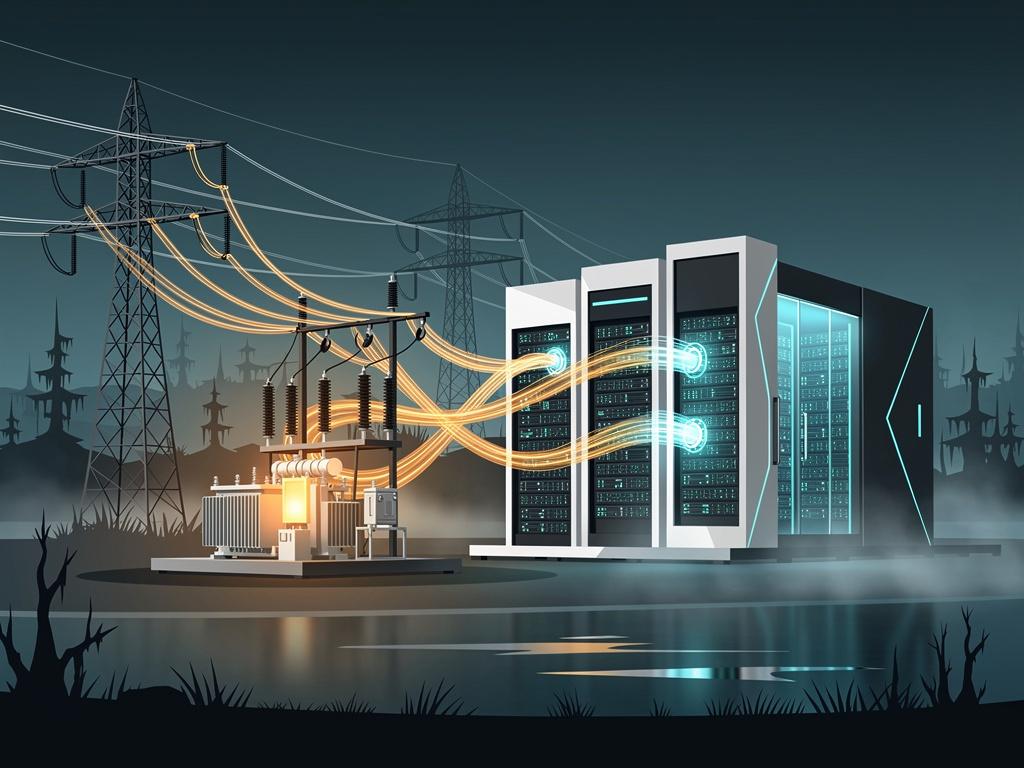
Meta Platforms has agreed to underwrite the electricity costs of a new data center in Louisiana — even before it draws a single watt from it. The arrangement, reported first by Mashable, represents one of the most aggressive moves yet by a Big Tech company to lock down reliable power supply for artificial intelligence infrastructure. And it signals just how far the industry is willing to go to solve what has become its most pressing constraint: energy.
The deal involves Entergy Louisiana, the regional utility, and a massive new data center facility that Meta is building in Richland Parish. According to filings reviewed by regulators, Meta has committed to covering the electricity costs associated with the facility even during construction phases when the data center isn’t operational. That means the company will essentially be paying for power capacity it isn’t consuming — a premium for priority access to the grid.
This isn’t charity. It’s strategy.
The AI arms race has created an unprecedented hunger for electricity. Training and running large language models demands enormous computational power, which in turn demands enormous electrical power. A single modern AI data center can consume as much electricity as a small city. Meta, which is racing to build out AI infrastructure to support its family of Llama models and AI-powered features across Facebook, Instagram, and WhatsApp, needs guaranteed access to reliable, large-scale power sources. In Louisiana, it appears willing to pay whatever it takes to get it.
The specifics of the financial commitment are striking. Entergy Louisiana filed with the Louisiana Public Service Commission outlining the terms under which Meta would bear the costs of grid infrastructure upgrades and electricity delivery ahead of the data center’s full activation. The filing indicates that Meta’s facility could eventually draw hundreds of megawatts of power — a staggering load that requires significant investment in transmission lines, substations, and generation capacity. By agreeing to underwrite these costs upfront, Meta is essentially de-risking the investment for the utility, making it far easier and faster for Entergy to green-light the necessary infrastructure buildout.
For Entergy, the calculus is straightforward. Utility companies traditionally bear the risk of building out infrastructure for large customers, hoping that the demand materializes and that the customer remains for decades. That model breaks down when a single customer can request power loads that dwarf entire neighborhoods. Meta’s guarantee removes the uncertainty. The utility gets a creditworthy counterparty — Meta’s market capitalization hovers around $1.5 trillion — promising to cover costs regardless of timing or utilization. It’s the kind of customer utilities dream about.
But the arrangement also raises questions that regulators and ratepayer advocates are watching closely. When a tech giant underwrites grid upgrades, who ultimately benefits? If the infrastructure Meta is funding also serves the broader community, existing ratepayers could see improved reliability without bearing the cost. On the other hand, if the massive power draw strains regional generation capacity, electricity prices for everyone else could rise. It’s a tension playing out across the country as data center construction accelerates.
And it is accelerating — fast.
According to recent reporting from Reuters, U.S. data center power demand is projected to triple by 2030, driven almost entirely by AI workloads. McKinsey has estimated that data centers could account for up to 12% of total U.S. electricity consumption by the end of the decade, up from roughly 4% today. The numbers are so large that they’ve forced policymakers, utility executives, and grid operators into an urgent conversation about whether the American power grid can handle what’s coming.
Meta isn’t the only company scrambling. Microsoft has signed deals to restart a dormant nuclear reactor at Three Mile Island in Pennsylvania to power its data centers. Google has inked agreements with nuclear startup Kairos Power for small modular reactors. Amazon Web Services has purchased a nuclear-powered data center campus in Pennsylvania and invested in nuclear development companies. The common thread: Big Tech has concluded that existing grid capacity is insufficient, and that waiting for normal infrastructure development timelines is unacceptable.
What makes Meta’s Louisiana deal distinctive is its directness. Rather than pursuing exotic energy sources or long-dated nuclear bets, Meta is simply paying the incumbent utility to accelerate conventional grid buildout. No fusion reactors. No experimental technology. Just money, applied with urgency, to ensure that when the data center switches on, the power is there.
Richland Parish, where the facility is being built, is a rural area in northeastern Louisiana with a population of roughly 20,000. The arrival of a Meta data center represents a transformative economic event for the community — construction jobs, permanent operations positions, and a massive new tax base. Local officials have been enthusiastic. But the sheer scale of the power requirements has also prompted concern about whether the regional grid, designed to serve agricultural communities and small towns, can accommodate a facility that will consume electricity on an industrial scale.
Entergy Louisiana has indicated that it plans to meet the increased demand through a combination of new natural gas generation, renewable energy procurement, and grid upgrades. Meta has publicly committed to matching its data center energy consumption with renewable energy purchases, though the electrons flowing into the facility will come from whatever mix of sources is on the grid at any given moment. The distinction between purchasing renewable energy credits and actually running on renewable energy is one that environmental advocates continue to press.
The broader pattern here is unmistakable. Tech companies are becoming some of the largest energy consumers in the country, and they’re increasingly willing to act as infrastructure developers themselves — financing power plants, transmission lines, and grid upgrades that traditionally fell to utilities and public agencies. This vertical integration of the energy supply chain by technology companies is reshaping the relationship between Silicon Valley and the power sector in ways that few predicted even five years ago.
Consider the numbers Meta has disclosed about its capital expenditure plans. The company said in its most recent earnings call that it expects to spend between $60 billion and $65 billion on capital expenditures in 2025, with the vast majority going toward AI infrastructure — data centers, chips, and the energy systems to power them. CEO Mark Zuckerberg has been explicit that he views this spending as essential to Meta’s competitive position, telling investors that he’d rather “over-invest” than fall behind.
That philosophy is evident in the Louisiana deal. Paying for electricity you don’t yet need is, by any conventional measure, an overspend. But in the context of a company betting its future on AI, it’s insurance. The cost of having a data center sit idle because the power isn’t ready is far greater than the cost of subsidizing grid construction for a few quarters.
There’s a historical parallel worth considering. In the early 2000s, telecom companies raced to lay fiber optic cable across the country, often overbuilding wildly in anticipation of internet demand that took longer than expected to materialize. Many went bankrupt. The infrastructure they built, however, eventually became the backbone of the modern internet. Today’s data center buildout has echoes of that era — massive capital deployed on the bet that AI demand will be insatiable. The key difference is that the companies making these bets today, Meta among them, have balance sheets strong enough to absorb even significant miscalculations.
Meta generated over $60 billion in free cash flow in 2024. It can afford to be wrong about the timing.
The Louisiana Public Service Commission will ultimately decide whether the terms of Meta’s arrangement with Entergy are in the public interest. Regulators must weigh the economic benefits to the region against the potential risks to existing ratepayers and the grid. Similar proceedings are playing out in Virginia, Texas, Georgia, and other states where data center construction is booming. In some cases, regulators have pushed back, demanding that tech companies bear a greater share of infrastructure costs rather than socializing them across the rate base. Meta’s willingness to pay upfront may actually position it favorably in this regard — it’s offering to cover costs that would otherwise fall to the utility and, indirectly, to other customers.
So what does this deal tell us about where the industry is headed? A few things. First, power availability has become the primary bottleneck for AI infrastructure expansion. Not chips, not real estate, not engineering talent — electricity. Second, tech companies are willing to pay premiums that would have been unthinkable even three years ago to secure that power. And third, the traditional boundaries between technology companies and energy companies are blurring rapidly, with implications for regulation, competition, and the structure of American energy markets.
The question nobody can answer yet is whether the AI demand curve will justify the investment. Meta is betting billions that it will. If the company is right, the Louisiana data center will be a node in a global AI infrastructure that generates extraordinary economic value. If it’s wrong, it will have built a very expensive building in a very small town and paid a utility company handsomely for the privilege.
Either way, the lights will be on.


 WebProNews is an iEntry Publication