
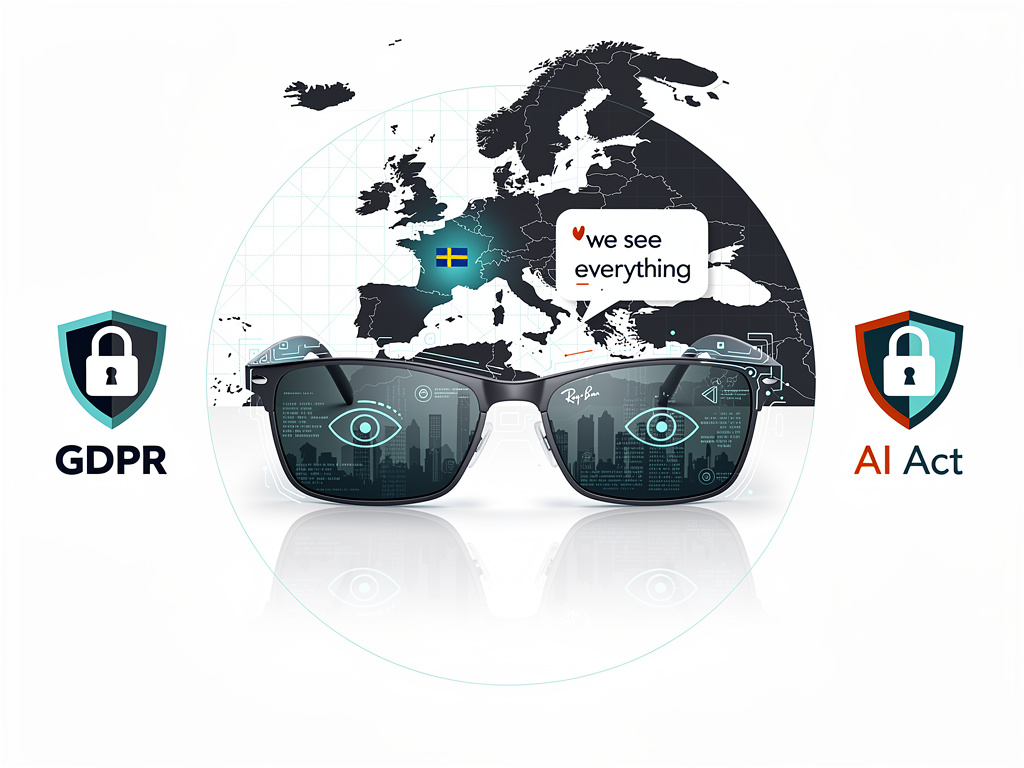
In warehouses, retail floors, and corporate offices across Europe and the United States, a quiet transformation is underway. Meta’s Ray-Ban smart glasses — equipped with cameras, microphones, and increasingly powerful artificial intelligence — are showing up on the faces of workers, managers, and everyday consumers. And the people around them are growing uneasy.
A striking investigation by Svenska Dagbladet (SvD) has brought fresh attention to the privacy implications of Meta’s wearable AI devices, featuring testimony from workers who describe the glasses’ capabilities in blunt terms: “We see everything.” The report details how employees equipped with the glasses can record video, take photos, livestream to social media, and query Meta’s AI assistant — all while the people being observed may have no idea a camera is pointed at them.
A Familiar Design Hiding Unfamiliar Power
Meta’s Ray-Ban Meta smart glasses, developed in partnership with EssilorLuxottica, look almost indistinguishable from ordinary Ray-Ban Wayfarers. That design choice is deliberate — and, critics argue, deceptive. Unlike a smartphone held up to record, or a GoPro strapped to a helmet, the glasses offer no obvious signal to bystanders that they are being filmed. A tiny LED light on the frame is supposed to indicate when the camera is active, but multiple reports have noted that the light is nearly invisible in daylight or from more than a few feet away.
The SvD investigation highlighted how this near-invisibility creates an asymmetry of power. Workers interviewed for the piece described scenarios in which supervisors or colleagues wearing the glasses could monitor activity on a shop floor without anyone being aware. “You don’t know if they’re recording or not,” one worker told the Swedish newspaper. “It changes the way you behave, the way you talk. It’s like being watched all the time without knowing it.”
The AI Layer Amplifies the Surveillance Concern
What separates Meta’s current generation of smart glasses from earlier attempts — including Google Glass, which provoked a public backlash a decade ago — is the integration of Meta AI. Users can activate the assistant by saying “Hey Meta” and ask it to identify objects, translate text, describe surroundings, or answer questions about what the camera sees. In April 2025, Meta rolled out expanded AI capabilities that allow the glasses to remember previous interactions and offer contextual suggestions throughout the day.
This persistent AI awareness raises the stakes considerably. The glasses are no longer just a passive recording device; they are an active perception system that can process and interpret visual and audio data in real time. According to reporting by The Verge, Meta has been steadily expanding what its AI can do through the glasses, including the ability to scan documents, recognize landmarks, and even identify products and suggest where to buy them. Privacy advocates have warned that facial recognition — which Meta has publicly said it will not enable — could be added at any time through a software update.
European Regulators Sound the Alarm
The European Union, which has the world’s most stringent data protection regime under the General Data Protection Regulation (GDPR), has been paying close attention. Italy’s data protection authority, the Garante, was among the first to raise concerns, sending formal questions to Meta about how the glasses handle personal data collection. The Irish Data Protection Commission, which oversees Meta’s European operations due to the company’s EU headquarters in Dublin, has also signaled that it is monitoring the situation.
In its reporting, SvD noted that Swedish privacy experts have expressed concern that the glasses could violate GDPR provisions on consent and purpose limitation. Under GDPR, recording individuals in public or private spaces generally requires either explicit consent or a legitimate legal basis. The notion that a passerby or coworker might be recorded without their knowledge — and that the footage could be processed by Meta’s AI systems — sits uneasily with these requirements.
Workplace Surveillance Takes on a New Dimension
The workplace implications are particularly fraught. Labor unions in several European countries have begun raising the issue of smart glasses as a tool of employer surveillance. In Sweden, where strong labor protections are deeply embedded in the culture, the SvD investigation resonated because it touched on fundamental questions about the balance of power between employers and employees.
Workers described to SvD a chilling effect: even when the glasses were not actively recording, their mere presence altered behavior. This phenomenon — sometimes called the “panopticon effect” after philosopher Jeremy Bentham’s concept of a prison where inmates never know if they are being watched — has been well documented in surveillance studies. The difference now is that the surveillance device fits on someone’s face and costs $299.
Meta’s Defense: Transparency and User Control
Meta has pushed back against the most alarming characterizations of its smart glasses. The company has pointed to several design features intended to protect privacy: the LED indicator light, the requirement that users manually activate recording, and the fact that video clips are limited to short durations. Meta has also emphasized that it does not use footage captured by the glasses to train its AI models, a claim that privacy researchers have had difficulty independently verifying.
In public statements, Meta has framed the glasses as a tool for personal productivity and creative expression, not surveillance. The company has noted that smartphones — which virtually everyone carries — are capable of the same recording functions and more. “People have been able to take photos and videos in public for decades,” a Meta spokesperson said in a statement earlier this year. “Our glasses include a visible LED light to let people nearby know when the camera is active.”
The Google Glass Precedent — and Why This Time Is Different
Veterans of the technology industry will recall the intense backlash against Google Glass in 2013 and 2014. Wearers were dubbed “Glassholes,” bars and restaurants banned the devices, and Google eventually pulled the consumer product from the market. But Meta’s smart glasses have avoided a similar fate, in part because they look like normal eyewear and in part because public attitudes toward constant recording have shifted in the age of TikTok and Instagram.
Yet the differences between 2013 and 2025 may make the current moment more consequential, not less. Google Glass had rudimentary capabilities compared to Meta’s AI-powered system. It could not identify objects, process natural language queries about its visual feed, or integrate with a social media platform used by billions. Meta’s glasses sit at the intersection of wearable hardware, artificial intelligence, and one of the world’s largest data-collection operations — a combination that did not exist a decade ago. As The Verge has documented, each software update makes the glasses more capable, and by extension, more intrusive.
The Broader Industry Trend Toward Ambient Computing
Meta is not alone in pushing wearable AI. Apple’s Vision Pro, though a different form factor, represents a similar bet on face-mounted computing. Startups like Brilliant Labs and established players like Snap have their own smart glasses initiatives. The broader industry thesis is that computing will move from devices we hold to devices we wear — what technologists call “ambient computing.” In this vision, AI is always present, always listening, always ready to assist.
The privacy implications of this shift are enormous. If smart glasses become as common as smartphones, the default state of public life will be one of pervasive, distributed recording. Every café, every sidewalk, every office will contain multiple camera-equipped, AI-connected devices on people’s faces. The question is not whether this technology will spread — it almost certainly will — but whether legal and social norms can adapt quickly enough to prevent abuse.
What Comes Next for Regulation and Public Trust
Regulators in Europe are likely to act first. The EU’s AI Act, which began phased implementation in 2024, includes provisions that could apply to the real-time processing capabilities of smart glasses, particularly if biometric identification features are added. The GDPR already provides a framework for challenging unconsented recording, though enforcement has been uneven.
In the United States, the regulatory picture is more fragmented. No federal privacy law governs this kind of consumer recording device comprehensively. Some states, including Illinois with its Biometric Information Privacy Act, offer stronger protections, but the patchwork approach leaves significant gaps. Congressional interest in AI regulation has grown, but legislation remains stalled amid broader political gridlock.
The workers interviewed by SvD offered perhaps the most direct assessment of the situation. They are not privacy lawyers or technology critics. They are people who wear the glasses, who understand what they can do, and who recognize the discomfort they cause. “We see everything,” they said. The question now is whether society will decide that seeing everything is something it wants to allow.


 WebProNews is an iEntry Publication