
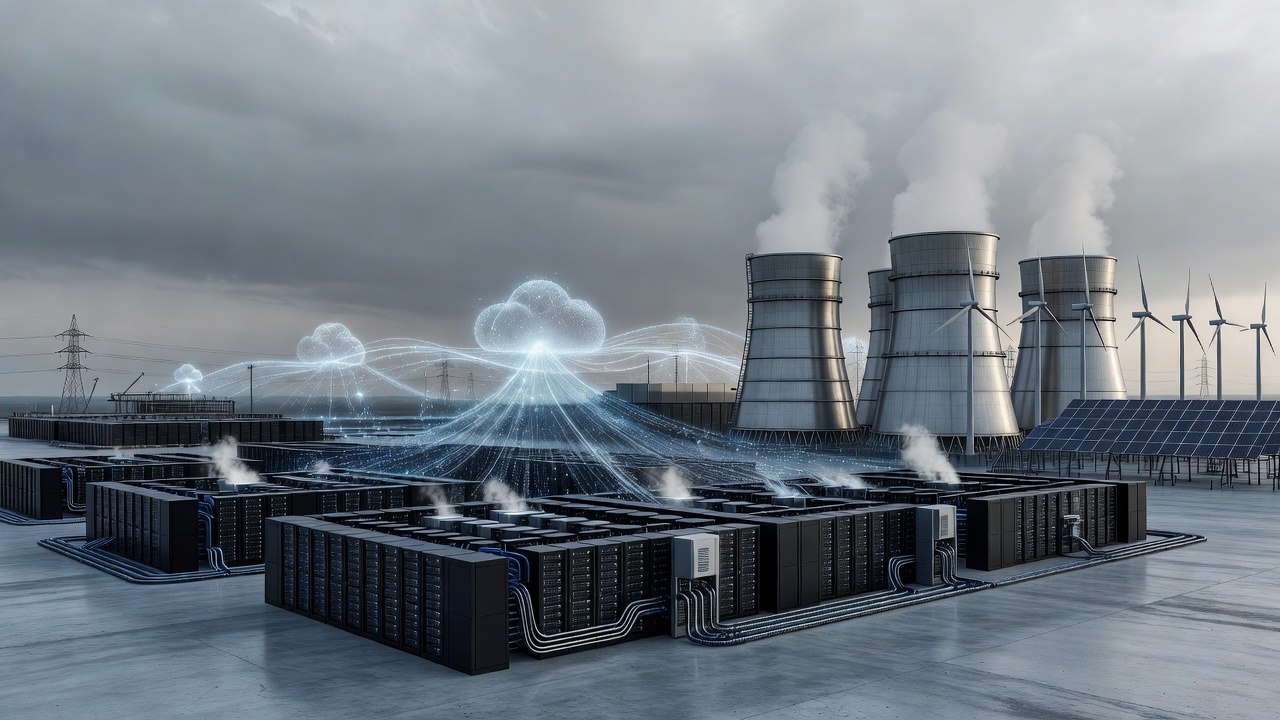
Mark Zuckerberg once again rewrote expectations. Meta Platforms now commits more than $600 billion to U.S. infrastructure by 2028. The bulk targets AI data centers on a scale that dwarfs prior tech builds. Short term? Capital expenditures hit between $115 billion and $135 billion for 2026 alone. That’s nearly double the prior year’s record.
The shift marks a departure. For years Meta poured resources into custom silicon and massive GPU clusters mainly to advance its own models and advertising tools. Now the company establishes Meta Compute. This new division manages excess capacity. It eyes sales of raw compute power and access to Llama models through a budding cloud service. Bloomberg first reported the move on July 1, 2026. Shares jumped over 7% that day. Yahoo Finance captured the investor reaction and the catch: infrastructure economics carry thinner margins than digital ads.
Zuckerberg leaves little doubt about ambition. “Meta is planning to build tens of gigawatts this decade, and hundreds of gigawatts or more over time,” he stated in January 2026. The words came as Meta formed Meta Compute under leaders Santosh Janardhan and Daniel Gross. Data Center Dynamics detailed the structure and the quote. Such capacity demands power plants, transmission lines and years of construction. It also demands fresh thinking on monetization.
Hyperion rises in rural Richland Parish, Louisiana. The project eyes 2 gigawatts at launch with potential to reach 5 gigawatts. A $27 billion joint venture with Blue Owl Capital funds much of it. Blue Owl covers 80% of costs. Similar builds dot other states. El Paso in Texas. Lebanon in Indiana. Tulsa in Oklahoma. Each facility carries 1 gigawatt or more once finished. Meta’s own site lists 32 owned and operated data centers worldwide. Newer ones follow an AI-optimized design that prioritizes efficiency and rapid scaling. Meta’s corporate blog highlights the $600 billion pledge and its role in adding 15 gigawatts of energy to American grids.
But power doesn’t appear from thin air. Meta signs deals for nuclear output reaching 6.6 gigawatts across agreements with Vistra, Constellation Energy and small modular reactor developers Oklo and TerraPower. It also contracts with Crusoe for 1.6 gigawatts at sites in Texas and Missouri. And it turns to hyperscalers and specialists. Over $10 billion with Google Cloud. $14.2 billion with CoreWeave. $3 billion with Nebius. Talks for $20 billion with Oracle. These moves buy time while owned facilities come online. They also signal that internal demand still outstrips supply.
Open source strategy underpins much of this spend. Llama 4 arrived in April 2025. Scout and Maverick versions brought native multimodality and mixture-of-experts architecture. A larger Behemoth model served as teacher. Meta positioned the family as top performers on benchmarks while remaining open weight. Developers downloaded them by the millions. That popularity drives inference demand. It also creates the very excess capacity Meta now seeks to sell.
Investors watch closely. Advertising still supplies 98% of revenue. First-quarter 2026 figures showed $56.31 billion total, $55.02 billion from ads. Operating margin held at 41%. Strong. Yet the infrastructure bill keeps climbing. Revised 2026 capex guidance of $125 billion to $145 billion reflects higher component prices and accelerated data center work. A cloud business could offset some expense. It might also drag Meta into direct competition with Amazon Web Services, Microsoft Azure and Google Cloud. Those players enjoy scale and established enterprise relationships. Meta starts from behind.
The Economic Footprint and Local Trade-offs
Meta casts the buildout as patriotic and practical. Since 2010 its data centers supported more than 30,000 skilled trade jobs and 5,000 permanent operational roles. Subcontractors received over $20 billion. The company ranks among the largest buyers of American steel, concrete and electrical equipment. Local communities gain roads, schools and workforce programs. Meta claims $58 million in recent grants. Meta’s corporate blog frames the $600 billion as reinforcement of U.S. technological leadership.
Critics see different numbers. A single hyperscale AI facility can consume electricity equal to hundreds of thousands of homes. Hyperion alone may eventually exceed the power draw of entire cities. New natural gas plants received approval to serve Louisiana and Ohio sites. Water usage raises flags too. Cooling towers pull millions of gallons daily in some counties. One Georgia facility already accounts for 10% of local supply. Reports from 2025 and 2026 document these pressures in states courting the projects with tax breaks. Meta counters with efficiency claims, water restoration projects and a goal to become water positive by 2030. Results remain uneven.
Recent coverage adds nuance. Fortune questioned the U.S.-centric approach on July 2, 2026. Gulf states offer cheaper power from oil and gas. Sovereign funds there pour money into data centers. Why not chase the lowest cost? Zuckerberg’s team appears to favor domestic control, regulatory familiarity and proximity to talent. The cloud business may further tilt the calculation toward utilization over pure cost.
Wall Street analysts split. Some praise the pivot to monetization. Others worry about execution risk and margin dilution. Goldman Sachs and McKinsey projections show hyperscalers together spending $600 billion to $700 billion in 2026. Meta’s share forms a sizable chunk. If utilization rates stay high and Llama adoption continues, the bet pays. If models plateau or competition intensifies, the fixed costs weigh heavier.
So far Meta shows no signs of slowing. It reuses older DDR4 memory in new servers through a project called Vistara. It experiments with low-carbon concrete and AI-optimized formulas. These steps trim expenses at the margin. Yet the core wager stays enormous. Hundreds of gigawatts. Tens of billions in annual spend. A new cloud division that must compete on price, reliability and model quality.
Zuckerberg believes superintelligence draws nearer. The infrastructure must arrive first. Everything else follows. Meta’s latest moves suggest the company no longer views its data centers as mere support systems for social media. They become a potential platform in their own right. The coming quarters will test whether that platform can generate returns worthy of the outlay. Or whether the catch Yahoo Finance flagged proves too expensive after all.


 WebProNews is an iEntry Publication