
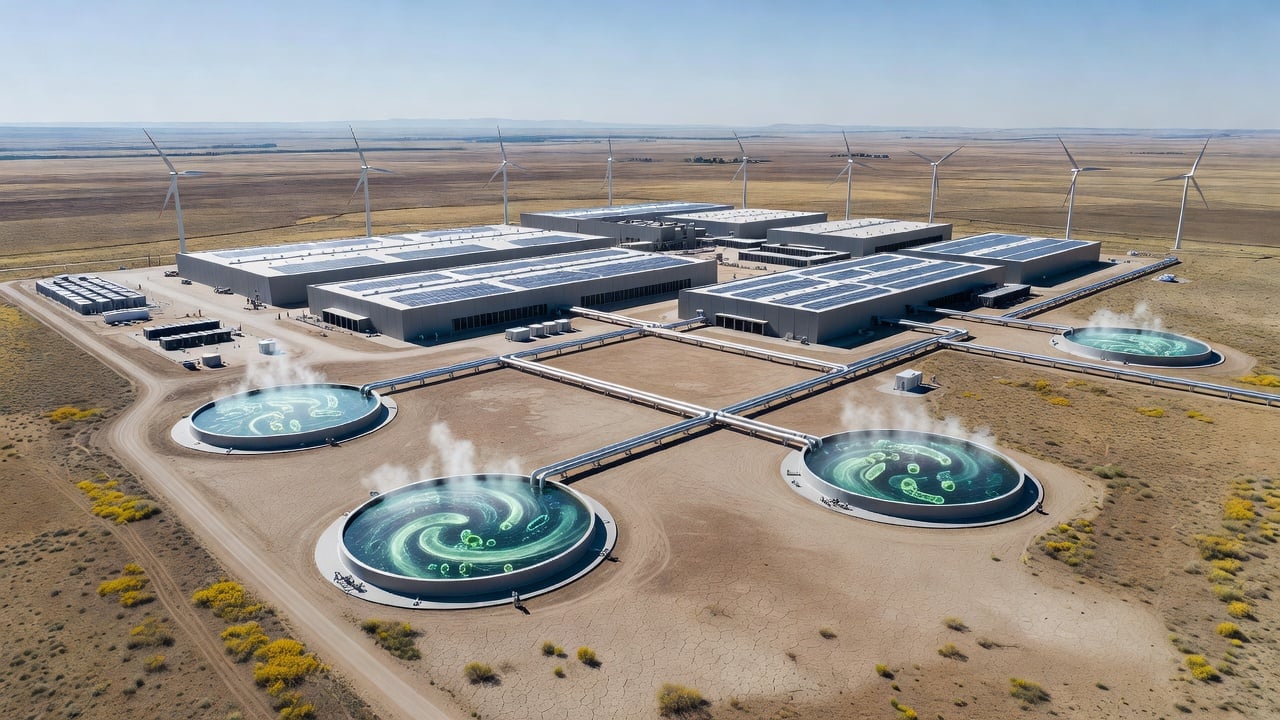
Mark Zuckerberg has drawn fresh attention to the scale of artificial intelligence infrastructure with plans for a massive data center in Wyoming that will rely on an unusual cooling method involving bacteria. The Meta chief executive confirmed the project during a public appearance, highlighting how the facility will consume enormous amounts of electricity and water while employing biological processes to manage heat. According to a report from the Daily Mail, the chosen location sits on a 900-acre site near Cody, a small town known more for its cowboy heritage than for silicon valley ambitions.
The facility represents one of several large-scale AI training centers Meta intends to build across the United States. Industry analysts estimate the Wyoming project alone could require up to 700 megawatts of power once fully operational, enough electricity to supply hundreds of thousands of homes. Such demand has raised immediate questions about local grid capacity and the environmental consequences of supporting advanced machine learning models that grow more resource-hungry with each generation.
Zuckerberg explained that traditional air cooling would prove inadequate for the dense clusters of graphics processing units expected inside the buildings. Instead, engineers plan to circulate water through the servers and then treat that water with specially selected bacteria. These microorganisms consume organic matter and help regulate temperature by breaking down waste products that might otherwise clog pipes or reduce efficiency. The biological approach aims to lower overall water consumption compared with evaporative cooling towers, which lose significant volumes to the atmosphere.
Local residents in Park County have expressed mixed feelings. Some welcome the economic boost that could arrive with construction jobs and long-term technical employment. Others worry about the strain on water resources in a state already facing periodic drought. Wyoming receives far less annual precipitation than coastal regions, and critics point out that even efficient bacterial systems still require substantial initial water volumes to operate the closed-loop cooling circuits.
Meta has committed to sourcing a large share of the electricity from renewable sources. Company representatives indicated that wind and solar farms will feed directly into the data center, supplemented by grid power when necessary. The state of Wyoming already hosts considerable wind generation capacity, which could align with Meta’s stated goal of carbon-neutral operations. However, renewable energy availability fluctuates, and experts caution that backup natural gas plants might still be needed during peak AI training cycles when models run without interruption for weeks at a time.
The bacterial cooling concept draws on existing research in bioremediation and industrial microbiology. Scientists have long used selected strains of bacteria to treat wastewater in municipal plants and factories. In the Meta installation, the microbes would target biofilm formation and mineral scaling inside heat exchangers. By keeping surfaces clean at a microscopic level, the system could maintain higher thermal transfer rates and reduce maintenance downtime. Engineers will monitor bacterial populations continuously, adjusting nutrient levels and pH to prevent any single strain from dominating and causing unintended corrosion.
This approach fits into a broader pattern of data center operators experimenting with alternative cooling technologies. Hyperscale facilities operated by Google, Microsoft, and Amazon have tested everything from deep lake water intake to immersion cooling with specialized fluids. Meta’s decision to incorporate living organisms marks a notable departure from purely mechanical solutions and reflects growing interest in biologically inspired engineering.
Beyond cooling, the Wyoming site will house thousands of the latest accelerator chips designed specifically for large language model training. These processors generate intense localized heat, often exceeding 700 watts per unit. Traditional server racks already pack dozens of such chips, and future designs are expected to increase density further. The resulting thermal load makes conventional air conditioning impractical, pushing operators toward liquid cooling in all its forms.
Zuckerberg has repeatedly emphasized that artificial intelligence represents the defining technology of the coming decade. During internal meetings and public interviews, he has described ambitious roadmaps that call for training models with trillions of parameters. Each leap in scale demands proportionally greater computing resources, which in turn translate into larger physical plants. The Wyoming facility forms part of a multi-billion-dollar capital expenditure program that Meta expects to sustain for several years.
Community leaders in Cody have begun negotiations over tax incentives and infrastructure upgrades. The town’s existing power substations would require significant expansion to accommodate the new load. Water rights also present a complex legal picture, as agricultural users hold senior claims in many Western states. Meta will likely need to secure long-term agreements that guarantee supply without disrupting local ranches and farms.
Environmental organizations have called for independent audits of the project’s projected water usage and carbon footprint. While bacterial treatment may reduce evaporation losses, the overall volume of water circulating through the system could still reach millions of gallons daily. Advocates urge Meta to publish detailed metrics and allow third-party verification, especially given the company’s past commitments to sustainability reporting.
On the technical side, researchers familiar with biological cooling note several challenges that must be solved before deployment. Bacterial colonies can evolve rapidly, potentially developing resistance to control measures or producing corrosive byproducts. Strict containment protocols will be necessary to prevent any escape into the surrounding environment. Additionally, the heat generated by server racks must be transferred efficiently to the water without killing the very organisms intended to keep the system clean. Engineers plan to maintain separate temperature zones, using heat exchangers that isolate the server loop from the biological treatment loop.
Despite these complexities, proponents argue that biological solutions could prove more adaptable than purely chemical or mechanical alternatives. Bacteria can be tuned through genetic selection to thrive under specific operating conditions, offering a degree of customization not easily matched by static materials. If successful, the Meta installation could serve as a proof of concept for other industries facing similar thermal management problems, from pharmaceutical manufacturing to high-performance computing clusters at universities.
The announcement also highlights the shifting geography of technology infrastructure. For decades, data centers clustered near major population centers or submarine cable landing points to minimize latency. Increasingly, operators choose remote locations with abundant land, cheap power, and favorable climates. Wyoming offers all three, along with a business-friendly regulatory environment that has attracted other large energy projects. Similar considerations have drawn hyperscale facilities to states such as Nevada, Iowa, and the Dakotas.
Zuckerberg’s personal involvement in the project underscores his hands-on approach to infrastructure decisions. The Meta founder has toured multiple proposed sites and reviewed architectural plans, according to people familiar with the process. His emphasis on sustainable cooling methods appears consistent with public statements about responsible AI development. Whether the bacterial system delivers on its promise remains to be seen, but the experiment itself signals a willingness to explore unconventional paths when standard approaches reach their limits.
Local economic development officials hope the data center will catalyze further investment in the region. Plans for fiber optic upgrades and workforce training programs have already surfaced in preliminary discussions. If the facility operates smoothly, it could encourage other technology companies to consider Wyoming as a viable alternative to traditional hubs in Virginia, Texas, or Oregon.
At the same time, energy experts caution that AI-driven demand could test the limits of even the most carefully designed renewable integration strategies. Training a single frontier model can consume electricity equivalent to the annual usage of thousands of households. As companies race to deploy ever-larger systems, the cumulative impact on national power grids may require policy changes at the federal level. Regulators have begun examining whether current permitting processes can keep pace with the speed of private investment in computing capacity.
Meta has indicated that construction could begin within the next year, subject to final regulatory approvals and successful pilot testing of the bacterial cooling technology. Early prototypes have shown encouraging results in laboratory settings, but scaling to full data center size introduces variables around flow rates, microbial stability, and integration with existing server hardware. The company plans to partner with specialized biotechnology firms to refine the bacterial mixtures and develop monitoring tools that provide real-time data on colony health.
For the residents of Cody, the coming months will bring a wave of technical assessments, public hearings, and community meetings. The project promises jobs and tax revenue but also carries risks related to resource consumption and landscape change. How local leaders balance those factors will help determine whether the bacterial data center becomes a model for responsible growth or a cautionary tale about unchecked technological expansion.
Zuckerberg himself has framed the initiative as part of a larger effort to build the infrastructure necessary for artificial intelligence to benefit society at large. He has spoken about using advanced models to accelerate scientific discovery, improve medical diagnostics, and address climate challenges. Realizing those aspirations, however, depends first on constructing the physical plants that can train the models, and doing so in ways that respect environmental boundaries. The Wyoming project will test whether biological innovation can meet that test at industrial scale.
As planning proceeds, engineers continue tweaking the precise bacterial strains and nutrient formulations. Early indications suggest that a carefully balanced consortium of species can maintain system performance while minimizing chemical additives. If those results hold under real-world conditions, the facility could demonstrate a new template for data center design that other operators might adopt. The outcome will likely influence not only Meta’s future expansion but also the broader conversation about how society powers and cools the computational engines driving the next phase of digital progress.


 WebProNews is an iEntry Publication