
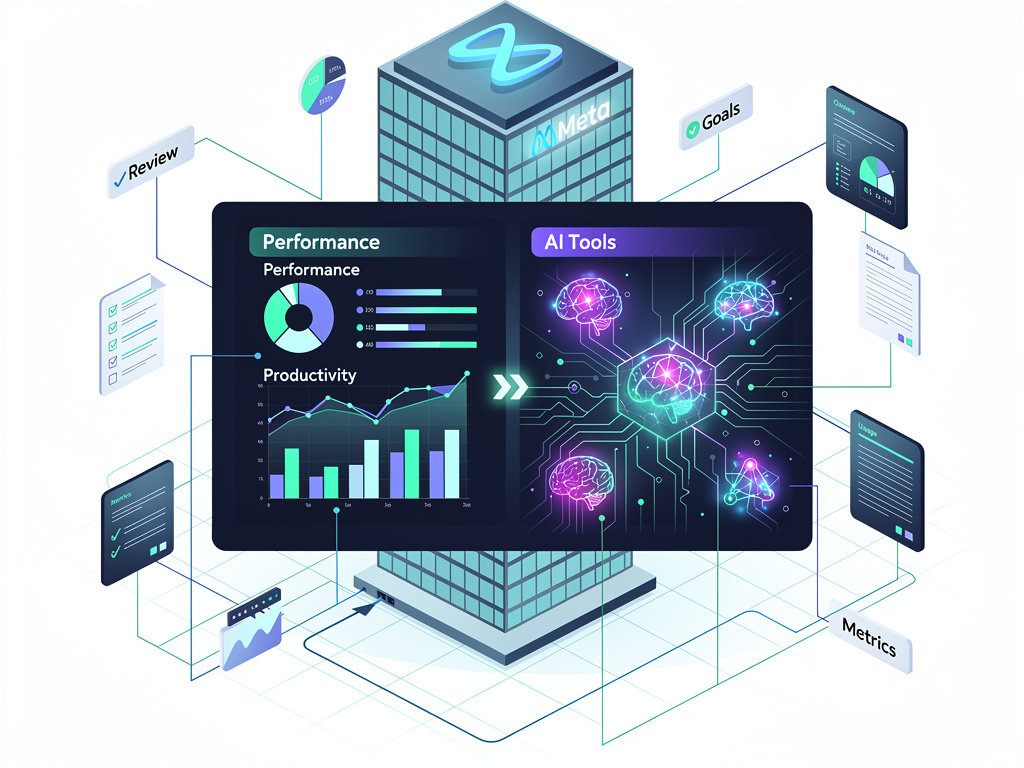
In a watershed moment for corporate technology adoption, Meta Platforms has become the first major technology company to formally integrate artificial intelligence tool usage into employee performance evaluations, according to The Information. The move signals a fundamental shift in how Silicon Valley measures productivity and worker value, potentially setting a precedent that could ripple across the technology sector and beyond.
The policy, which took effect in Meta’s latest performance review cycle, requires employees to demonstrate regular engagement with the company’s suite of AI-powered tools, including its internal coding assistants and productivity applications. Engineering managers at the Menlo Park-based company now evaluate workers partly on their ability to leverage these systems to accelerate development cycles and improve code quality. This mandate arrives as companies worldwide grapple with justifying massive investments in generative AI infrastructure while struggling to quantify tangible returns on those expenditures.
Meta’s decision reflects broader anxiety among technology executives about adoption rates for AI tools despite billions in capital expenditures. The company has invested heavily in developing proprietary large language models and integrating AI capabilities across its product suite, yet internal surveys revealed that significant portions of its engineering workforce were not consistently utilizing available tools. By tying performance metrics to AI usage, Meta is effectively forcing a behavioral change that voluntary adoption campaigns failed to achieve.
The Productivity Measurement Dilemma Facing Tech Giants
The challenge of measuring AI-driven productivity gains has emerged as one of the most vexing problems for corporate leadership in 2024. While companies like Microsoft, Google, and Amazon have deployed AI coding assistants to tens of thousands of developers, concrete data demonstrating measurable efficiency improvements remains elusive. Traditional metrics such as lines of code written or tickets closed fail to capture the nuanced ways AI tools can enhance developer workflows, from accelerating debugging to improving code documentation.
Meta’s approach attempts to sidestep this measurement problem by focusing on adoption as a proxy for productivity. The underlying assumption is that if tools are used consistently, productivity gains will naturally follow. However, this logic has drawn criticism from software engineering experts who argue that forced adoption without proper training and cultural support may actually decrease productivity in the short term as workers adjust to new workflows.
Microsoft and OpenAI Navigate Security Concerns Amid Expansion
Meanwhile, Microsoft and OpenAI are confronting a different set of challenges as they scale their AI offerings to enterprise customers. The Information reported that security vulnerabilities in OpenClaw, an internal tool used by both companies, have raised concerns about the safety of deploying AI systems in sensitive corporate environments. The security issues involve potential data leakage between different customer instances, a critical flaw that could expose proprietary information if left unaddressed.
These security concerns arrive at a particularly sensitive moment for Microsoft’s AI ambitions. The company has positioned its Copilot suite of AI tools as essential infrastructure for modern enterprises, with CEO Satya Nadella repeatedly emphasizing AI as the defining technology platform of the coming decade. Any perception that these systems compromise data security could significantly slow enterprise adoption, particularly in regulated industries such as finance and healthcare where data protection requirements are stringent.
OpenAI, for its part, has been working to address these vulnerabilities while simultaneously managing the explosive growth of its enterprise customer base. The company has hired additional security personnel and implemented more rigorous testing protocols for its production systems. However, the incidents underscore the inherent tension between rapid deployment of AI capabilities and the methodical security practices that enterprise customers demand.
The Competitive Dynamics of Enterprise AI Adoption
Meta’s performance review policy also reflects intensifying competition among technology companies to demonstrate AI leadership to investors and customers. After spending tens of billions of dollars on AI infrastructure, companies face mounting pressure to show that these investments are translating into concrete business advantages. By mandating AI tool usage, Meta can point to near-universal adoption rates as evidence that its AI strategy is gaining traction internally, even if quantifying the productivity impact remains challenging.
This competitive dynamic has created a feedback loop where companies feel compelled to match or exceed the AI commitments of their peers. When one major technology company announces aggressive AI integration plans, others feel pressure to respond with equally ambitious initiatives. The result is an arms race of AI adoption where the focus on speed and scale sometimes overshadows questions about effectiveness and return on investment.
Employee Response and Workforce Implications
Within Meta, the performance review policy has generated mixed reactions from employees. Some engineers have embraced the mandate as validation of their existing AI tool usage and appreciate having clear guidelines about expectations. Others view the policy as heavy-handed micromanagement that fails to account for the reality that AI tools are not equally useful across all engineering tasks or domains.
The policy also raises questions about how companies should handle workers who struggle to adapt to AI-augmented workflows. While younger engineers who have trained on AI tools from the beginning of their careers may find the transition natural, more experienced developers accustomed to traditional methods may require significant retraining. Meta has indicated it will provide additional training resources, but the effectiveness of these programs in changing long-established work habits remains to be seen.
There are also concerns about potential bias in how AI tool usage is measured and evaluated. Engineers working on legacy systems or specialized domains where AI tools are less applicable may find themselves at a disadvantage compared to colleagues working on newer codebases where AI assistance is more readily integrated. Meta has stated that managers will have discretion to account for these variations, but the lack of standardized metrics could lead to inconsistent application of the policy across different teams.
Broader Industry Implications and Future Trajectory
Meta’s decision to formalize AI usage in performance reviews will likely prompt other technology companies to consider similar policies. Google, Amazon, and Microsoft have all invested heavily in internal AI tools and may view Meta’s approach as a template for driving adoption within their own organizations. However, each company faces unique cultural considerations that will shape how they approach this challenge.
The move also has implications beyond the technology sector. As AI tools become more sophisticated and widely available, companies across industries are wrestling with how to encourage adoption while measuring impact. Meta’s experiment in tying performance reviews to AI usage provides one data point in what will likely be a broader evolution of how companies think about productivity in an AI-augmented workplace.
Looking ahead, the success or failure of Meta’s policy will depend largely on whether forced adoption translates into genuine productivity gains. If the company can demonstrate measurable improvements in development velocity, code quality, or other key metrics, other organizations will likely follow suit. Conversely, if the policy creates resentment among employees without delivering clear benefits, it may serve as a cautionary tale about the limits of top-down AI adoption mandates.
The Evolving Definition of Engineering Excellence
At a deeper level, Meta’s policy represents a fundamental rethinking of what constitutes engineering excellence in the age of AI. For decades, the ability to write elegant code from scratch has been a hallmark of exceptional software engineers. Now, companies are beginning to value the ability to effectively leverage AI tools as an equally important skill. This shift has profound implications for how engineers are trained, evaluated, and compensated.
The transition also raises philosophical questions about the nature of software development work. If AI tools can handle routine coding tasks, what becomes the primary value that human engineers provide? Meta’s bet is that engineers who can effectively combine their domain expertise with AI capabilities will be more valuable than those who rely solely on traditional methods. Whether this proves true will shape the trajectory of software engineering as a profession for years to come.
As the technology industry continues to navigate this transition, Meta’s performance review policy stands as a bold experiment in accelerating AI adoption through institutional pressure. The outcomes will be closely watched by executives, investors, and workers across the sector as they seek to understand how artificial intelligence will reshape the future of knowledge work.


 WebProNews is an iEntry Publication