
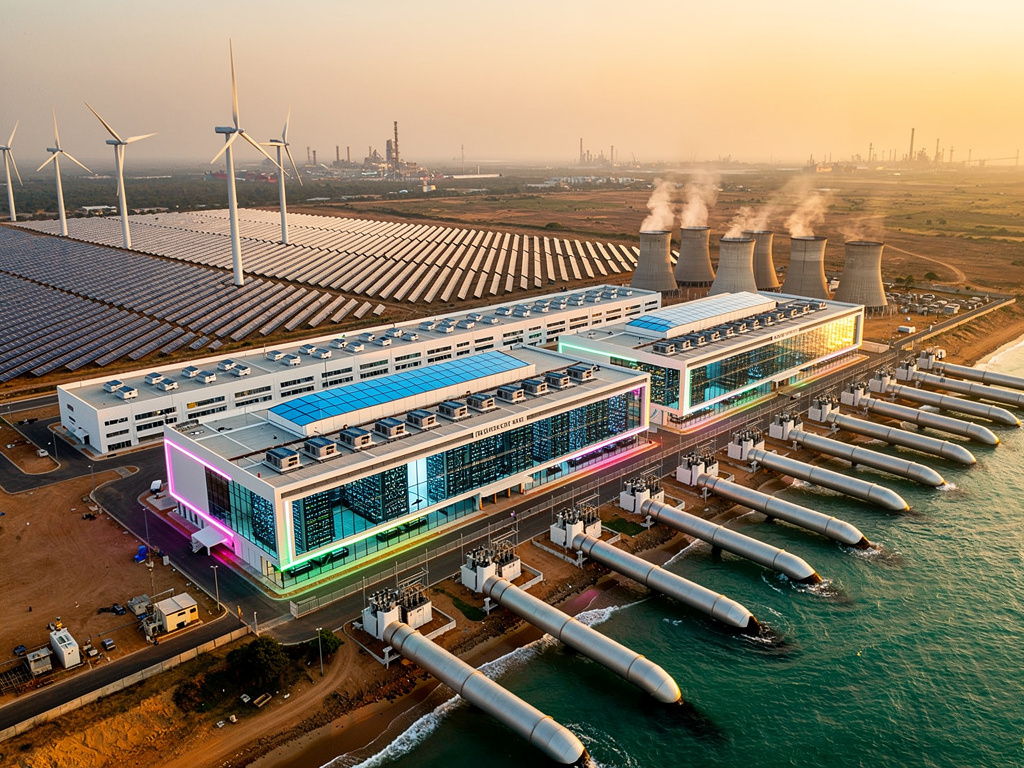
Meta Platforms struck a deal Wednesday to lease a 168-megawatt AI-ready data center in Jamnagar, Gujarat. Reliance Industries will build and operate the facility. The agreement marks Meta’s first custom-built data center on Indian soil.
The news comes as Mukesh Ambani’s conglomerate accelerates plans to spend roughly $110 billion on AI infrastructure over seven years. Construction has already started on multi-gigawatt facilities in Jamnagar. More than 120 megawatts of capacity are slated to come online in the second half of 2026. TechCrunch reported the scale of that commitment in February.
But the Meta transaction stands out. It deepens a relationship that began in 2020 with a $5.7 billion investment in Jio Platforms. Last year the two companies formed a joint venture to create enterprise AI tools based on Meta’s Llama models. Now they move from software to the physical backbone that powers large-scale artificial intelligence.
“Building India’s first built-to-suit data centre for a global technology leader of Meta’s scale demonstrates India’s readiness to be at the forefront of the global AI revolution,” Ambani said in a statement. Jamnagar will become a landmark destination for hyperscale AI computing, he added.
The facility will run on renewable energy. It will use desalinated seawater for cooling. That choice matters in a country where water stress often complicates data center projects. Reliance already operates the world’s largest single-site oil refinery in Jamnagar. The company now pivots parts of that industrial base toward compute.
Meta will lease the 168-megawatt site with options to expand. The U.S. company did not disclose financial terms. It did say the data center will serve one of its fastest-growing user communities. India counts more than 300 million monthly active users on Facebook alone. WhatsApp reaches even more.
And power costs matter. So do latency requirements. Local infrastructure lets Meta train and serve models closer to its Indian audience. It also aligns with New Delhi’s push to keep data within borders. The government has offered foreign companies tax breaks lasting more than 20 years for using local data centers. Reuters detailed those incentives in its coverage of the announcement.
Reliance’s ambitions stretch far beyond this single lease. The company aims for gigawatt-scale AI data centers. It plans a nationwide edge computing network. Jio Intelligence, its new sovereign AI stack, targets India’s languages and real-world needs. Ambani unveiled the vision in February at the India AI Impact Summit in New Delhi. He framed the effort as nation-building.
Other Indian giants chase the same prize. Adani Group pledged $100 billion for AI and data infrastructure. Global cloud providers pour in capital too. Google partnered with Jio to give millions of users free access to Gemini AI Pro. Microsoft and Amazon expand their own footprints.
Yet supply lags demand. India’s electricity grid strains under the load of new AI facilities. Water availability creates another bottleneck in many regions. The Jamnagar project’s seawater cooling offers one workaround. Still, experts question whether renewable generation can scale fast enough to match announced targets.
Meta’s move carries strategic weight. The company faces pressure to cut reliance on third-party cloud providers for its own AI work. Owning or leasing dedicated capacity gives tighter control over costs and performance. It also lets Meta test Llama model inference and fine-tuning at scale in a high-growth market.
The joint venture from last year, Reliance Enterprise Intelligence Limited, gives Meta a 30 percent stake. Initial capital stood at about $100 million. That entity focuses on enterprise AI services for Indian businesses. The data center lease feeds directly into those ambitions.
Construction timelines remain fluid. The partners expect the facility to go live within two years. That would put it online in 2028 at the latest. By then Reliance hopes to have hundreds more megawatts running in Jamnagar alone.
Analysts see the partnership as a template. Global technology firms gain access to cheap land, favorable policy and local execution muscle. Indian conglomerates secure cutting-edge models, technical expertise and long-term leases that help finance massive builds. Both sides win market position in what could become one of the world’s largest AI consumption markets.
Challenges remain. Talent shortages plague the sector. Regulatory questions around data sovereignty persist. And the sheer capital intensity of gigawatt-scale projects tests even companies of Reliance’s size. Ambani has sold stakes and raised debt before. He may need to do so again.
Still, momentum builds. On X, traders and observers reacted quickly to the announcement. One noted that Meta will cover energy and water costs under the lease structure. Another highlighted the seawater cooling as an engineering edge in a water-stressed country.
The deal arrives at a moment when U.S. tech giants hunt for AI infrastructure anywhere they can find it. Power constraints in Virginia, land shortages in Europe and political risk in some Asian markets make India look increasingly attractive. Tax breaks help. So does the sheer size of the addressable user base.
Meta’s official blog post called the agreement a significant expansion of the strategic partnership. The company stressed that the data center is purpose-built for its needs. Reliance will handle construction, operations and maintenance. Meta focuses on the compute workload.
That division of labor plays to each company’s strengths. Ambani’s team has decades of experience building and running massive industrial plants. Meta knows how to design AI systems that serve billions. Together they aim to create something new for the Indian market.
Whether this single 168-megawatt site sparks a broader wave of foreign leases remains to be seen. Yet the signal is clear. After years of investing in Indian digital services, Meta now bets on Indian physical infrastructure to power its AI future. Reliance, for its part, gains a flagship customer that validates years of planning.
The two companies have more to discuss. Options to scale capacity suggest future phases. Joint development of AI applications for Indian enterprises could follow. And both have expressed interest in expanding the partnership into other areas of digital infrastructure.
For now the focus stays on Jamnagar. The refinery city that once symbolized India’s oil ambitions now hosts an early chapter in its AI story. Concrete will pour. Servers will rack. And the power draw will test just how ready India’s grid truly is for the artificial intelligence age.
One thing looks certain. The partnership between Meta and Reliance has moved past financial investment and software collaboration. It now includes bricks, steel and megawatts. That shift could influence how other global technology companies approach the Indian market in the years ahead.


 WebProNews is an iEntry Publication