
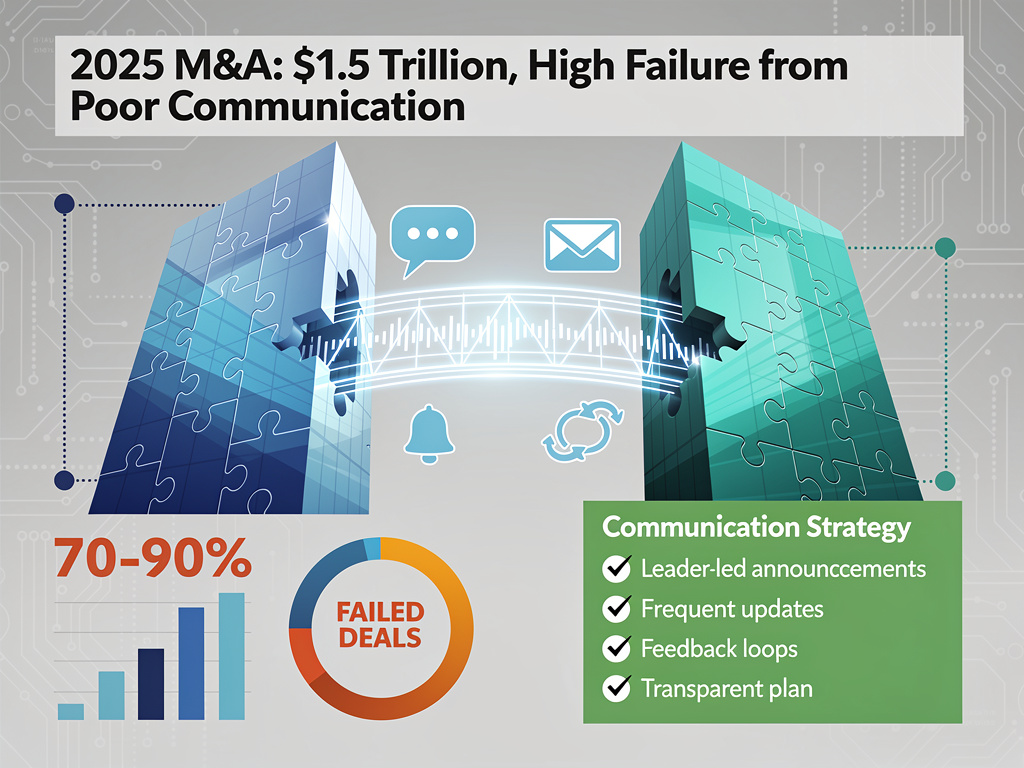
In the high-stakes arena of mergers and acquisitions, where deals worth trillions reshape industries, the true battle often unfolds not in boardrooms but on factory floors and office Slack channels. As global M&A value hit $1.5 trillion in the first half of 2025, up 15% from the prior year, executives face a stark reality: poor communication dooms most transactions. Studies show 70% to 90% of deals fail to deliver expected value, with breakdowns in employee trust and integration cited as primary culprits, according to analyses from Harvard Business School and NYU Stern’s Baruch Lev and Feng Gu in The M&A Failure Trap, which reviewed 40,000 acquisitions.
David Olsson, managing director at the Institute for Mergers, Acquisitions and Alliances, warns that without precise messaging, “gossip and rumors…come into play.” His February 2025 IMAA post stresses articulating the deal’s strategic purpose upfront, addressing concerns head-on, and delivering continuous updates to curb anxiety. This approach, echoed across recent expert guidance, underscores a shift: in 2025’s purpose-driven mid-market surge per PwC’s Global M&A Industry Trends, people synergies eclipse tech gains, as noted by Jessica Ciccozzi of East Executive.
Christopher Kummer, IMAA founder and CEO, insists leaders deliver tough news personally: “I think it’s a matter of leadership to go there and deliver this message yourself, even if it’s not a nice one.” Such candor preserved morale in deals like RHI Magnesita’s merger, where a dedicated app replaced outdated newsletters, eased cultural shifts, and drove 11% revenue growth post-integration, as detailed by theEMPLOYEEapp.
Pre-Deal Planning Locks In Alignment
Effective strategies begin long before announcements. Assemble cross-functional teams from HR, legal, IT, and communications to craft unified plans, as outlined in Cerkl’s 10-step framework and YourThoughtPartner’s nine-step guide. Identify audiences—segmenting by role, department, and tenure—ensures tailored delivery. PwC notes 2025’s strategic deals demand this precision amid economic flux.
Jo Sutherland of Magenta Associates emphasizes a “crisp messaging framework” with three pillars: deal rationale, benefits, and timelines. “M&A touches people emotionally—employees worry about jobs, teams, and culture,” she says in Financier Worldwide. Pre-empt questions with FAQs and leader toolkits; train managers to field queries consistently, avoiding the vacuum that breeds speculation.
Timing proves critical. Brief influencers first, cascade via ‘Day 1’ timelines legally permissible. McKinsey’s 2024 report flags delays hitting 30% of major acquisitions, urging contingency plans to sustain momentum. Gallup’s 2025 State of the Global Workplace reveals engagement dipping to 21%, amplifying the need for empowered managers in transitions.
Announcement Precision Cuts Through Fog
The initial reveal demands top-leader delivery via town halls, videos, or emails matching external statements. Business.com’s guide, updated January 2026 by Julie Thompson, structures it thus: state the fact and timeline; explain the ‘why’ like market expansion; tackle job security and benefits directly; route questions to HR. Olsson reinforces: “Whatever you’re saying externally has got to match what you’re saying internally.”
Video emerges as a 2025 staple, per Tribe Pictures, humanizing leaders in deals like BD’s CareFusion acquisition. For employees, highlight opportunities—promotions, growth—over threats. WTW’s Josephine Gartrell notes 72% of firms use retention agreements, communicated transparently, to stem exits.
Greencrest’s March 2025 best practices urge swift rumor countermeasures: multiple channels from webinars to Slack, with a central contact ensuring consistency. Engage influencers early for buy-in, turning potential resistors into advocates.
Sustaining Cadence Builds Lasting Trust
Post-announcement, frequency trumps volume. Cerkl advocates weekly updates tied to milestones, celebrating wins and admitting hurdles with “we’re still working on that.” Two-way channels—surveys, forums—foster feedback loops, adjusting plans dynamically as in the professional services merger case where task forces co-created values, yielding a 100-page client playbook and 1,500-employee buy-in, per YourThoughtPartner.
ROI Communication’s six phases—pre-close collaboration to integration monitoring—stress avoiding the ‘go-dark’ trap. Deloitte finds effective communicators 3.5 times more likely to retain talent; KPMG reports 91% of aligned-leadership deals hit financial targets.
Cultural fusion demands deliberate effort. Octanner highlights recognition programs signaling priorities, while Forbes councils urge ‘better together’ narratives. In cross-border complexities, Aventis Advisors’ Marcin Majewski calls sequencing vital: “Acquirer’s employees should view it as an opportunity for promotion.”
Metrics and Adaptation Drive Execution
Measure via sentiment polls, engagement rates, turnover metrics. Cerkl’s tools enable real-time tracking; adjust if gaps emerge. Financier Worldwide warns volatile 2025 geopolitics demands empathetic, proactive tones ready for social media speed.
Mercer data shows 73% of employees value comms for anxiety reduction; 67% of rewarding firms succeed in integration. EY’s nine-step integration urges integration management offices to communicate rationales clearly, cutting uncertainty.
Forbes contributors like Tribe Inc.’s CEO stress early acquired-employee outreach to counter limbo disengagement. As M&A pipelines swell into 2026 per Harvard Corporate Governance, disciplined dialogue—transparent, consistent, empathetic—turns disruption into durable value.


 WebProNews is an iEntry Publication