
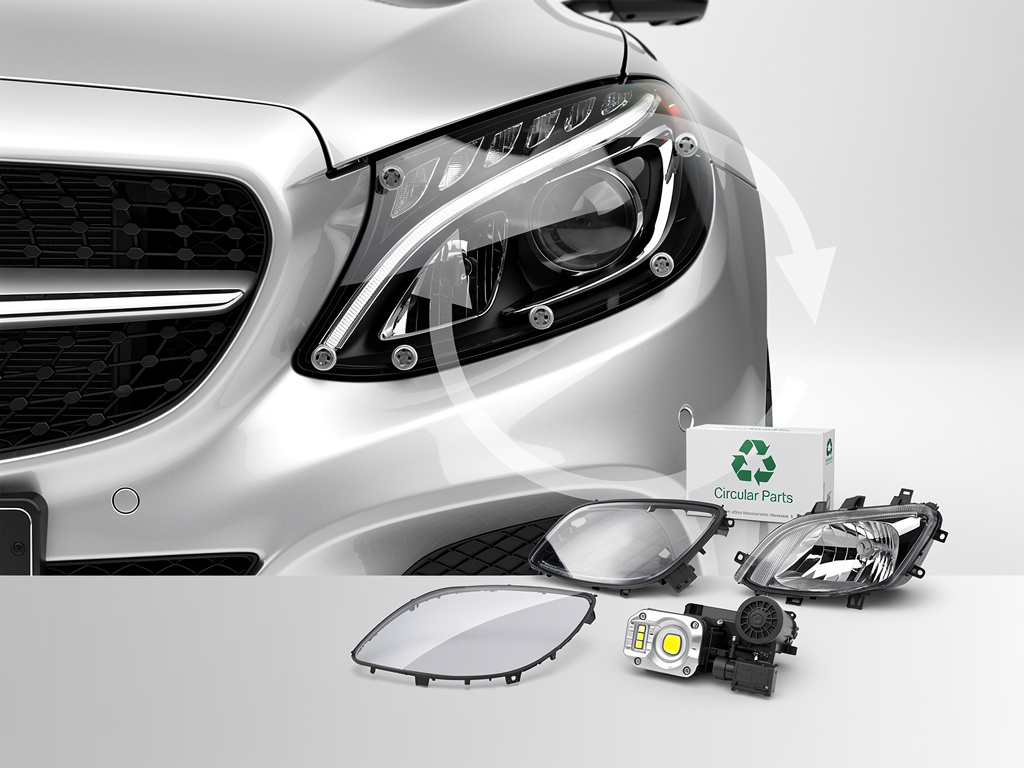
Mercedes-Benz is reviving a mechanical staple—screws—to tackle a persistent flaw in contemporary vehicle design: irreparable headlights. Under its Tomorrow XX initiative, the German automaker plans to assemble future headlight units with fasteners instead of adhesives, enabling mechanics to replace damaged lenses or frames without discarding entire assemblies. This shift promises to curb waste, lower repair bills and slash carbon emissions by nearly half compared to glued predecessors, according to company projections.
Current headlights, bonded with glue for weight savings and streamlined production, often demand full replacement for minor damage like stone chips—a practice that inflates costs for owners and insurers while generating electronic scrap. Mercedes’ mono-material approach, where components such as lenses, frames and trim share uniform composition, further eases recycling by simplifying material sorting. “There can be no doubt that the overriding goal for all our products is to excite our customers while decarbonizing the automobile, driving down resource use and growing the circular economy,” said CarBuzz quoting Olaf Schick, member of the Mercedes-Benz Group AG board for integrity, governance and sustainability.
The recyclable headlight prototype highlights Tomorrow XX’s broader ambition to embed circularity across the vehicle lifecycle, from raw materials to end-of-life disassembly. Unveiled in December 2025, the program targets over 40 components, partnering with suppliers and startups to validate innovations for production.
From Glue to Fasteners: A Design Overhaul
Mercedes engineers are reconfiguring headlight housings so the lens, cover trim, frame, electronics and other elements fasten via screws, allowing targeted repairs. A chipped lens, for instance, could be unscrewed and swapped independently, avoiding the $1,000-plus price tag of complete units prevalent today. This addresses a core inefficiency in modern assembly lines, where adhesives prioritize permanence over serviceability.
The mono-material strategy doubles recycled content potential, Mercedes estimates, as uniform plastics and metals recycle more efficiently than composites. Prototypes demonstrate feasibility, with the firm eyeing rollout as technical hurdles clear. “Avoiding a full assembly replacement reduces harmful emissions and makes the headlight easier to recycle, since individual parts are simpler to separate and sort,” reported Motor1.
U.S. regulations currently bar replaceable lenses due to sealing requirements, but global markets stand to gain, particularly in Europe where right-to-repair mandates intensify. Industry observers note this echoes broader pressures on automakers to extend component lifespans amid rising raw material costs.
Tomorrow XX’s Wider Circular Vision
Beyond lighting, Tomorrow XX repurposes waste streams innovatively. Fiberglass-reinforced polyamide from old airbags feeds into engine mounts and valve housings, while tire fibers create vibration dampers. Brake pads incorporate 40% recycled disc material, cutting production emissions by 85%, per Mercedes data shared via Mercedes-Benz Group.
Door panels swap ultrasonic welding for reversible thermoplastic rivets, facilitating material recovery. Recycled PET lightens door pockets by 40%, and low-carbon aluminum from electrolysis enters chassis parts. A new take-back facility in northwest Germany will process end-of-life vehicles, closing the loop. “Innovation is a key route to achieving this and Tomorrow XX makes clear the huge strides we are taking,” Schick added in the same CarBuzz coverage.
Procurement head Gunnar Güthenke emphasized urgency: “If we don’t take the big steps now, we won’t reach our targets for 2039.” The program spans electric and combustion models, decoupling sustainability from powertrain type.
Repair Economics Meet Regulatory Heat
Owners face steep penalties from sealed designs; a single LED failure or lens crack triggers full swaps, often insurer-covered yet environmentally costly. Screws restore modularity, potentially halving ownership expenses over time. Carscoops highlighted how stone damage now dooms assemblies, but modular builds change that calculus.
Competitors watch closely as EU directives demand reparability scores and recycled content quotas. Mercedes’ Immendingen light center, opened in October 2025 with €10.5 million investment, accelerates testing of advanced systems amid evolving lighting rules for autonomy. “The Immendingen Test and Technology Center is the first digitized Mercedes-Benz proving ground,” said CTO Markus Schäfer, per Autoblog.
This facility merges real-world and digital twins for headlights, sensors and chassis, prioritizing efficiency under sustainability scrutiny. Bloomberg notes investors now weigh environmental metrics alongside performance.
Industry Ripples and Production Timelines
Tomorrow XX remains developmental, with headlights in early prototyping and expansion planned over years. No firm production dates tie to specific models, but validations proceed rapidly. The Drive detailed how screws enable fewer full replacements, extending unit life.
Jalopnik praised the enthusiast angle: screws aid tuners and right-to-repair advocates, countering glued disposability. Jalopnik foresaw business upsides amid lithium and copper shortages, favoring cheap outer part swaps.
Mercedes positions this as leadership in circular manufacturing, influencing suppliers chain-wide. As 2039 net-zero goals loom, such pragmatic innovations could redefine luxury auto durability.
Headlights Beyond Repair: Tech Horizons
While screws target sustainability, Mercedes advances lighting performance via Digital Light, featuring over one million micromirrors per unit for dazzle-free HD beams and road projections. Though unrelated directly to Tomorrow XX, Immendingen tests integrate these with repairable designs.
Recent X discussions underscore buzz, with users debating recyclability’s impact versus electrification. The program’s scope—from LABFIBER tire-derived leather alternatives to underbody cladding from shredded vehicles—signals comprehensive overhaul, as covered by Mercedes-Benz USA.


 WebProNews is an iEntry Publication