
Mercedes’ Urban Odyssey: Pioneering Driver Assistance on City Roads
In the evolving realm of automotive technology, Mercedes-Benz is pushing boundaries with its latest advancements in driver assistance systems, particularly tailored for the complexities of surface streets. Recent demonstrations and announcements highlight how the company is integrating sophisticated sensors, AI-driven software, and high-definition mapping to enable hands-free driving in urban environments. This development comes at a time when competitors like Tesla are also vying for dominance in autonomous features, but Mercedes emphasizes a safety-first approach that sets it apart.
Drawing from a hands-on demo reported by Ars Technica, the system allows drivers to relinquish control on city roads, managing tasks like lane changes, traffic light responses, and pedestrian avoidance with remarkable precision. The technology, dubbed MB.DRIVE ASSIST PRO, builds on Mercedes’ existing DRIVE PILOT, which has primarily been highway-focused. Now, extending to surface streets, it promises to transform daily commutes by reducing driver fatigue and enhancing safety in congested areas.
Industry insiders note that this leap is facilitated by partnerships with tech giants like NVIDIA, providing the computational backbone for real-time decision-making. According to details from Mercedes-Benz’s official releases, the system operates at SAE Level 2, meaning it assists rather than fully automates, requiring driver supervision. Yet, its ability to navigate stop-and-go traffic on non-highway roads marks a significant milestone, especially as regulatory approvals for such features gain traction in the U.S.
Expanding Horizons in Autonomous Assistance
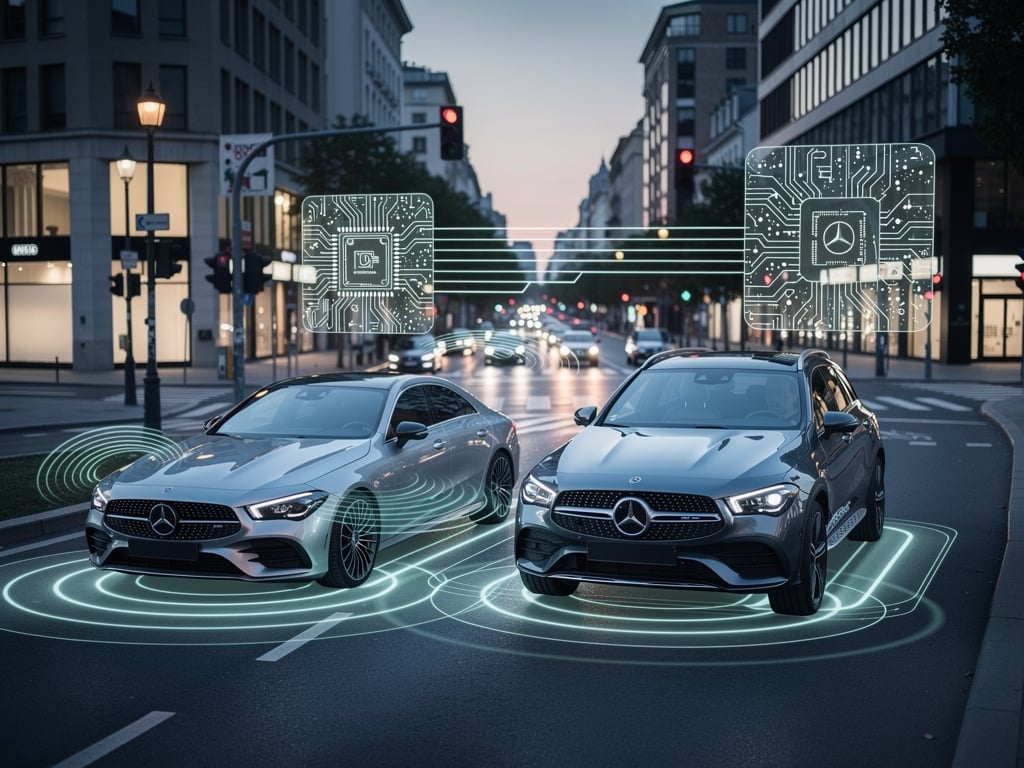
Mercedes’ push into surface street assistance isn’t just about convenience; it’s a strategic move to address the limitations of current systems that falter in unpredictable urban settings. Traditional driver aids excel on highways but struggle with the chaos of city driving—think erratic cyclists, sudden jaywalkers, and complex intersections. The new technology uses an array of cameras, radar, and lidar to create a 360-degree awareness bubble around the vehicle.
As per insights from MotorTrend, early rides in prototypes showcase the system’s prowess in handling real-world scenarios, such as yielding to emergency vehicles or adjusting speeds in school zones. This capability is set to debut in models like the all-new CLA and electric GLC, unveiled at CES 2026, signaling Mercedes’ commitment to embedding these features across its lineup by mid-2026.
Collaboration with NVIDIA is pivotal here. The partnership leverages NVIDIA’s DRIVE AGX platform for accelerated computing, enabling the AI to process vast data streams instantaneously. Mercedes’ engineers have fine-tuned algorithms to interpret subtle cues, like a pedestrian’s intent to cross, drawing from machine learning models trained on millions of miles of driving data.
Safety as the Cornerstone
Safety remains paramount in Mercedes’ ethos, a contrast to some rivals criticized for overhyping capabilities. Consumer Reports, in a comparative analysis, ranked Mercedes’ systems higher than Tesla’s due to rigorous testing and fail-safes. For instance, the technology includes redundant sensors to prevent single-point failures and automatic handback to the driver if conditions exceed its operational domain.
Recent posts on X reflect growing excitement among tech enthusiasts, with users praising the system’s smooth integration in demos. One post highlighted how it effortlessly manages light braking and acceleration resumption, mirroring natural driving behaviors without abrupt interventions. This sentiment aligns with broader industry trends toward more reliable semi-autonomous tools.
Moreover, Mercedes is addressing regulatory hurdles head-on. In the U.S., the system is designed to comply with evolving guidelines from bodies like the National Highway Traffic Safety Administration, ensuring it can be deployed without legal snags. This proactive stance could accelerate adoption, especially as cities like Los Angeles and New York pilot smart infrastructure to complement such technologies.
Technological Underpinnings Revealed
At the heart of MB.DRIVE ASSIST PRO is a fusion of hardware and software that Mercedes has refined over years. High-definition maps provide granular details of road layouts, updated in real-time via over-the-air connections. This allows the vehicle to anticipate turns, merge lanes, and even park autonomously in designated spots.
From CNBC‘s evaluation, Mercedes outshines competitors by prioritizing user trust through transparent interfaces—drivers receive clear visual and auditory cues about the system’s actions. This reduces the “automation complacency” risk, where over-reliance leads to accidents.
The CES 2026 showcase, as detailed in Mercedes-Benz’s press materials, emphasized integration with the MBUX infotainment system, allowing seamless transitions between assisted driving and navigation. For urban dwellers, this means hands-free operation from parking lots to destinations, potentially cutting commute stress significantly.
Market Implications and Competitor Dynamics
As Mercedes rolls out this technology, it positions itself against Tesla’s Full Self-Driving suite, which has faced scrutiny over safety incidents. Mercedes’ measured approach—focusing on Level 2 with eyes-on requirements—aims to build consumer confidence gradually. Industry analysts predict this could capture a larger share of the premium market, where buyers prioritize reliability over flashy promises.
Posts on X from automotive influencers underscore a shift in public perception, with many noting Mercedes’ cultural emphasis on engineering excellence. One viral thread compared it favorably to Tesla, citing fewer disengagements in urban tests. This buzz is amplified by recent news from Reuters, highlighting AI’s role at CES amid dialed-back EV ambitions.
Furthermore, the economic ripple effects are noteworthy. By enhancing driver assistance, Mercedes could reduce accident rates, lowering insurance premiums and boosting resale values. For fleet operators, like ride-sharing services, this technology offers scalable solutions for urban mobility, potentially reshaping transportation economics.
Innovation Through Partnerships
The NVIDIA-Mercedes alliance, announced in prior years but culminating in 2026 models, exemplifies how cross-industry collaborations drive progress. NVIDIA’s AI stack processes environmental data at speeds unattainable by onboard computers alone, enabling predictive behaviors like preemptive slowing for hidden obstacles.
Insights from Dataconomy reveal how the electric GLC incorporates this tech, blending sustainability with autonomy. The vehicle’s debut at CES underscores Mercedes’ vision for electrified, intelligent transport, where driver aids enhance efficiency by optimizing routes and energy use.
Beyond hardware, software updates will keep the system evolving. Mercedes plans regular enhancements via cloud connectivity, ensuring adaptability to new traffic patterns or regulations. This forward-thinking strategy positions the brand as a leader in sustainable, tech-infused mobility.
Challenges on the Horizon
Despite the promise, challenges loom. Urban environments vary widely, from pothole-riddled streets in developing regions to hyper-dense Asian megacities. Mercedes must ensure its mapping and sensors perform universally, a point raised in critical X discussions questioning scalability beyond Western markets.
Regulatory fragmentation poses another hurdle. While Germany has approved similar systems for highways, surface street deployment requires nuanced approvals. Mercedes is lobbying for standardized frameworks, as evidenced by its participation in global automotive forums.
Additionally, ethical considerations around AI decision-making—such as prioritizing pedestrian safety over vehicle speed—demand transparent algorithms. Mercedes addresses this through third-party audits, fostering trust in an era of data privacy concerns.
Future Trajectories in Urban Mobility
Looking ahead, Mercedes’ advancements could catalyze broader adoption of assisted driving, influencing everything from urban planning to insurance models. Imagine cities redesigned with dedicated lanes for semi-autonomous vehicles, reducing congestion and emissions.
Comparative studies, like those from Consumer Reports, suggest Mercedes’ edge lies in its holistic integration—combining assistance with luxury features like adaptive cruise and augmented reality displays. This synergy appeals to executives who value productivity during drives.
As 2026 unfolds, with models hitting showrooms, real-world feedback will refine these systems. Early adopters, as per enthusiastic X posts, are eager for the hands-off experience, potentially accelerating the shift toward more autonomous futures.
Pushing Boundaries Further
Mercedes isn’t stopping at Level 2. Whispers from industry events hint at Level 3 aspirations, where eyes-off driving becomes feasible under specific conditions. This progression depends on sensor advancements and AI maturation, areas where NVIDIA’s involvement is crucial.
The electric GLC’s unveiling, covered extensively in automotive media, ties driver assistance to electrification goals. By 2030, Mercedes aims for a fully electric portfolio, with these technologies enhancing range through efficient driving patterns.
User experiences shared on platforms like X paint a picture of empowerment—drivers reclaiming time for calls or relaxation, all while the car navigates urban mazes safely.
The Road Ahead for Industry Standards
In the competitive arena, Mercedes’ innovations pressure rivals to elevate their games. Tesla’s ongoing updates and Waymo’s robotaxi trials represent parallel paths, but Mercedes’ focus on premium integration could define the segment.
Economic analyses predict a surge in advanced driver assistance system (ADAS) markets, valued in billions, driven by safety mandates and consumer demand. Mercedes’ entry into surface streets amplifies this growth, particularly in North America.
Ultimately, as vehicles become smarter, the human element persists. Mercedes’ philosophy ensures technology augments rather than replaces drivers, a balanced approach that could set new benchmarks for the industry.


 WebProNews is an iEntry Publication