
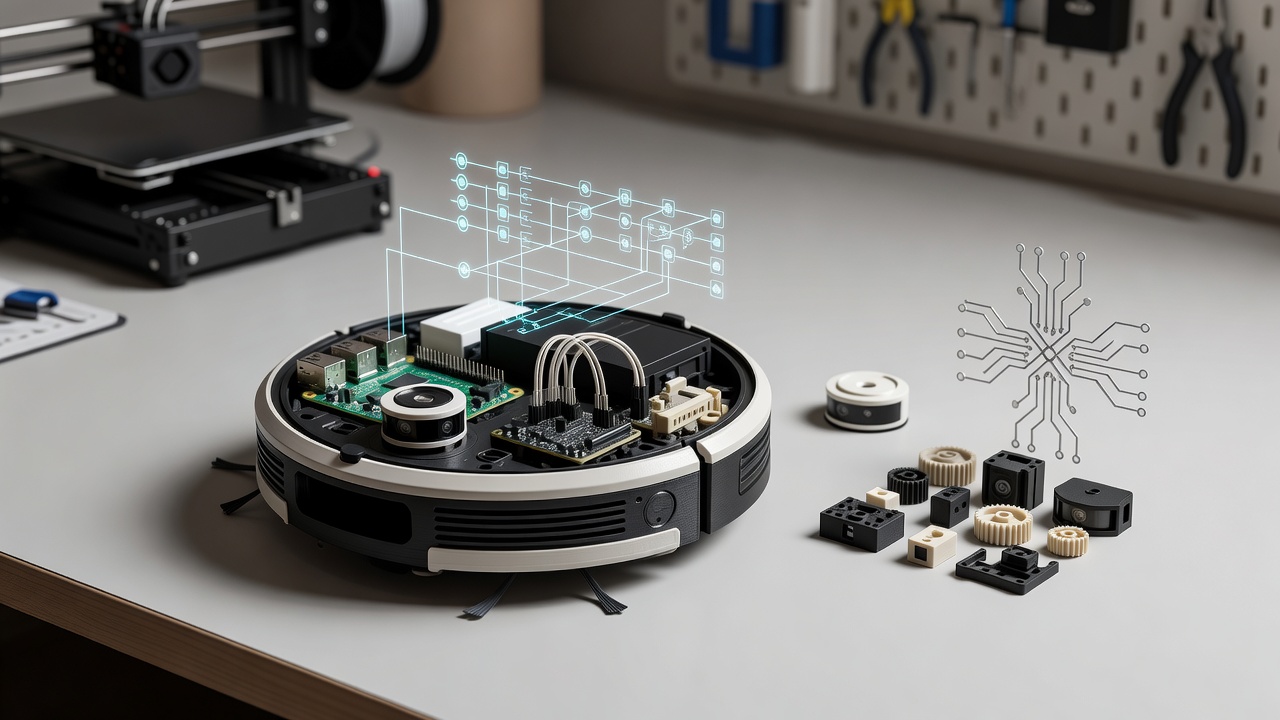
Robot vacuums fill homes with convenience. They also create persistent privacy headaches. Commercial models from major brands beam maps, floor plans and live camera feeds to distant servers. Recent hacks have shown just how exposed those devices can be. Yet a new project from Maker’s Pet offers a different path. Oomwoo lets enthusiasts 3D print and assemble their own fully local robot vacuum. No cloud connection required. Ever.
The project launched in mid-June. Ilia O of Maker’s Pet detailed the effort in a blog post that immediately drew attention across maker communities. Maker’s Pet describes oomwoo as an open-source home robot vacuum you build yourself. It targets Raspberry Pi, ROS 2, Home Assistant and 3D-printing enthusiasts. The robot maps homes using an affordable 2D LiDAR sensor. Navigation runs on ROS 2 with the Nav2 stack. Integration with Home Assistant stays completely local.
Everything stays open. Hardware designs, firmware and software fall under the Apache 2.0 license. Users can source every component themselves or purchase an optional convenience kit from Maker’s Pet. The name itself carries a clever touch. “Oomwoo” forms a rotational ambigram. It reads the same when flipped 180 degrees. Just like the robot roaming floors in every direction.
Security concerns drive much of the interest. Commercial robot vacuums have suffered repeated vulnerabilities. At DEF CON 32 in 2024, researchers Dennis Giese and Braelynn Luedtke demonstrated how several Ecovacs models could be hijacked over Bluetooth. Attackers gained access to cameras and microphones. Giese described the security as “really, really, really, really bad.” In one incident hijacked DEEBOT X2 units shouted slurs and chased pets in U.S. homes. A separate token flaw in DJI’s Romo line exposed floor plans and live feeds from roughly 6,700 vacuums worldwide.
Some owners have taken extreme measures. One revived a remotely bricked vacuum using custom boards and Python scripts to run it offline. Projects like Valetudo offer local control for existing devices. Maintained by Sören Beye since 2018, Valetudo replaces cloud connections on supported Dreame, Roborock and Xiaomi models. Yet installation often requires rooting firmware. That process voids warranties and cannot always be undone.
Oomwoo takes a cleaner approach. It eliminates the attack surface from the start. The reference design relies on 2D LiDAR and bumper sensors. No cameras point into the room. Tom’s Hardware covered the launch two days ago, highlighting how the project sidesteps cloud security risks by running fully offline. Tom’s Hardware noted the combination of Raspberry Pi, ROS 2, 2D LiDAR and a 3D-printed chassis.
The project sits at an early stage. Ilia O develops it in public from the first commit. Current status remains design and request-for-comments. No complete build instructions exist yet. The first bill of materials targets mid-July. V0 milestone focuses on basics. A 3D-printed chassis. ROS 2 Gazebo simulation. LiDAR with manual SLAM. Compute options include Raspberry Pi 5, ESP32 running micro-ROS or both. The exact architecture decision stays open.
Deliverables will arrive in phases. Bill of materials. 3D-printable files. ROS 2 packages. Firmware. A custom motor-driver and sensor PCB. Full build, bring-up and troubleshooting documentation. Demo videos. The GitHub repository outlines everything. GitHub – makerspet/oomwoo organizes the work into self-contained modules. Contributors pick what interests them. They work in parallel. Submit pull requests. Multiple people can tackle the same module. The best solution wins.
Modules ready now include ROS 2 URDF and Gazebo simulation. First clean coverage while SLAM-mapping. Dust bin design. Vacuum fan and blower assembly. Related repositories handle installation, simulation and more. The approach draws from open-source robotics traditions. It also echoes successful hardware projects that split complex builds into parallel tracks.
Cost targets remain realistic. Ilia O aims for parts totaling $100 to $200 plus a Raspberry Pi. That positions the finished device against mid-range commercial vacuums priced around $500 to $600. The design document lists what to 3D print versus source from suppliers like AliExpress. Motors, sensors, vacuum assemblies come from existing supply chains. Chassis, bumpers and brackets get printed on standard desktop machines.
Community response has been enthusiastic. 3DPrinting.com reported on the launch yesterday, emphasizing its appeal to makers who want to build or adapt their own version. 3DPrinting.com noted the Apache 2.0 license and optional kit. Discussions on X and Reddit highlight demand for privacy-friendly alternatives. One detailed analysis called oomwoo a reminder that open-source hardware gains real value when it shifts control boundaries. The project makes the entire stack legible. From mechanical design through navigation algorithms.
Challenges remain significant. Commercial vacuums solve docking, obstacle avoidance, sensor fusion and anti-stuck behaviors at scale. Oomwoo starts simpler. Low obstacles rely on bumpers. LiDAR has a blind spot below about 10 centimeters. Recovery behaviors will demand careful tuning. Yet the public development model invites help exactly where needed. Comments on the original blog suggest retrofitting existing vacuums, adding self-emptying docks and exploring mopping attachments. Ilia O has responded to many directly. He welcomes input on sourcing, older Raspberry Pi models and integration with projects like Valetudo.
Broader context matters. The robot vacuum market continues rapid refinement. 2026 models from Roborock, Dreame, Eufy and others push suction higher, add better obstacle avoidance and introduce features like stair-climbing legs or steam mopping. Consumer Reports, CNET and others test dozens of units each year. They evaluate pickup power, navigation and data privacy. Many still depend on cloud services. Oomwoo stands apart by design. It promises the core cleaning functions work offline forever. Optional cloud features or an app store of ROS 2 behaviors can layer on top without compromising the local foundation.
Ilia O draws from personal experience. He has installed Valetudo on his own Dreame vacuum. The project also connects to remake.ai, which will provide a robot apps platform later. For now the focus stays grounded. Get a working chassis. Validate parts. Build simulation models. Document every step so others can follow without guesswork.
Interest spans beyond hobbyists. Home Assistant users seek deeper integration without vendor lock-in. Robotics learners want hands-on experience with ROS 2, SLAM and Nav2 in a practical device. 3D printing communities see an appliance that actually uses their machines for functional parts rather than decorations. Even security researchers may find value in an auditable, camera-free platform.
The coming weeks will prove decisive. Once the bill of materials lands and initial hardware validation begins, build instructions can follow. Early contributors shaping the URDF model or dust bin design will set the project’s trajectory. Discussions on Discord, GitHub and X already show momentum. One recent X post captured the sentiment simply. “3D printed, open source robot vacuum by @makerspet – whoa!”
Oomwoo won’t replace flagship commercial robots anytime soon. Those devices pack advanced AI vision, self-emptying docks and multi-year support. But for tinkerers tired of black-box appliances, it offers something rare. Full visibility into how their vacuum works. The ability to modify, repair and extend it. And confidence that floor plans and sensor data never leave the home unless the owner chooses.
That combination explains the quick attention. In a market flooded with incremental upgrades to connected devices, a truly open alternative built from the ground up feels refreshing. The project remains ambitious. Robotics integration problems rarely yield to simple solutions. Yet by building in public and inviting parallel contributions, Ilia O has created space for the community to share the load. The result could influence not just future robot vacuums but how makers approach other smart home robots.
Watch the repositories. Join the Discord if the hardware stack interests you. The first real builds may still be months away. But the foundation takes shape now. And unlike many commercial products, every layer stays open for inspection, improvement and reuse.


 WebProNews is an iEntry Publication