
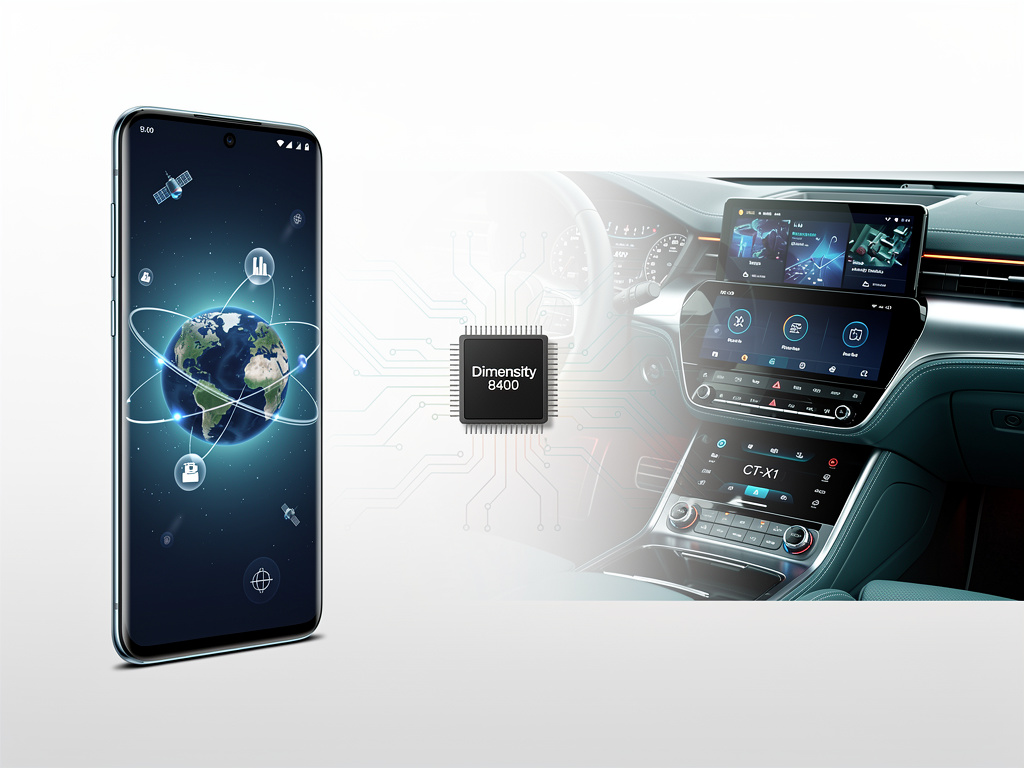
MediaTek, the Taiwanese semiconductor giant that has quietly become the world’s largest supplier of smartphone chipsets by volume, is making aggressive moves into two of the most strategically important growth areas in the technology sector: satellite communications and automotive computing. The company’s latest announcements position it to challenge Qualcomm on multiple fronts, extending well beyond the mobile phone arena where the two have long competed.
At the heart of MediaTek’s latest offensive is a pair of product announcements that together paint a picture of a company determined to diversify its revenue base and establish dominance in markets that are still in their formative stages. The first is the Dimensity 8400, a new upper-midrange smartphone processor that integrates support for two-way satellite calling — a feature that until recently was reserved for only the most expensive flagship devices. The second is the CT-X1 platform, MediaTek’s first dedicated chipset for Android Automotive, aimed squarely at powering the next generation of in-vehicle infotainment systems.
Satellite Calling Comes to the Midrange
As reported by Android Authority, the Dimensity 8400 is significant because it brings satellite communication capabilities to phones that will likely retail in the $300 to $500 range, rather than the $800-plus flagships where such features have typically debuted. The chip supports two-way satellite voice calling and messaging via non-terrestrial networks (NTN), meaning users in remote areas without cellular coverage could still make phone calls and send texts through satellite connections.
This is not merely an incremental upgrade. Satellite connectivity in smartphones has been one of the most closely watched developments in the mobile industry since Apple introduced emergency SOS via satellite on the iPhone 14 in 2022. Since then, Qualcomm has partnered with Iridium to offer Snapdragon Satellite, and Huawei has integrated satellite messaging into several of its devices using China’s BeiDou satellite system. MediaTek’s approach differs in that it is building NTN support directly into its mid-tier silicon, which could dramatically accelerate the adoption curve by making the technology accessible to hundreds of millions of additional consumers worldwide.
The Dimensity 8400: Technical Specifications and Market Positioning
The Dimensity 8400 is built on TSMC’s 4nm process node and features an octa-core CPU architecture based on Arm’s latest Cortex-A series cores. According to Android Authority, the chip includes an integrated 5G modem with support for sub-6GHz and mmWave bands, alongside the NTN satellite connectivity. MediaTek has also equipped the chip with a dedicated AI processing unit (APU) designed to handle on-device generative AI tasks, reflecting the broader industry trend of pushing large language model inference capabilities down to the device level.
MediaTek has historically excelled in the mid-tier and budget segments of the smartphone market, where its chips power devices from brands like Xiaomi, Oppo, Vivo, and Samsung’s Galaxy A series. The Dimensity 8400 appears designed to bring premium features — satellite connectivity, advanced AI processing, and flagship-class camera capabilities — to this massive volume segment. The strategy mirrors what MediaTek did with 5G, where it aggressively pushed modem integration into mid-range chips to accelerate adoption in markets like China, India, and Southeast Asia.
Android Automotive: MediaTek’s Play for the Dashboard
Perhaps even more consequential for MediaTek’s long-term growth trajectory is the CT-X1 platform, the company’s first chipset purpose-built for Android Automotive OS. The automotive semiconductor market is projected to reach $117 billion by 2030, according to McKinsey & Company, and MediaTek has been notably absent from the in-vehicle computing space until now. The CT-X1 changes that.
The platform is designed to power in-vehicle infotainment (IVI) systems running Google’s Android Automotive operating system — not to be confused with Android Auto, which mirrors a phone’s interface on a car’s display. Android Automotive is a full, standalone operating system that runs natively on the vehicle’s hardware, and it has been adopted by automakers including Volvo, Polestar, General Motors, Ford, and Renault. As Android Authority noted, the CT-X1 supports multi-display configurations, which is increasingly important as automakers add screens for rear-seat passengers and instrument clusters in addition to the central infotainment display.
Challenging Qualcomm’s Automotive Stronghold
MediaTek’s entry into automotive computing puts it in direct competition with Qualcomm, which has built a substantial automotive business around its Snapdragon Digital Chassis platform. Qualcomm’s automotive pipeline exceeded $45 billion in total contract value as of its most recent earnings report, and the company counts General Motors, BMW, Mercedes-Benz, and Hyundai among its automotive customers. Qualcomm CEO Cristiano Amon has repeatedly described automotive as one of the company’s most important growth vectors.
MediaTek will need to demonstrate that the CT-X1 can match or exceed the performance, reliability, and software integration that Qualcomm’s automotive chips offer. Automotive design cycles are notoriously long — typically three to five years from chip selection to vehicle production — so the CT-X1’s commercial impact may not be fully felt until the latter half of this decade. However, MediaTek’s cost competitiveness, which has been its primary weapon in the smartphone market, could prove equally potent in the automotive sector, where automakers are under intense pressure to reduce the cost of electronic components even as they add more technology to their vehicles.
The Broader Strategic Context
MediaTek’s dual push into satellite and automotive should be understood in the context of a maturing smartphone market. Global smartphone shipments have been largely flat for several years, hovering around 1.2 billion units annually according to IDC. While MediaTek continues to gain share — it held approximately 36% of the global smartphone chipset market in Q1 2025, ahead of Qualcomm’s roughly 24%, per Counterpoint Research — the company recognizes that long-term revenue growth requires expansion beyond handsets.
The satellite connectivity play addresses this in two ways. First, it adds a premium feature that can command higher average selling prices for MediaTek’s chips, improving margins. Second, it positions MediaTek as a key enabler of the direct-to-device satellite communication trend, which is being driven by partnerships between mobile operators and satellite companies like AST SpaceMobile, SpaceX’s Starlink, and Lynk Global. T-Mobile’s partnership with SpaceX to offer Starlink-based messaging to standard smartphones is perhaps the most high-profile example of this trend, and chipmakers that can support these hybrid terrestrial-satellite networks stand to benefit significantly.
AI Integration Across Product Lines
Both the Dimensity 8400 and the CT-X1 reflect MediaTek’s broader strategy of embedding AI capabilities across all of its product lines. The company’s flagship Dimensity 9400 chip, launched earlier this year, was among the first mobile processors to support on-device execution of large language models with billions of parameters. MediaTek has been working with Meta to optimize Llama models for its hardware, and with Google to support Gemini Nano on Dimensity-powered devices.
In the automotive context, AI processing is becoming essential for features like natural language voice assistants, real-time navigation with predictive routing, driver monitoring systems, and personalized in-cabin experiences. The CT-X1’s AI capabilities could help MediaTek differentiate its offering from lower-cost automotive chip suppliers while positioning it as a credible alternative to Qualcomm’s AI-focused Snapdragon Ride Flex platform, which combines infotainment and advanced driver-assistance system (ADAS) processing on a single chip.
What This Means for Consumers and the Industry
For consumers, MediaTek’s strategy should translate into more affordable devices with features that were previously exclusive to premium products. A $350 smartphone with satellite calling capability, for instance, could be transformative for users in rural or underserved regions across Africa, South America, and Asia, where cellular infrastructure remains sparse. The democratization of satellite connectivity could also have significant implications for emergency services and disaster response, giving more people the ability to call for help when traditional networks are unavailable.
For the semiconductor industry, MediaTek’s moves underscore a broader trend of chipmakers expanding beyond their traditional strongholds. Just as Qualcomm has pushed aggressively into PCs with its Snapdragon X Elite processors, and Nvidia has expanded from gaming GPUs into data center AI and automotive computing, MediaTek is signaling that it intends to be far more than a smartphone chip company. The competitive dynamics between MediaTek and Qualcomm, already intense in the mobile space, are now set to play out across multiple new arenas — from the satellites orbiting overhead to the dashboards of the cars we drive.
MediaTek has not yet disclosed specific automaker partnerships for the CT-X1 or provided detailed pricing for the Dimensity 8400. The company is expected to share more details at upcoming industry events in the second half of 2025. Investors and industry observers will be watching closely to see whether MediaTek can replicate its smartphone playbook — offering competitive performance at aggressive price points — in these new and potentially lucrative markets.


 WebProNews is an iEntry Publication