
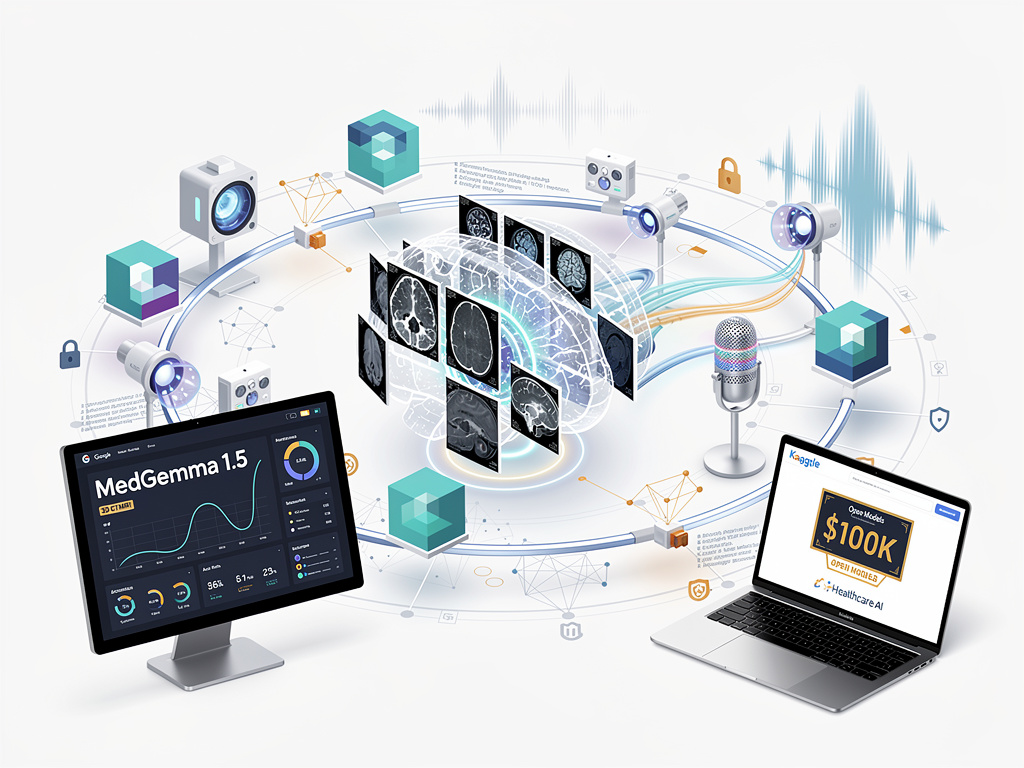
Google Research has unleashed MedGemma 1.5, a 4-billion-parameter multimodal model that pioneers open-source interpretation of complex 3D medical images like CT and MRI scans, alongside text-based clinical reasoning. Released January 13, 2026, as part of the Health AI Developer Foundations program, the update addresses a critical gap in accessible tools for healthcare developers, enabling offline deployment in data-sensitive environments. Paired with MedASR, a speech-to-text model slashing transcription errors by up to 82% versus OpenAI’s Whisper large-v3, these models signal Google’s bet on open weights to outpace proprietary rivals in medical AI.
The 4B model, available on Hugging Face and Vertex AI, builds on Gemma 3 with a SigLIP image encoder pre-trained on de-identified datasets spanning chest X-rays, dermatology, ophthalmology, and histopathology. It handles high-dimensional volumes, whole-slide pathology, longitudinal chest X-rays, and anatomical localization with bounding boxes. Benchmarks show striking gains: 69.1% on MedQA (up 5% from MedGemma 1), 90% accuracy on EHRQA (22% improvement), and 38% IoU on Chest ImaGenome localization (35% better), per the model card on Hugging Face.
Pioneering 3D Medical Vision
MedGemma 1.5’s edge shines in volumetric imaging, where it boosts CT classification accuracy to 61% (3% gain) and MRI to 65% (14% leap), according to Google’s research blog. Histopathology ROUGE-L scores hit 0.49, rivaling specialized models like PolyPath. For chest X-ray report generation on MIMIC-CXR, fine-tuned versions achieve a state-of-the-art RadGraph F1 of 30.3, with 81% of outputs deemed clinically equivalent by a board-certified radiologist in unblinded tests.
Unlike closed systems from OpenAI or Anthropic, MedGemma emphasizes developer control for privacy and customization. “MedGemma 1.5 isn’t some instant cure-all sitting in a lab. It’s a toolset for developers to make other tools that might someday help clinicians,” writes Richard Harris in App Developer Magazine. A larger 27B variant persists for text-heavy tasks, but the efficient 4B runs on edge devices, vital for low-connectivity clinics.
Speech Recognition Revolution
MedASR complements by transcribing clinical dictation with 5.2% word error rate on benchmarks—58% fewer errors on X-ray reports (versus Whisper’s 12.5%) and 82% overall reduction. Trained for accents, noisy environments, and terminology, it feeds outputs into MedGemma for multimodal workflows, per the Google blog.
Challenge Ignites Developer Momentum
To spur adoption, Google launched the MedGemma Impact Challenge on Kaggle, a $100,000 hackathon open until February 24, 2026. Over 4,100 entrants and 61 teams target human-centered apps emphasizing privacy, deployability, and real-world feasibility. Prizes reward main track winners ($30,000 for first) plus categories like Agentic Workflow and Edge AI. Judges score on model use (20%), impact (15%), and execution (30%), fostering apps for workflows where cloud models falter.
Early entries highlight fine-tuning for detection, as shared by developer harpreet on X, with starter notebooks accelerating progress. “MedGemma 1.5 supports detection, but for best results, you’ll need to fine-tune,” notes the post.
Real-World Deployments Emerge
Implementations validate potential: Qmed Asia’s askCPG uses MedGemma to navigate 150+ Malaysian guidelines, while Taiwan’s National Health Insurance Administration analyzed 30,000 pathology reports for lung cancer decisions, as cited in Google’s blog and Adwaitx. In Malaysia’s Ministry of Health deployment, it streamlines guideline access.
Healthcare AI adoption races at twice the economy’s pace, per Google, fueling a market from $52 billion in 2026 to $928 billion by 2035 (Adwaitx). Yet caveats persist: models demand fine-tuning, validation, and clinician oversight. “Models like MedGemma are not clinical grade,” Harris cautions.
Benchmark Breakdown and Edges Over Rivals
Full metrics from Hugging Face reveal prowess: 76.8% on EyePACS diabetic retinopathy, 70% PathMCQA, 89.6% EHRQA. Versus general models, it excels on domain tasks—e.g., 27.0 macro F1 on CT-RATE—while compute efficiency suits on-device use. MedASR’s dictation superiority positions it for EHR integration, reducing clinician burden.
Developer Tools and Guardrails
Access demands terms acceptance covering prohibited clinical decisions without verification. Tutorials on GitHub, DICOMweb integration, and FHIR agents aid prototyping. Safety evals show low violation rates, though biases in age, sex, and devices warrant checks.
Edge AI and Privacy Frontier
The Kaggle challenge prioritizes edge scenarios, mirroring MedGemma’s offline viability. Teams like Ron Reed’s in Seoul pursue privacy-first apps, per X posts. As competitors like Claude for Healthcare go enterprise, Google’s open strategy—millions of downloads—democratizes innovation.
Path to Clinical Reality
For insiders, MedGemma 1.5 lowers barriers: fine-tune on MIMIC-CXR for reports, chain with MedASR for dictation-to-insight pipelines. Vertex AI scales production; Hugging Face variants proliferate. With challenge results in March 2026, expect breakthroughs in diagnostics support and workflow augmentation, tempered by rigorous validation.


 WebProNews is an iEntry Publication