
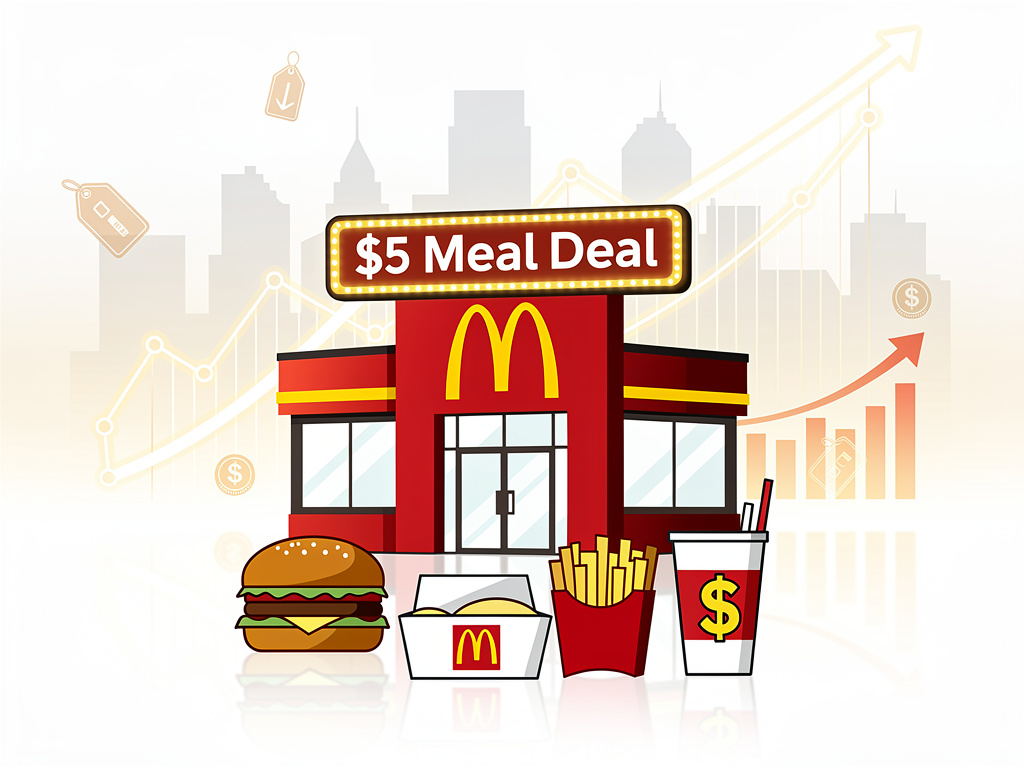
McDonald’s Corporation, the world’s largest fast-food chain by revenue, has found its footing again after a turbulent stretch marked by declining traffic and consumer backlash over rising menu prices. The company’s secret weapon? A return to the value-driven playbook that built its empire decades ago. The $5 Meal Deal, initially launched as a limited-time promotion in the summer of 2024, has proven so successful that it has become a semi-permanent fixture on the menu — and a powerful magnet for price-sensitive consumers navigating persistent inflation.
According to Fox Business, McDonald’s reported that its value meal strategy has been instrumental in reversing a troubling trend of declining customer visits. The $5 Meal Deal, which typically includes a McChicken or McDouble, small fries, four-piece Chicken McNuggets, and a small drink, has resonated deeply with consumers who had been trading down or eating at home to save money. The deal has not only brought back lapsed customers but has also driven incremental purchases, as diners frequently add items beyond the base meal.
A Turnaround Built on Affordability
The value push comes after McDonald’s experienced its first significant same-store sales decline in years. In late 2024, the company reported a dip in U.S. comparable sales, a metric closely watched by Wall Street, as consumers grew increasingly frustrated with what many perceived as runaway fast-food inflation. Social media was awash with viral posts from customers expressing sticker shock at McDonald’s menu boards, where a Big Mac combo in some markets had crept past the $18 mark. The backlash was real, measurable, and deeply concerning to corporate leadership in Chicago.
CEO Chris Kempczinski acknowledged the challenge head-on, telling investors and analysts that McDonald’s needed to recalibrate its value proposition. The company’s leadership recognized that while commodity costs and labor expenses had risen substantially, the brand’s core identity as an affordable dining option was being eroded. The $5 Meal Deal was the centerpiece of a broader strategic recalibration designed to reassure consumers that McDonald’s remained a place where a family could eat without breaking the bank.
The Numbers Tell a Compelling Story
The results have been encouraging. McDonald’s reported that traffic trends improved meaningfully after the value meal’s introduction, with the deal driving a notable uptick in customer counts — a metric that had been under pressure for several consecutive quarters. While the company has not disclosed exact figures on how many $5 Meal Deals have been sold, executives have described the promotion’s performance as exceeding internal expectations. Franchisees, who initially expressed concern about margin compression from such aggressive pricing, have largely come around as the increased foot traffic has translated into higher overall ticket averages through upselling and add-on purchases.
The strategy reflects a broader industry-wide recalibration. Rival chains including Burger King, Wendy’s, and Taco Bell have all rolled out or expanded their own value menus in recent months, recognizing that the consumer appetite for affordable options is not a passing trend but a structural shift in dining behavior. Burger King launched its own $5 Your Way Meal, while Wendy’s has leaned into its Biggie Bag offerings. The competitive intensity around value pricing has escalated to levels not seen since the so-called “value wars” of the early 2010s.
Consumer Sentiment and the Inflation Hangover
The urgency behind McDonald’s value pivot is rooted in macroeconomic reality. While headline inflation has moderated from its 2022 peaks, food-away-from-home prices remain significantly elevated compared to pre-pandemic levels. According to the Bureau of Labor Statistics, restaurant prices have risen more than 30% since 2019, far outpacing grocery inflation over the same period. For lower- and middle-income households — McDonald’s core demographic — this cumulative price increase has fundamentally altered dining-out calculus.
Consumer confidence data reinforces the picture. The University of Michigan’s consumer sentiment index has shown persistent weakness among households earning under $75,000 annually, with respondents frequently citing food costs as a primary financial concern. McDonald’s internal research reportedly found that a meaningful percentage of its customer base had reduced visit frequency specifically because of price perceptions. The $5 Meal Deal was engineered to address that perception directly, offering a complete meal at a price point that feels tangibly affordable in an era of $10 fast-casual bowls and $15 casual-dining entrees.
Franchisee Economics and the Margin Debate
One of the most closely watched dynamics in McDonald’s value strategy is its impact on franchisee profitability. McDonald’s operates primarily as a franchisor, with approximately 95% of its U.S. restaurants owned and operated by independent franchisees. These operators bear the direct cost of food, labor, and occupancy, meaning that aggressive value pricing can squeeze already-thin margins if not managed carefully.
Early in the $5 Meal Deal’s rollout, some franchisees pushed back, arguing that the promotion’s economics were unsustainable given elevated input costs. McDonald’s corporate responded by providing partial subsidies to offset the margin impact and by emphasizing the deal’s role as a traffic driver rather than a standalone profit center. The theory — which appears to be playing out in practice — is that customers drawn in by the $5 deal will frequently purchase additional items at full margin, such as desserts, premium beverages, or upgrades to larger sizes. This “trade-up” behavior has been critical to making the math work for operators.
Digital and Loyalty Integration Amplifies the Value Message
McDonald’s has also leveraged its rapidly growing digital ecosystem to amplify the value proposition. The McDonald’s app, which now boasts tens of millions of active users in the U.S., has become a primary vehicle for delivering personalized deals and offers that complement the in-store value menu. The company’s MyMcDonald’s Rewards loyalty program, launched in 2021, has matured into a sophisticated data engine that allows the chain to target promotions with precision, offering specific deals to lapsed customers or incentivizing higher-frequency visits among existing loyalists.
The digital strategy serves a dual purpose. It drives incremental traffic and sales while simultaneously building a first-party data asset that reduces McDonald’s dependence on expensive traditional advertising. According to company disclosures, digital channels — including the app, delivery, and kiosk orders — now account for a substantial and growing share of total U.S. sales. The integration of value deals into the digital experience creates a flywheel effect: customers download the app for deals, the app captures behavioral data, and that data enables more targeted and effective promotions.
International Markets and the Global Value Imperative
The value strategy is not limited to the United States. McDonald’s has implemented localized value platforms across its major international markets, recognizing that affordability pressures are a global phenomenon. In the United Kingdom, France, Germany, and Australia — among the company’s largest international markets — similar value-oriented promotions have been introduced to combat traffic softness. The specifics vary by market, reflecting local competitive dynamics, cost structures, and consumer preferences, but the strategic thrust is consistent: reassert McDonald’s position as the most accessible and affordable option in quick-service dining.
In China, where the economic recovery has been uneven and consumer confidence remains fragile, McDonald’s has been particularly aggressive with value pricing, offering meal bundles at price points designed to compete with local fast-food chains and street food vendors. The international segment, which has historically been a growth engine for the company, faces its own set of challenges including currency headwinds and geopolitical uncertainty, but the value playbook provides a reliable foundation for stabilizing traffic trends.
Wall Street’s Verdict and the Road Ahead
Investors have responded positively to McDonald’s renewed focus on value. The company’s stock, which had underperformed the broader market in late 2024 amid the traffic declines, has recovered as analysts have grown more confident in the turnaround narrative. Several Wall Street firms have reiterated or upgraded their ratings on McDonald’s shares, citing the improved traffic trajectory and the company’s demonstrated ability to balance value with profitability.
However, challenges remain. The competitive environment in quick-service restaurants is intensely promotional, and there is a risk that the industry’s collective embrace of value pricing could trigger a race to the bottom that pressures margins across the sector. McDonald’s must also navigate ongoing cost inflation in key areas including beef, chicken, packaging, and labor, particularly as minimum wage increases continue to roll out in states like California, where fast-food workers now earn a mandated $20 per hour.
Perhaps the most critical question facing McDonald’s leadership is whether the current value strategy represents a temporary tactical response or a permanent strategic shift. The company has signaled that affordability will remain a pillar of its go-to-market approach for the foreseeable future, but the specific mechanics — deal structures, price points, and promotional cadence — will continue to evolve based on consumer response and economic conditions. What is clear is that McDonald’s has absorbed the lesson of the past two years: in an era of persistent cost pressures on the American household, the brand that wins on value wins the customer. And for now, the Golden Arches appear to be winning that battle.


 WebProNews is an iEntry Publication