
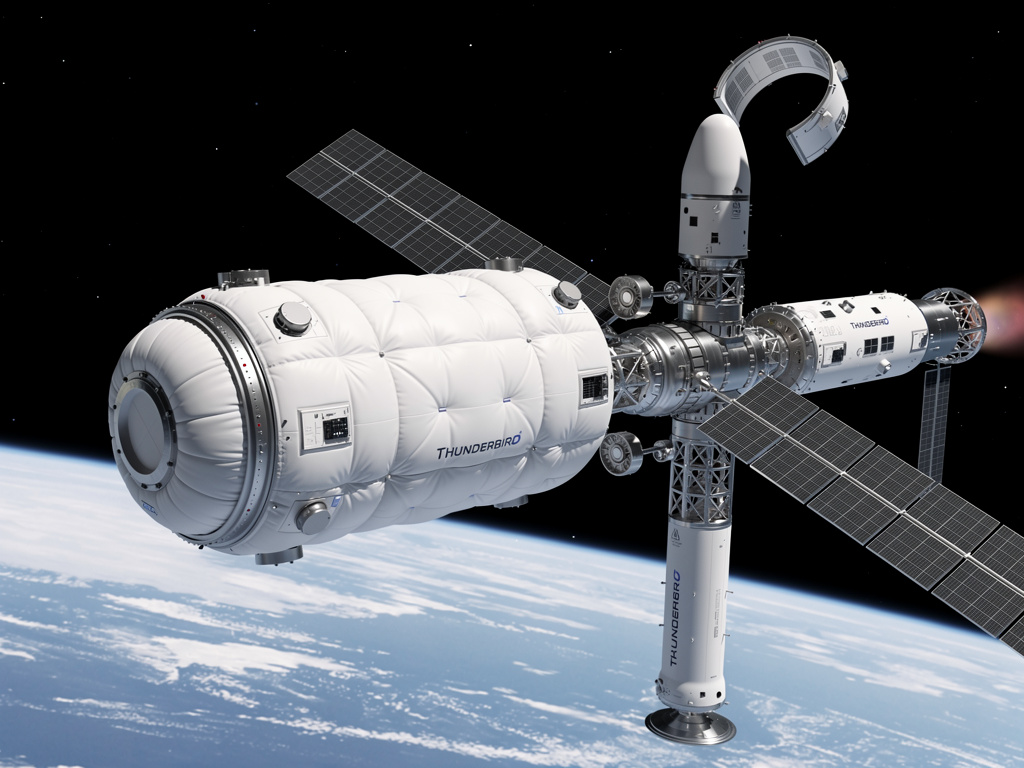
Inflating the Future: How Max Space’s Thunderbird Could Revolutionize Orbital Living
In the rapidly evolving realm of private space exploration, a new contender is pushing the boundaries of what’s possible in low Earth orbit. Max Space, a startup founded by aerospace veterans, has unveiled plans for Thunderbird, an inflatable space station that promises to deploy from a compact capsule into a sprawling habitat. This innovation draws on decades of inflatable technology research, aiming to provide scalable, cost-effective solutions for long-term human presence in space. Unlike traditional rigid modules that require multiple launches and complex assembly, Thunderbird is designed to launch aboard a single SpaceX Falcon 9 rocket, expanding dramatically once in orbit.
The concept isn’t entirely new—NASA experimented with inflatable habitats like the BEAM module attached to the International Space Station—but Max Space is taking it to unprecedented scales. According to details shared in a recent announcement, Thunderbird could inflate to a volume of 12,300 cubic feet, offering room for crew quarters, research labs, and even recreational areas. This expansion is made possible through advanced materials that withstand the harsh vacuum of space while remaining lightweight during launch. Industry experts see this as a game-changer, potentially reducing costs by eliminating the need for robotic arms or astronaut spacewalks for construction.
Max Space’s approach leverages partnerships with established players like SpaceX, ensuring compatibility with existing launch vehicles. The startup’s co-founders, including former NASA engineers, emphasize that Thunderbird isn’t just a station; it’s a modular platform that could serve as a stepping stone for lunar bases or Mars missions. Early prototypes are slated for testing as soon as 2027, with a full operational version targeted for 2029, aligning with the planned decommissioning of the ISS.
Engineering Marvels Behind the Expansion
At the heart of Thunderbird’s design is its inflatable structure, composed of multiple layers of high-strength fabrics and radiation-shielding materials. When packed, the module fits snugly within the Falcon 9’s fairing, measuring just a fraction of its deployed size. Upon reaching orbit, a controlled inflation process using onboard gases transforms it into a cylindrical habitat with a diameter of about 20 feet and length exceeding 60 feet. This method not only saves on launch mass but also allows for greater internal volume per unit of weight compared to metal modules.
Sources from Futurism highlight how this expansion could enable “shape-shifting rooms,” where internal partitions adjust to mission needs, from zero-gravity experiments to crew sleeping pods. The article describes the station’s ability to support four astronauts continuously, with life support systems integrated into the inflatable walls. This flexibility addresses a key challenge in space architecture: adapting to evolving mission requirements without costly redesigns.
Beyond the technical specs, Max Space is positioning Thunderbird as a commercial venture, open to partnerships with governments, research institutions, and private companies. The startup has already secured funding from venture capitalists betting on the post-ISS era, where private stations will fill the void. As noted in reports, the design draws inspiration from Bigelow Aerospace’s earlier work, but Max Space claims improvements in durability and scalability.
Strategic Positioning in a Competitive Field
The push for commercial space stations comes at a pivotal time, with NASA encouraging private sector involvement through programs like the Commercial Low Earth Orbit Destinations initiative. Thunderbird’s single-launch deployment gives it an edge over competitors like Axiom Space or Vast, which rely on multi-module assemblies. This efficiency could translate to lower operational costs, making orbital research more accessible to non-governmental entities.
Insights from SpaceNews reveal that Max Space plans to demonstrate a subscale prototype in 2027, potentially hitching a ride on a SpaceX rideshare mission. This step-by-step validation is crucial for building investor confidence and securing regulatory approvals from bodies like the FAA and NASA. The article underscores the startup’s ambition to not only orbit Earth but also adapt the technology for lunar surface habitats, where radiation and micrometeorite protection are paramount.
On social platforms like X, discussions among space enthusiasts highlight growing excitement. Posts describe Thunderbird as a “bonkers” innovation, with users speculating on its potential to host space tourism or microgravity manufacturing. While some express skepticism about inflation reliability, the overall sentiment leans positive, reflecting broader optimism in reusable rocketry’s role in democratizing space access.
Economic Implications for Space Ventures
Launching a fully functional station in one go could disrupt the economics of space infrastructure. Traditional stations like the ISS required dozens of launches and billions in funding; Thunderbird aims to achieve comparable utility at a fraction of the cost. Max Space estimates that their expandable tech could cut deployment expenses by up to 90%, a figure that resonates with budget-conscious agencies and corporations eyeing orbital real estate.
Drawing from Gizmodo, the prototype launch in 2027 will test key systems like pressure retention and thermal control, essential for crew safety. Success here could accelerate commercialization, attracting clients for drug development, materials science, or even entertainment productions in space. The piece notes that Max Space’s timeline aligns with SpaceX’s Starship advancements, potentially enabling even larger variants in the future.
Industry insiders point out that Thunderbird’s modularity allows for easy upgrades. Modules could be added post-deployment, creating a network of connected habitats. This vision extends to interplanetary applications, where inflatable structures might form the backbone of human outposts on the Moon or Mars, as suggested in various aerospace forums.
Technological Hurdles and Innovations
Despite the promise, challenges remain in ensuring the inflatable materials endure long-term exposure to space radiation and debris. Max Space is investing in proprietary composites that incorporate Kevlar-like fibers for puncture resistance. Testing regimes, including ground-based simulations and orbital prototypes, are designed to mitigate these risks before human occupation.
A report in Interesting Engineering details how Thunderbird avoids the assembly pitfalls of rivals by being operational immediately after inflation. This “no assembly required” philosophy could shave years off development timelines, positioning Max Space as a nimble player in a field dominated by legacy contractors.
Recent X posts echo this, with users sharing visuals of the expansion process and debating its advantages over rigid designs. One thread compares it to historical breakthroughs like the Skylab, emphasizing how inflation tech could enable rapid scaling for ambitious projects like space hotels.
Broader Impacts on Space Policy and Collaboration
As governments worldwide ramp up space programs, Thunderbird could influence international cooperation. The U.S. aims to maintain leadership in low Earth orbit post-ISS, and private initiatives like this bolster that effort. Max Space’s plans include docking ports compatible with Crew Dragon and other vehicles, facilitating crew rotations and resupply.
From Actualidad Aeroespacial, the station’s adaptability for lunar and Martian environments is highlighted, with potential for hybrid modules combining inflatable and rigid elements. This versatility could attract global partners, from ESA to emerging space nations.
Moreover, the environmental angle is gaining traction. Inflatable designs minimize launch mass, reducing the carbon footprint of space missions. As sustainability becomes a priority, Thunderbird’s efficiency might appeal to eco-conscious investors and regulators.
Pioneering Crew Comfort and Sustainability
Focusing on human factors, Thunderbird incorporates features like artificial gravity simulation through rotation, though initial versions will rely on microgravity. Crew amenities include spacious living areas, hydroponic gardens for fresh food, and advanced recycling systems to extend mission durations.
Insights from TechSpot describe the 350 cubic meters of habitable volume—roughly a third of the ISS—packed into a single payload. This density allows for dedicated zones for science, exercise, and relaxation, addressing psychological challenges of long-duration spaceflight.
X conversations often touch on these aspects, with posts envisioning Thunderbird as a “home away from home,” complete with virtual reality for mental health. Enthusiasts speculate on its role in training astronauts for deeper space exploration.
Future Trajectories and Industry Shifts
Looking ahead, Max Space envisions a fleet of Thunderbird-derived stations, each tailored to specific orbits or purposes. This could foster a marketplace for orbital services, from satellite servicing to zero-g tourism.
A piece in Universe Magazine projects the 2029 launch as a milestone, potentially coinciding with NASA’s Artemis program. The integration with lunar missions underscores Thunderbird’s role as a proving ground for technologies needed for sustained human presence beyond Earth.
In the broader context, this development signals a shift toward privatized space infrastructure, where startups like Max Space challenge incumbents. By mastering inflatable habitats, they could unlock new frontiers, from asteroid mining to interstellar probes.
Sustaining Momentum in Orbital Innovation
To maintain progress, Max Space is ramping up collaborations, including with universities for materials research. Funding rounds are expected to fuel prototype builds, with early successes likely to draw more capital.
From posts on X, there’s palpable buzz around the “Thunderbird Soars” narrative, as seen in shares from space news accounts. This public engagement could pressure competitors to innovate faster.
Ultimately, Thunderbird represents a bold step in reimagining space habitation, blending engineering prowess with economic savvy to pave the way for humanity’s multi-planetary future. As prototypes take flight, the startup’s vision may well inflate the possibilities of what’s achievable in the cosmos.


 WebProNews is an iEntry Publication