
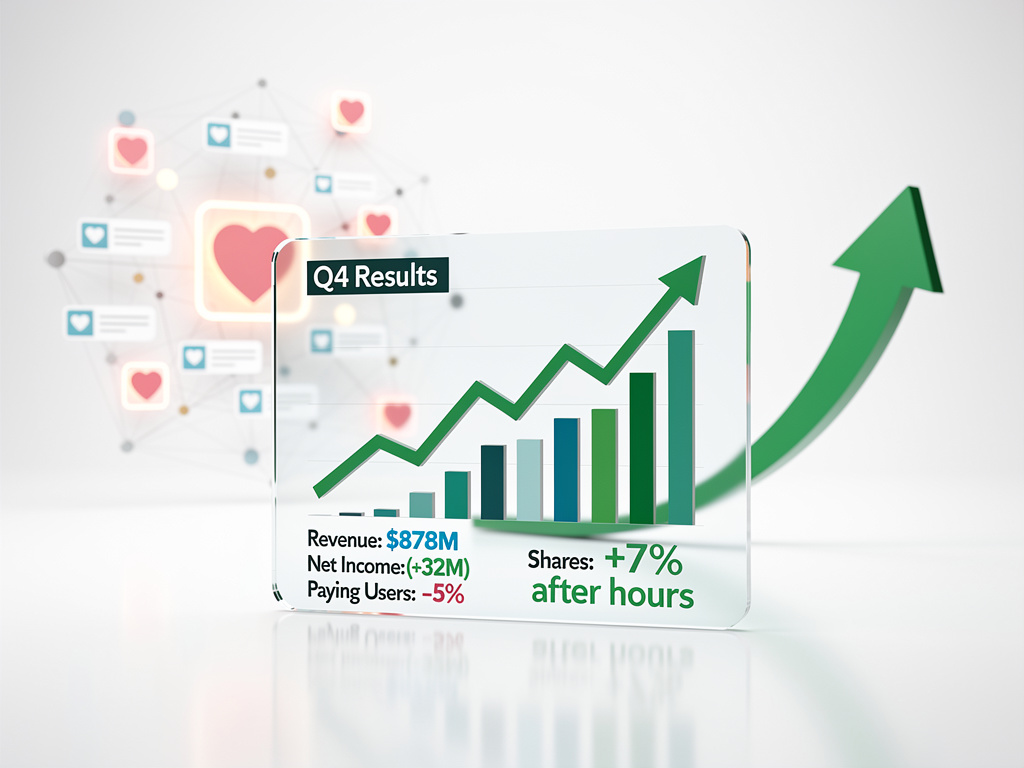
Match Group Inc., the parent company of dating platforms including Tinder, Hinge, and Match.com, delivered fourth-quarter financial results that exceeded Wall Street expectations, signaling that its strategic overhaul aimed at capturing younger users may finally be gaining traction. The company reported revenue of $878 million for the quarter ending December 31, representing a 2% year-over-year increase and surpassing analyst estimates of $871 million, according to Bloomberg. More impressively, net income surged 32% to $210 million, demonstrating improved operational efficiency even as the company navigates a challenging transition period.
The earnings announcement sent Match Group’s stock soaring more than 7% in after-hours trading, as investors responded positively to signs that the company’s multi-year transformation strategy is beginning to yield tangible results. This performance comes despite a notable 5% decline in paying users to 13.8 million, a metric that would typically concern investors but was overshadowed by the company’s ability to extract more revenue per user and control costs more effectively. The results suggest that Match Group’s pivot toward features and experiences that resonate with Generation Z and younger millennials—including video-based interactions, AI-powered matching algorithms, and more authentic profile verification—may be offsetting the subscriber headwinds that have plagued the company in recent quarters.
According to CNBC, the company’s management emphasized during its earnings call that the decline in paying subscribers was anticipated and represents a strategic trade-off as Match Group focuses on attracting higher-quality users who are more engaged with the platform rather than simply maximizing subscriber counts. This approach marks a significant departure from the growth-at-all-costs mentality that dominated the online dating industry during the pandemic years, when lockdowns drove millions of isolated singles to download dating apps.
Strategic Transformation Takes Center Stage
The fourth-quarter results cap a tumultuous year for Match Group, which has been working aggressively to reposition its portfolio of dating brands amid intensifying competition from newer entrants and changing user preferences. The company has invested heavily in product development, with particular emphasis on Tinder and Hinge, its two flagship platforms targeting different segments of the dating market. Tinder, which remains the company’s largest revenue generator, has undergone significant interface redesigns and introduced new features aimed at reducing the superficiality that critics have long associated with swipe-based dating.
Hinge, meanwhile, has emerged as a particular bright spot in Match Group’s portfolio, with the app positioning itself as the platform “designed to be deleted”—a marketing message that resonates with users seeking serious relationships rather than casual encounters. The company’s earnings materials, detailed in a PR Newswire release, indicated that Hinge continued to show strong momentum in both user acquisition and monetization, though specific figures for individual brands were not disclosed. This performance is particularly notable given that Hinge operates in a more crowded segment of the market, competing directly with apps like Bumble and newer entrants that have gained popularity through viral social media marketing.
The company’s ability to grow revenue while shedding paying subscribers points to successful execution of its premium pricing strategy. Match Group has systematically increased subscription prices across its portfolio while simultaneously introducing tiered membership options that offer enhanced features at higher price points. These premium tiers, which can cost users upward of $40 per month, include features such as unlimited likes, the ability to see who has already liked your profile, and priority placement in potential matches’ feeds. The strategy appears to be working, with average revenue per paying user showing significant improvement even as the total subscriber base contracts.
Market Dynamics and Competitive Pressures
Reuters reported that Match Group also issued an upbeat revenue forecast for the current quarter, further bolstering investor confidence that the turnaround strategy is sustainable rather than a one-time aberration. The company’s guidance suggests management believes it has successfully navigated the worst of its transition period and can now focus on growth from a more stable operational foundation. This optimism stands in stark contrast to the cautious tone that characterized the company’s communications throughout much of the previous year, when executives repeatedly warned that transformation efforts would require patience from investors.
The online dating industry has undergone profound changes since the pandemic-era boom, when dating apps experienced unprecedented growth as in-person socializing became impossible or inadvisable. As society has reopened, many users have returned to meeting potential partners through traditional means such as social events, workplace interactions, and introductions through friends. This normalization has forced dating app companies to work harder to demonstrate value and justify subscription costs to users who now have more options for meeting people.
Additionally, Match Group faces intensifying competition from social media platforms that are increasingly incorporating dating features into their existing products. Meta Platforms’ Facebook Dating, while not yet a dominant force, represents a potential long-term threat given Facebook’s massive user base and sophisticated targeting algorithms. TikTok, meanwhile, has become an unexpected competitor as users increasingly leverage the short-form video platform to meet potential partners through creative content rather than traditional dating profiles. These competitive dynamics have forced Match Group to innovate more aggressively and justify its position as the market leader in a space that no longer has clear boundaries.
Operational Efficiency Drives Margin Expansion
Beyond top-line growth, Match Group’s fourth-quarter results revealed significant progress on operational efficiency, which contributed substantially to the 32% surge in net income. The company has undertaken extensive cost-cutting measures over the past year, including workforce reductions, consolidation of redundant technology infrastructure across its portfolio of brands, and more disciplined marketing spending. Rather than pursuing growth through expensive user acquisition campaigns, Match Group has shifted toward organic growth strategies and viral marketing tactics that leverage existing users as brand ambassadors.
This operational discipline has allowed the company to expand profit margins even while investing heavily in product development and artificial intelligence capabilities. Match Group has been particularly aggressive in deploying AI technologies to improve matching algorithms, detect and remove fake profiles, and personalize user experiences. These investments, while substantial, are expected to pay dividends over time by improving user satisfaction and retention rates—metrics that ultimately drive long-term profitability in the subscription-based dating app business model.
The company’s focus on profitability over growth represents a broader shift in investor sentiment toward technology companies. In an era of higher interest rates and greater scrutiny of unprofitable growth, Match Group’s ability to demonstrate both revenue growth and margin expansion positions it favorably compared to competitors who continue to prioritize user acquisition at the expense of profitability. This disciplined approach may prove particularly valuable if macroeconomic conditions deteriorate and consumers become more selective about discretionary spending on services like dating app subscriptions.
Looking Ahead: Challenges and Opportunities
Despite the positive fourth-quarter results, Match Group still faces significant challenges as it works to sustain momentum throughout the current year. The decline in paying subscribers, while strategically intentional according to management, cannot continue indefinitely without eventually impacting revenue growth. The company must demonstrate that it can stabilize and eventually grow its subscriber base while maintaining the higher average revenue per user that has driven recent financial performance. This balancing act will require continued innovation in product features, pricing strategies, and user acquisition tactics.
The company also faces ongoing questions about the long-term viability of the dating app business model itself. Some industry observers have suggested that dating apps face an inherent contradiction: they succeed when users find partners and leave the platform, creating a constant need to acquire new users to replace those who achieve the app’s stated purpose. Match Group has attempted to address this challenge by diversifying into adjacent services such as relationship advice, social discovery features that go beyond romantic matching, and even video-based social networking. Whether these initiatives can create sustainable new revenue streams remains to be seen.
Regulatory scrutiny also looms as a potential headwind, with lawmakers in multiple jurisdictions examining the safety and privacy practices of dating apps. Concerns about fake profiles, catfishing, romance scams, and the potential for dating apps to facilitate criminal activity have prompted calls for stricter oversight and verification requirements. While Match Group has proactively implemented safety features such as photo verification and background checks for certain users, additional regulatory requirements could increase operational costs and potentially impact user experience in ways that drive some customers away from paid subscriptions.
Industry Implications and Broader Trends
Match Group’s fourth-quarter performance offers important insights into the evolving dynamics of the online dating industry and the broader consumer internet sector. The company’s success in growing revenue while reducing subscriber counts demonstrates that mature technology platforms can shift from growth-focused strategies to profitability-focused approaches without sacrificing shareholder value. This lesson may prove instructive for other consumer internet companies facing similar transitions as they mature and investor expectations evolve.
The results also highlight the importance of brand portfolio management in the dating app space. Match Group’s strategy of operating multiple distinct brands targeting different user segments—from Tinder’s casual dating focus to Match.com’s emphasis on serious relationships—has allowed the company to capture a broader swath of the market than would be possible with a single-brand approach. This portfolio strategy provides resilience against shifts in consumer preferences and competitive threats, as weakness in one brand can be offset by strength in others.
As Match Group moves forward from this strong quarterly performance, the company’s ability to maintain momentum will depend on continued execution of its strategic priorities: attracting younger users through innovative features, extracting more value from existing subscribers through premium pricing tiers, and maintaining operational discipline to protect profit margins. The 7% after-hours stock surge suggests investors believe management is on the right track, but sustained success will require navigating an increasingly complex competitive environment while adapting to evolving user preferences and potential regulatory changes. For now, the fourth-quarter results provide evidence that Match Group’s transformation strategy is working, offering a template for how legacy internet platforms can successfully reinvent themselves for a new era of user expectations and investor demands.


 WebProNews is an iEntry Publication