
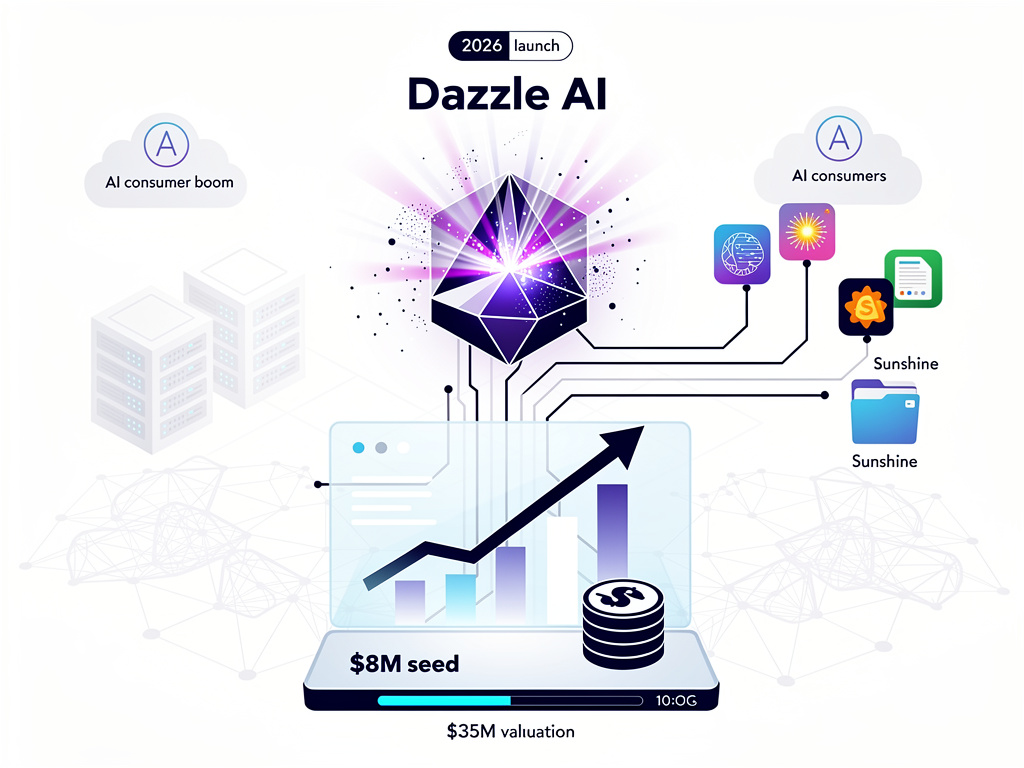
Former Yahoo chief Marissa Mayer is back in the startup arena with Dazzle, an AI venture that just secured $8 million in seed funding at a $35 million post-money valuation. The round, announced December 23, was led by Forerunner Ventures’ Kirsten Green, with participation from heavyweights including Kleiner Perkins, Greycroft, Offline Ventures, Slow Ventures, Bling Capital, Amino Capital and the Acquired Wisdom Fund. Mayer, drawing on her experience at Google and Yahoo, aims to craft intuitive AI tools that bridge everyday user needs and advanced technology.
Dazzle emerges from the ashes of Mayer’s prior effort, Sunshine, a photo and contact management app she shuttered in September. Rather than let its assets fade, Mayer folded them into Dazzle, signaling a strategic pivot toward broader AI applications. The company’s mission, as stated on its press page, focuses on “making technology more intuitive and genuinely useful in everyday life,” targeting the disconnect between user intentions and AI capabilities.
Mayer’s Proven Playbook Returns
Mayer’s track record adds heft to Dazzle’s ambitions. As employee No. 20 at Google, she shaped the search giant’s early products, then steered Yahoo through turbulent times as CEO from 2012 to 2017. Post-Yahoo, she co-founded Lumi Labs in 2018, experimenting with AI-driven consumer apps. Sunshine, launched out of stealth in 2020, raised millions but struggled to scale amid fierce competition in photo-sharing. SiliconANGLE notes Dazzle positions itself for the surge in AI-powered consumer tools, with plans to unveil products in 2026.
Investors see echoes of Mayer’s past successes. Kirsten Green, Forerunner’s founder, has a knack for consumer hits like Dollar Shave Club and Chime. Her lead signals confidence in Dazzle’s potential to capture the next wave of AI adoption. Posts on X from industry observer Dylan Casey highlight early buzz, calling it a “massive win” after testing the beta.
From Sunshine’s Sunset to Dazzle’s Dawn
Sunshine’s closure wasn’t a retreat but a recalibration. In a move detailed by TechCrunch in September, Mayer sold Sunshine’s assets to Dazzle, streamlining operations and shedding prior obligations. This asset flip allowed fresh capital infusion without legacy investor drag, a tactic Hacker News discussions praised for resetting the cap table.
Dazzle’s funding terms reflect measured optimism in a frothy AI market. At $35 million valuation on $8 million raised, it implies strong insider belief without overhyping. eWeek reports Mayer’s venture is gearing up for AI’s consumer boom, leveraging her user-centered design expertise from Google days.
Valuation Signals and Investor Calculus
The $35 million post-money mark draws scrutiny. Implicator argues this figure “tells you everything,” underscoring how seed rounds in AI now command premiums for pedigreed founders like Mayer. Kleiner Perkins, an early Google backer, joins as if closing a circle—Mayer’s first employer meets her latest bet.
Dazzle’s backers bring more than checks. Greycroft funded Snapchat; Slow Ventures backed Pinterest. This syndicate blends AI specialists and consumer mavens, poised to guide Dazzle through product launches and scaling. The press release emphasizes Mayer’s dedication to tools that simplify AI for daily use.
Product Vision Takes Shape
While still in stealth, Dazzle hints at next-generation personal assistants. Unlike generic chatbots, it promises context-aware aids that handle photos, contacts and beyond, building on Sunshine’s foundations. Beta testers, per X posts, rave about its potential. Mayer’s history suggests polished, mobile-first experiences—think Google’s clean interfaces meets Yahoo’s social features.
Timing aligns with AI’s maturation. Large language models now power sophisticated agents, but usability lags. Dazzle aims to fix that, targeting consumers weary of clunky interfaces. Dazzle’s site vows to close the “gap between what people want to do and what they can do with AI.”
Market Forces at Play
AI personal assistants face crowded fields—Apple’s Siri, Google’s Gemini, emerging players like Anthropic’s Claude. Yet Mayer’s edge lies in consumer intuition, honed over decades. Forerunner’s Green, per TechCrunch, backs Dazzle for its read on impending AI consumer shifts, much like her early bets on e-commerce disruptors.
Risks abound: AI hype cycles burst fast, and monetization remains tricky. Sunshine’s pivot underscores execution challenges. Still, at $8 million, Dazzle has runway to iterate without pressure. Industry watchers on X express optimism, with Casey noting excitement for 2026 launches.
Team and Traction Build Momentum
Mayer leads a compact team blending ex-Google, Yahoo and AI research talent. Details are sparse in stealth mode, but funding scale suggests 10-20 engineers focused on core AI models. Sunshine hires likely transitioned, preserving institutional knowledge.
Palo Alto-based, Dazzle taps Silicon Valley’s talent pool amid remote-work flexibility. Valuation implies 20-25% dilution for new investors, leaving ample equity for growth. SiliconANGLE frames it as Mayer’s bid to reclaim consumer AI leadership.
Broader AI Investment Trends
Dazzle’s raise mirrors 2025’s seed frenzy, with AI consumer apps drawing outsized valuations. Comparables like Perplexity AI hit billions post-seed; Dazzle’s modest cap reflects its early stage but pedigreed promise. Implicator posits the numbers reveal investor appetite for founder-market fit over raw tech.
Exit paths? Mayer’s network hints at acquisitions—Apple, Google or Meta could eye polished assistants. IPO feels distant, but her Yahoo tenure equips her for scrutiny. For now, 2026 product drops loom as key milestones.
Stakeholder Perspectives Emerge
Casey, on X, shared: “I’ve been playing with the beta and can’t wait for the product to launch.” Such endorsements fuel hype. Mayer’s past X posts underscore her builder ethos, from Google origins to AI musings. Investors like Green bet on her ability to navigate consumer tech’s pitfalls.


 WebProNews is an iEntry Publication