
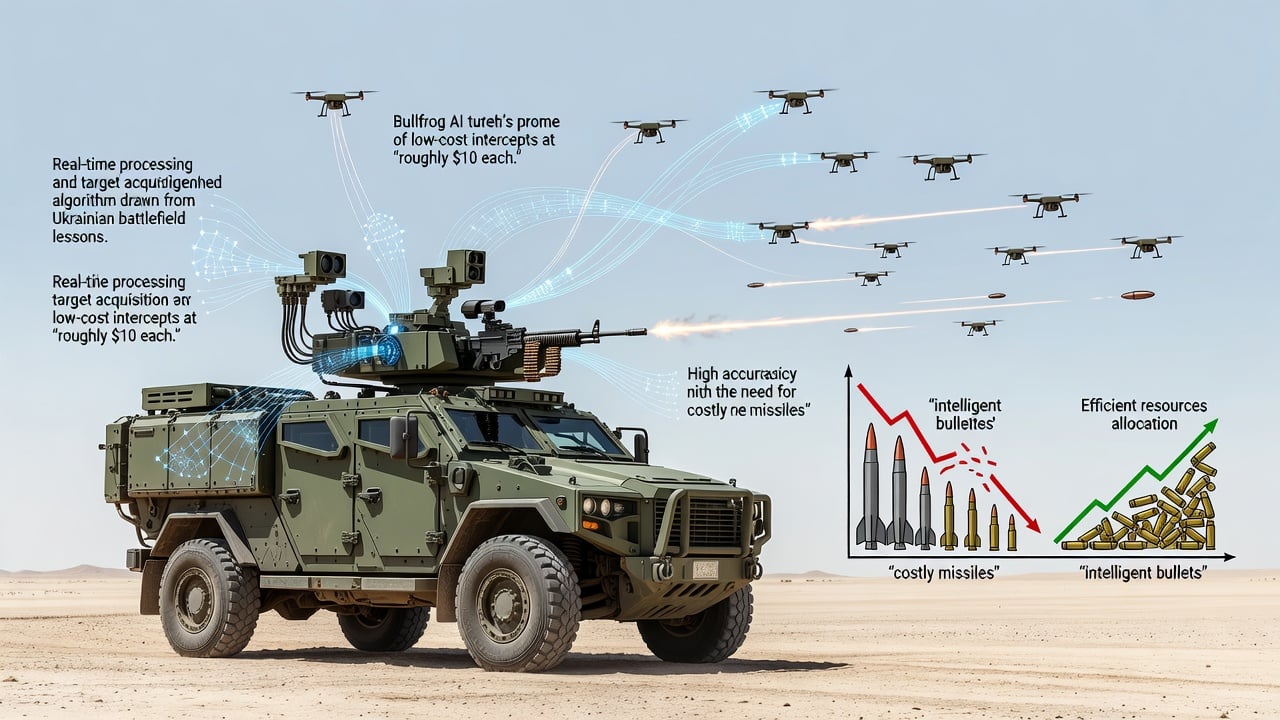
The U.S. Marine Corps has picked a Texas startup’s robotic gun mount to arm its most mobile counter-drone vehicles. Called Bullfrog, the system takes ordinary machine guns and adds artificial intelligence, computer vision and precision motors so they can spot, track and destroy small unmanned aircraft with minimal human direction. The deal, announced this week, marks another step in the Pentagon’s push to counter cheap enemy drones without burning through expensive missiles.
Allen Control Systems developed the Bullfrog as a modular add-on. It fits legacy weapons such as the M240, which spits out 7.62-millimeter rounds at up to 850 per minute. The whole station weighs about 300 pounds without ammunition. Its sensors stay passive. No radar pings that might give away the position. Cameras and onboard processing do the work. Effective range against drone targets reaches 1,500 meters depending on the gun fitted. Defence Blog reported the details Monday.
Integration targets the Light Marine Air Defense Integrated System, or L-MADIS. Two Polaris MRZR all-terrain vehicles work as a pair. One carries sensors and electronic warfare gear to jam drones. The other will mount the Bullfrog. The setup keeps the force light and expeditionary. Marines can haul it on ships or small islands. A prototype contract valued near $6.2 million kicked things off. The Corps seeks $1.27 billion in fiscal 2027 for broader ground-based air defense.
“The Marine Corps requires the most sophisticated and accurate possible capabilities to carry out its critical missions,” said Mike Wior, co-founder and chief executive of Allen Control Systems. “We are honored to support Marines with fast, scalable, and cost-effective counter-drone solutions that integrate into existing platforms.” His words appeared in the company announcement covered by multiple outlets.
Cost sits at the heart of the appeal. A single drone intercept with a missile can run hundreds of thousands of dollars. Bullfrog uses standard bullets. The marginal expense per kill lands around $10. That math comes straight from battlefield lessons in Ukraine, where Russian Shahed-style loitering munitions and small FPV drones have overwhelmed traditional defenses. United24 Media highlighted the potential for similar systems to reach Ukrainian forces.
But the technology raises hard questions. Videos from Allen Control Systems show the turret shifting targets from flying drones to objects on the ground. No software blocks appear to prevent autonomous engagement of human figures. The system still needs a human to authorize shots. Yet once cleared, it can act fast. The Register noted this dual-use reality on Tuesday. The same hardware that downs Group 1-to-3 drones, those under 1,320 pounds with speeds below 250 knots, could target troops or vehicles.
The Marines join the Army and Navy, which already field Bullfrog units. Special Operations Command ordered versions for maritime platforms last year. South Korea, the United Arab Emirates and Romania have signed deals or agreements too. Early validation came during a 2024 Pentagon technology exercise at Camp Atterbury, Indiana. The system beat drone targets consistently in front of senior officials.
Observers see clear echoes of Ukrainian ingenuity. Kyiv’s forces cobbled together AI turrets like the Sky Sentinel to guard the capital against Shahed attacks. Those static systems used commercial parts and machine learning trained on real flight data. Bullfrog looks similar in concept but travels with troops. “I would chalk this up to a private defense firm copying a good idea,” wrote analyst Wes O’Donnell. He added that while not an exact replica, “the spirit of the Sky Sentinel now exists in a new American platform.” His Substack post from last year gained fresh relevance with the Marine selection.
Recent demonstrations reinforce the trend. In June, six companies including Allen Control Systems threw together autonomous drone-killing vehicles in two days at an Army event. The Bullfrog provided the firepower. Radar from Leonardo DRS and autonomy software from Havoc and Anduril tied it together. DefenseScoop covered the rapid integration in June.
Army experiments have paired similar turrets with new radars and AI to engage threats in under three seconds. No new hardware required beyond software and sensors. The Marines’ choice of L-MADIS fits the pattern. Keep the vehicles light. Add proven weapons. Let AI handle the tedious tracking. The approach avoids the procurement headaches of entirely new gun systems.
Critics worry about proliferation. Cheap autonomous weapons could spread beyond state militaries. The same passive sensors and edge AI that make Bullfrog hard to detect also lower barriers for others. Export customers already include Gulf states facing Houthi and Iranian drones. Romania plans local production. The technology moves quickly from prototype to partner forces.
Allen Control Systems offers variants for heavier guns. The M2 .50-caliber, M230 chain gun and even M134 minigun can mount. Each keeps the core AI and robotics. Operators swap weapons to match the threat or platform. For the Marines, the lighter M240 suits the MRZR’s payload limits. Ammunition stays standard. Logistics stay simple. No exotic missiles to stock.
Drone swarms change the math of modern conflict. A single operator can launch dozens of cheap aircraft. Traditional air defense radars and missiles scale poorly against that volume. Gun-based systems with AI fill the gap for short-range defense. They don’t replace missiles. They complement them. Expensive interceptors handle the high-end threats. Bullets chew through the low-cost mass.
The Marine Corps has doubled down on this mix. Its Force Design 2030 strategy emphasizes expeditionary units that operate inside enemy sensor ranges. Small teams on islands or forward bases need portable protection. L-MADIS with Bullfrog delivers exactly that. Two vehicles. Sensors, jammers and guns. All terrain capable. Ship transportable.
Challenges remain. Passive sensors struggle in bad weather or heavy jamming. AI must distinguish friend from foe accurately. Rules of engagement still require human sign-off, which could slow response against fast swarms. Testing continues. The $6.2 million prototype deal will yield data on real-world performance.
So the Pentagon bets on adaptation. Take existing guns. Add brains. Drive down costs. Learn from Ukraine’s desperate innovations and scale them with American industry. Bullfrog embodies that bet. Cheap. Modular. Lethal. And ready to ship to the front lines where drones already dominate the sky.


 WebProNews is an iEntry Publication