
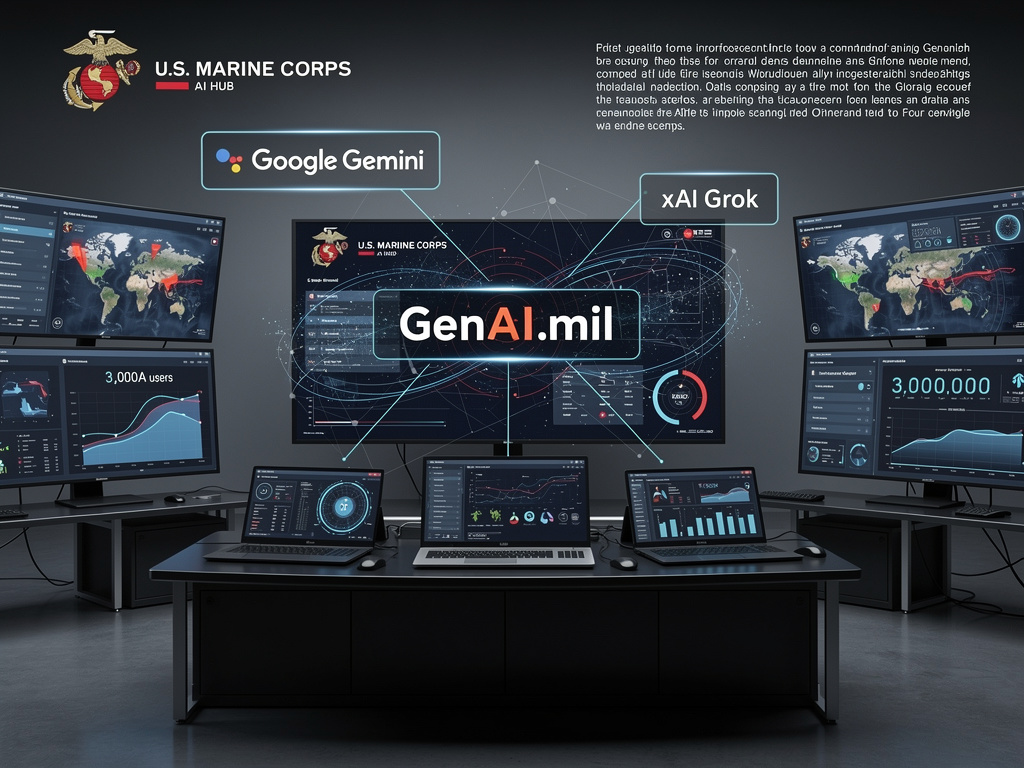
The U.S. Marine Corps has officially anointed GenAI.mil as its enterprise AI platform, a pivotal shift that centralizes generative AI access for all Marines, civilians and contractors while phasing out fragmented legacy tools from other services. Capt. Christopher Clark, the Corps’ AI lead, emphasized the breakthrough in an interview with DefenseScoop. “Until this point, there was no enterprise solution for USMC users,” he said. “GenAI.mil is the first true enterprise solution for Marines to use generative AI.”
This designation arrives amid the Pentagon’s aggressive push to embed commercial large language models across its 3 million-strong workforce, following the platform’s December 2025 debut powered by Google Cloud’s Gemini for Government. The Marine Corps move aligns with a broader Department of Defense strategy to consolidate “duplicative, general-purpose” AI efforts, as older systems like the Air Force’s NIPRGPT and Army’s CamoGPT are distanced in favor of the unified GenAI.mil hub.
The platform, authorized for Controlled Unclassified Information at Impact Level 5, promises secure handling of sensitive data without risking spillage seen in commercial tools. Users can now access frontier models for tasks from document drafting to intelligence analysis, though officials stress rigorous verification due to potential inaccuracies.
Genesis of a Pentagon AI Powerhouse
GenAI.mil emerged from contracts awarded in summer 2025 to OpenAI, Anthropic, Google and xAI, each valued up to $200 million, enabling access to advanced LLMs and agentic tools. Google’s Gemini launched first on December 9, 2025, as announced by Chief Technology Officer and Undersecretary Emil Michael at a DefenseScoop event. “For the first time ever, by the end of this week, three million employees, warfighters, contractors, are going to have AI on their desktop, every single one,” Michael declared, per Breaking Defense.
Defense Secretary Pete Hegseth championed the rollout in a video and memo, proclaiming, “The future of American warfare is here, and it’s spelled AI.” He mandated immediate integration: “I expect every member of the department to login, learn it, and incorporate it into your workflows immediately.” The platform supports unclassified workflows like personnel onboarding and contract acceleration, with data sovereignty ensuring no training on DoD inputs, as detailed in Google Cloud’s press release.
Expansion plans include xAI’s Grok models, set for early 2026 rollout at IL5, providing real-time insights from the X platform for decision-making and warfighting, according to xAI. Navigational hints on GenAI.mil already tease OpenAI’s ChatGPT and Anthropic’s Claude.
Marine Corps’ Calculated Pivot
Prior to GenAI.mil, Marines lacked a service-wide solution, relying on inter-service tools that created silos. The Corps’ spring 2025 AI implementation plan—a 56-page roadmap—prioritized user empowerment, use case prioritization and infrastructure fixes. MARADMIN 018/26 formalized governance, echoing prior orders on responsible AI use.
Transition efforts focus on migrating high-priority data from NIPRGPT, with GenAI.mil consolidating general-purpose needs. “All personnel are responsible for critically evaluating and verifying any output from GenAI.mil before using it for official purposes,” the Corps warns, addressing non-deterministic risks like bias or incompleteness.
Upcoming events underscore commitment: A March 9-12, 2026, workshop at Quantico on genAI and agentic AI—postponed from fall 2025 due to appropriations lapse—will evaluate LLMs against real-world challenges, per DefenseScoop. “GenAI is advancing rapidly with broad applicability to augment Marines across the spectrum of functional areas and activities,” the announcement states.
Security and Sovereignty Imperatives
IL5 authorization enables CUI processing in a sovereign cloud, a leap from earlier pilots. Google CEO Sundar Pichai hailed it as delivering “secure, sovereign, and enterprise-ready AI,” while xAI positions Grok for tactical edge use. Free training accompanies rollout to build proficiency.
Yet challenges persist. Early users report mixed reactions, with some implementation experts “beyond upset” over perceived stovepiping, as noted in DefenseScoop. A senior Army official described the mandate as unprecedentedly forceful compared to prior optional rollouts.
Broader DoD memos, like Hegseth’s, frame GenAI.mil as essential for outpacing adversaries like China, whose LLM advances were flagged in congressional reports. Marine Corps Data Officer Colin Crosby called it “deliberate weaponization of data and AI to drive cognitive overmatch.”
Agentic Horizons and Warfighting Edge
Agentic AI—systems planning multi-step tasks autonomously—looms large. Quantico sessions will demo joint and industry solutions, aiming for a USMC “North Star” integration path. Michael eyes classified extensions and warfighting applications like logistics and simulations.
Hegseth’s vision: “We are pushing all of our chips in on artificial intelligence as a fighting force. The department is tapping into America’s commercial genius, and we’re embedding generative AI into our daily battle rhythm,” per DoD releases on war.gov.
For the Marine Corps, GenAI.mil cements a unified path forward, empowering rapid innovation while enforcing accountability in an era of accelerating AI competition.


 WebProNews is an iEntry Publication